Hello! Welcome back to our course on advanced Meta advertising.
In our last lesson, we established the new rule of the game: "creative is the new targeting." We saw how Meta's Andromeda algorithm analyzes our ad creatives to find the right audience, making creative diversity and velocity essential for success. This naturally leads to a crucial question: where do we find a constant stream of high-potential creative ideas to feed the algorithm?
Today, we'll answer that question directly. We're going to get practical and learn how to systematically analyze competitor creatives to identify strategic patterns and opportunities. Your goal is to develop a repeatable playbook for scaling, and this process of strategic intelligence gathering is a cornerstone of that playbook. By the end of this lesson, you'll have a framework to turn your competitors' ad spend into your own strategic advantage.
We will cover:
- How to use the Meta Ads Library as your primary competitive research tool.
- How to identify a competitor's likely "winning" ads without seeing their performance data.
- A six-part framework for deconstructing any ad to understand its strategic components.
- How to turn your analysis into actionable hypotheses for your own campaigns.
The Modern Marketer's Secret Weapon: The Meta Ads Library
Your first and most powerful tool for competitor analysis is the Meta Ads Library. It's a free, public, and fully searchable database of every ad currently running across Meta's platforms (Facebook, Instagram, etc.). Instead of guessing what's working in your market, you can see exactly where your competitors are placing their bets.
The video below from HubSpot Marketing provides a great initial walkthrough of the library's interface and core functions.
How to Use the Facebook Ads Library for Your Business (Step-by-Step Tutorial)
This video, 'How to Use the Facebook Ads Library for Your Business,' offers a clear and concise introduction to the tool. It will quickly get you familiar with the basic navigation and purpose of the library.
Please watch from the beginning until 03:15. Focus on understanding how to access the library, search for competitors, and use the basic filter options like country and active status.
Now that you have a feel for the interface, let's refine that process into a more structured workflow.
The Meta Ads Library: A Founder's Guide To Creative Strategy
The article 'The Meta Ads Library: A Founder's Guide To Creative Strategy' from Ask Needle provides an excellent, step-by-step guide to using the library effectively. We'll use it to build a more robust process.
Please read the first two main sections: 'What Is The Meta Ads Library And Why Founders Should Care' and 'How To Navigate The Meta Ads Library: A Practical Walkthrough.' Pay close attention to the table of key search filters and the step-by-step workflow example.
To summarize the key steps for effective searching:
- Go to the Meta Ads Library website.
- Set your target country.
- Leave Ad Category as "All Ads."
- Search by a specific advertiser's name. This is the most direct way to analyze a known competitor.
- Use the filters to refine your search. The most important filters for you are:
- Active status: Select "Active ads" to see what they are spending money on right now.
- Platform: Isolate ads on Instagram, Facebook, etc., to understand their platform-specific strategies.
- Media Type: Filter by Images, Videos, etc., to see what formats they are prioritizing.
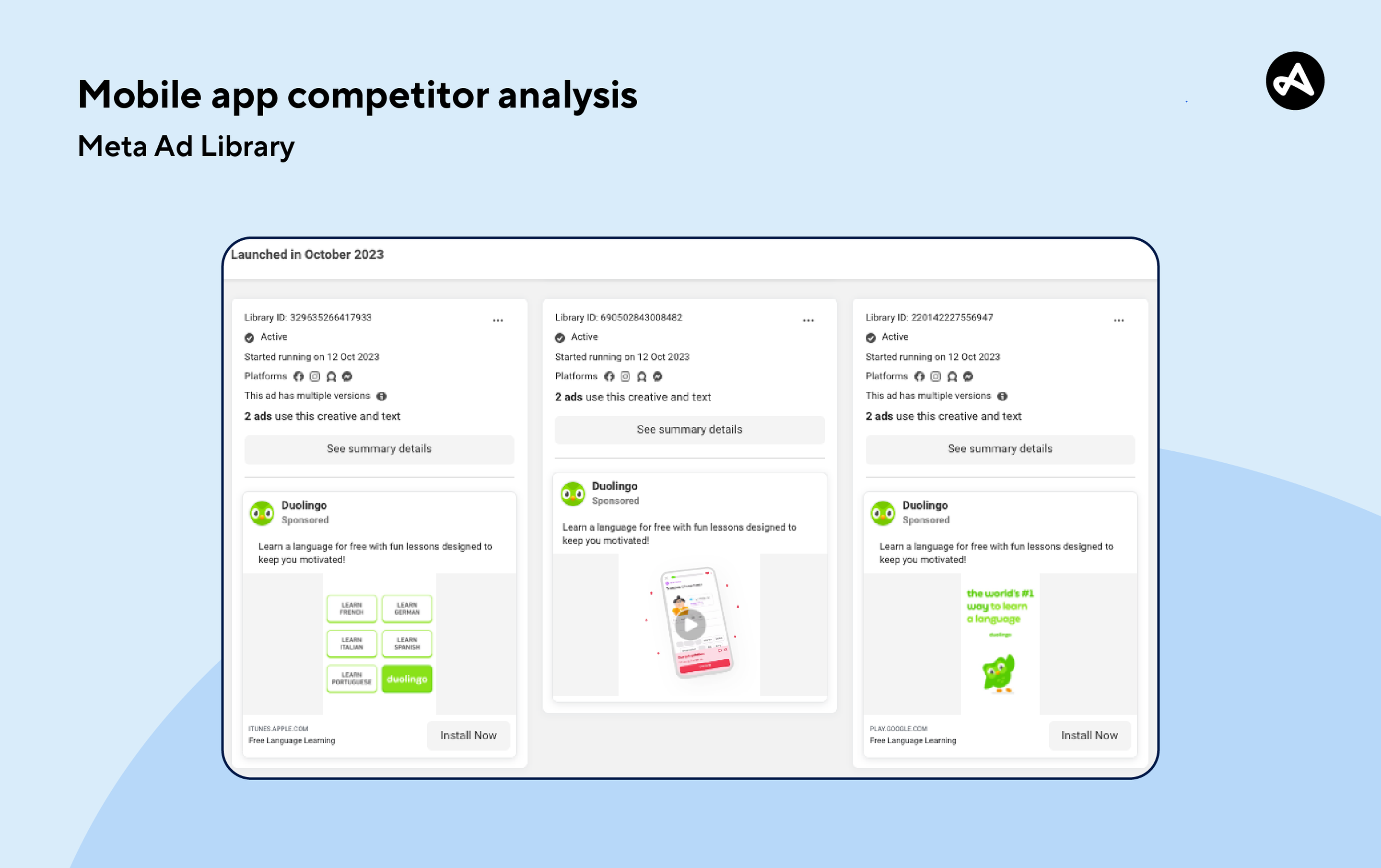
Here's an example of what you'll see. This screenshot shows several active ads for the language app Duolingo, illustrating the variety of creatives one brand can run simultaneously.
How to Spot a Winning Ad Without Seeing the Data
The Ads Library is powerful, but as the Ask Needle article points out, it has limitations. It doesn't show you performance metrics like ROAS, CPA, or budget. So, how do we identify which of a competitor's hundreds of ads are their top performers? We have to learn to read the signals.
There are two primary signals that indicate a successful ad:
-
The Longevity Signal: This is the most reliable indicator. Brands don't waste money running unprofitable ads for long periods. An ad that has been active for several weeks or months is almost certainly a winner. When you analyze a competitor, sort their ads and pay closest attention to those with the oldest "Started running on" dates.
-
The Scaling Signal: When a brand finds a winning concept, they don't just let it run; they scale it. In the Ads Library, this often appears as multiple variations of the same core ad. You might see the same video with five different headlines, or the same offer presented with three different images. This is a huge tell that they've found a profitable formula and are now testing variables to maximize its performance.
The Meta Ads Library: A Founder's Guide To Creative Strategy
Let's return to the Ask Needle article, which explains these signals perfectly.
Read the section titled 'How to Spot Your Competitors' Best-Performing Ads.' Focus on the concepts of the 'Longevity Signal' and the 'Scaling Signal.'
One final, crucial tip on this topic comes from advertiser Sam Piliero. When choosing competitors to analyze, be strategic.
The Best Facebook Ad Creative Strategy for 2026
In this clip, Sam Piliero gives some excellent advice on how to select the right competitors for analysis and what to look for.
Watch from 03:39 to 05:25. Pay close attention to his 'pro tip' about not comparing your brand to giants like Nike, but rather to brands that are a step or two ahead of you. Also, notice how he identifies a Lululemon ad that has run for 469 days as a clear 'winning concept.'
Test your understanding!
You are analyzing a competitor. You find two ads:
- Ad A: A beautifully produced, high-budget video that started running 3 days ago.
- Ad B: A simple, user-generated style image with a text overlay that has been active for 45 days. You also notice three other active ads that use the same image but test different headlines.
Which ad provides a stronger signal of a winning concept, and why?
Show answer
Ad B provides a much stronger signal. Its longevity (45 days) indicates it's likely profitable. The presence of multiple variations (the scaling signal) further confirms that the brand has identified it as a winning formula and is now investing more resources to optimize and scale it. Ad A, while visually impressive, is too new to draw any conclusions about its performance.
A Framework for Deconstructing Competitor Creatives
Once you've identified a handful of a competitor's likely winners, the real work begins. It's time to deconstruct them to understand why they work. To do this effectively, you need a systematic approach. Simply watching an ad isn't enough; you need to analyze its components.
Creative strategist Mirella Crespi developed an excellent six-theme framework for this. She suggests watching an ad six times, focusing on a different theme each time. This is the kind of tactical framework that will be invaluable for your playbook.
Competitor Ads Analysis Guide: Insights by Mirella Crespi
The article 'Competitor Ads Analysis Guide: Insights by Mirella Crespi' on Motion's blog details this powerful framework. This will form the core of your analysis process.
Read from the section 'The six stages of competitive research, according to Mirella Crespi' to the end of 'Theme 6: Congruency.' For each of the six themes, focus on the bulleted questions Mirella suggests asking.
Let's summarize the six themes you'll use for your analysis:
-
Concept: What is the core idea?
- What is the central message?
- What pain points is it addressing? What benefits is it highlighting?
-
Hook: What grabs attention in the first 3 seconds?
- What are the opening visuals, text, and audio?
- What emotion does it provoke?
-
Script Structure: How is the story told?
- What are the "building blocks" (e.g., Problem -> Solution -> Demo -> CTA)?
- How do these blocks flow together?
-
Visuals: What visual elements are used?
- What kind of shots (UGC, product shots, talking heads)?
- How are text captions and transitions used? Are they native to the platform (e.g., TikTok fonts)?
-
Pacing: How fast or slow is the ad?
- How quickly do visuals change?
- Does the pace match the likely target audience (e.g., faster for Gen Z, slower for older demographics)?
-
Congruency: Does the ad match the landing page?
- Click the ad's CTA. Does the landing page headline and visual style match the ad?
- Is the user journey from ad to page seamless and trustworthy?
By running competitor ads through this six-part filter, you move beyond surface-level observations ("that's a nice video") to deep strategic understanding ("they're using a fast-paced, UGC-style hook that addresses the pain point of X, which flows into a product demo and then a landing page that reinforces the same offer").
Turning Your Analysis into Action
The final step is to translate your research into winning campaigns for your own brand. The goal is not to copy your competitors. It's to form better, data-informed hypotheses for your own creative testing.
Your research should inspire two main actions:
-
Adapt Proven Concepts: If you notice that multiple successful competitors are using a specific angle (e.g., testimonial videos), format (e.g., carousels showcasing product features), or offer (e.g., "Buy 2, Get 1 Free"), that's a powerful signal. Your next action is to brainstorm how you can adapt that proven psychological trigger to your own brand, voice, and product. You're borrowing the strategy, not the execution.
-
Spot and Own the Gaps: Sometimes, the most valuable insight is what your competitors aren't doing. Is everyone in your niche using polished, professional studio photos? That could be a massive opportunity for you to stand out with raw, authentic, user-generated content. Are they all talking about features? You can win by creating ads focused on benefits and emotional outcomes. Use competitive analysis to find the empty space and be the first to fill it.
This process transforms you from a reactive advertiser into a proactive strategist, using market data to guide your creative development.
Conclusion
Let's recap the key takeaways from today's lesson. You now have a repeatable process for competitor analysis:
- Use the Meta Ads Library as your primary tool to see exactly what ads your competitors are running.
- Identify probable winners by looking for the longevity signal (long run times) and the scaling signal (multiple variations of a core concept).
- Deconstruct these winning ads using the six-theme framework: Concept, Hook, Script Structure, Visuals, Pacing, and Congruency.
- Turn your insights into action by adapting proven concepts and spotting strategic gaps in the market to generate hypotheses for your own creative tests.
You've learned how to find inspiration and strategic direction from the wider market. This is a critical input for feeding the diverse creative diet that Meta's algorithm demands.
In our next lesson, we will synthesize these external insights with your internal business goals. We will learn how to define a creative strategy framework based on audience awareness stages and campaign objectives. This will help you structure your creative ideas and map them directly to your marketing funnel, moving us one step closer to your personalized scaling playbook.