Introduction
Welcome to your intensive one-day crash course for the Backend Software Engineer interview! Our goal today is to rapidly deepen your existing knowledge, focusing on the architectural thinking, trade-offs, and production mindset expected in a senior role.
We'll begin our journey in the "Advanced Python for Backend Engineers" module. This first lesson tackles a fundamental and often misunderstood topic: the Python Global Interpreter Lock (GIL). Your learning outcome is to be able to explain the GIL and its practical implications for concurrency in Python web servers.
Understanding the GIL is not just an academic exercise; it's critical for making informed architectural decisions about concurrency and performance in the Python services you build. It directly impacts how you scale applications built with frameworks you're familiar with, like Django and FastAPI. This lesson will provide the foundation for our next topic, where we'll compare threading, multiprocessing, and asyncio in detail.
What is the Global Interpreter Lock (GIL)?
At its core, the GIL is a mechanism that dictates how the most common Python interpreter, CPython, manages multiple threads.
To start, let's get a clear definition. I recommend reading the first two sections of the following article from Backblaze. It provides a concise explanation of what the GIL is and why it was created.
What Is the Python GIL and Will They Get Rid of It? - Backblaze
This article, 'What Is the Python GIL and Will They Get Rid of It?', provides a great introduction to the GIL and its historical context.
Please read the first two sections: 'First Things First: What Is the GIL?' and 'Here’s Where the GIL Comes In: Reference Counting and Concurrency'. Focus on understanding the GIL as a mutex and its role in protecting Python's memory management.
As you've just read, the GIL is a mutex (a lock) that allows only one thread to execute Python bytecode at a time within a single process.
Here are the key points to internalize:
- Purpose: The primary reason for the GIL's existence is to simplify memory management in CPython. Python uses a technique called reference counting to manage memory. The GIL prevents race conditions where multiple threads might try to update the reference count of the same object simultaneously, which could lead to memory leaks or crashes.
- Trade-off: This design decision simplified the development of CPython and made it easier to write C extensions, which contributed significantly to Python's rich ecosystem. The trade-off is that it prevents true parallelism for multi-threaded Python programs on multi-core processors.
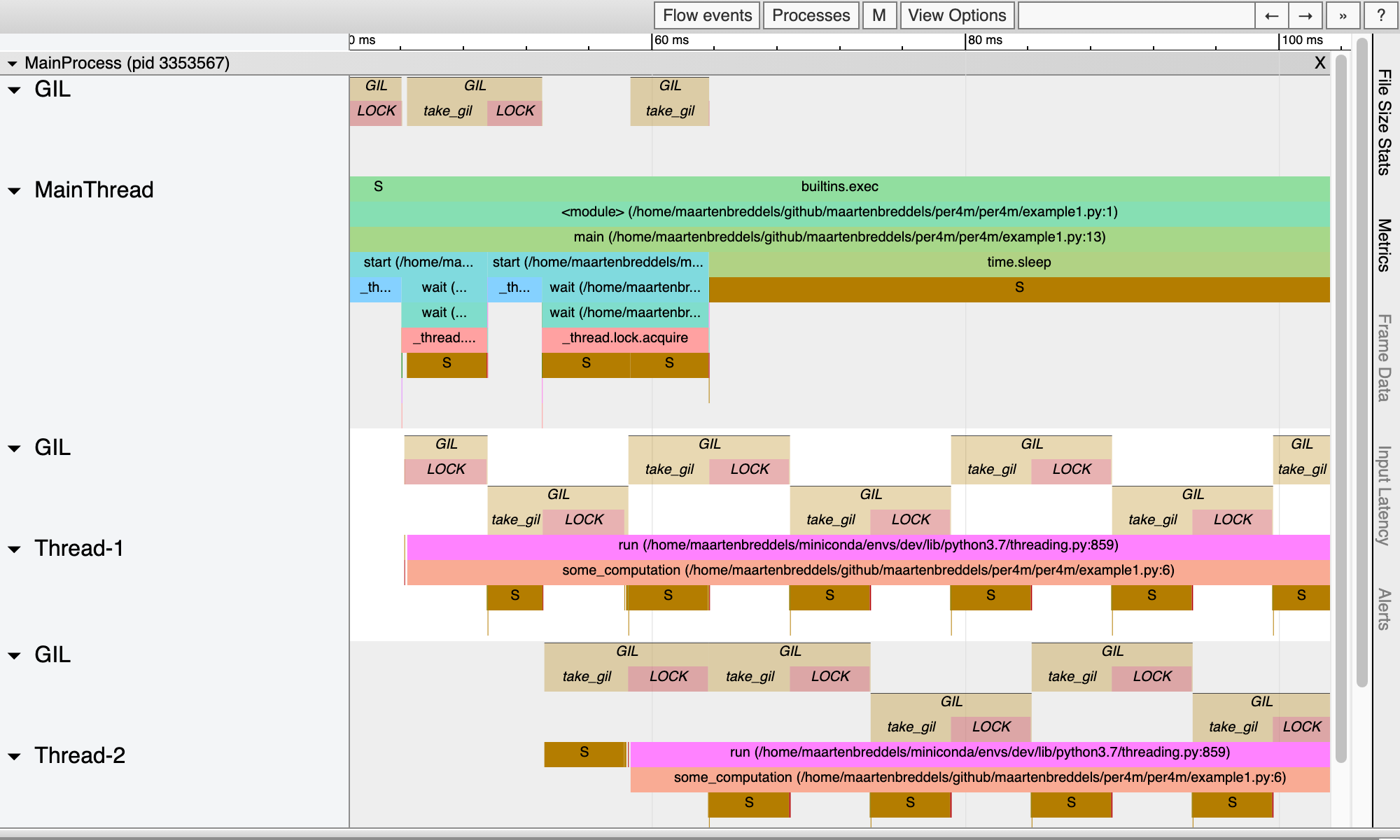
How the GIL Behaves: CPU-Bound vs. I/O-Bound Tasks
The impact of the GIL depends entirely on the type of work your threads are doing. This distinction is critical for backend development.
-
I/O-Bound Work: This involves waiting for an external resource to respond, such as a database query, a network API call, or reading from a disk. Python's standard library and many third-party libraries are designed to release the GIL during these I/O waiting periods. This is the key to effective concurrency in most Python web applications. While one thread is waiting for the database, the GIL is released, and another thread can run to handle a different web request.
-
CPU-Bound Work: This involves intensive computation, like complex mathematical calculations, data processing, or image manipulation. In this case, a thread will hold the GIL for the duration of its computation. If you have multiple threads trying to do CPU-bound work, they will not run in parallel. Instead, they will compete for the GIL, and the operating system will switch between them, which adds overhead and can actually slow down your application compared to running on a single thread.
The following video provides an excellent demonstration of this counter-intuitive behavior.
Andrew Montalenti: Beating Python's GIL to Max Out Your CPUs
This clip from the PyData talk 'Beating Python's GIL to Max Out Your CPUs' clearly shows the performance degradation caused by the GIL in CPU-bound multi-threaded scenarios.
Watch the section from 03:19 to 04:31. The speaker explains why running two CPU-bound threads on two cores can be much slower than running them on a single core due to GIL contention.
Practical Implications for Python Web Servers
Now, let's connect this theory to your world of Django and FastAPI, using a tool like Gunicorn as a web server. This is where you'll be evaluated in an interview.
Most web server workloads are fundamentally I/O-bound. A typical request involves:
- Receiving the request (I/O).
- Authenticating the user (might involve a database query - I/O).
- Fetching or saving data in the database (I/O).
- Calling other microservices (network I/O).
- Sending the response back (I/O).
Because the GIL is released during these I/O waits, using a multi-threaded web server is effective. For example, configuring Gunicorn with the gthread worker type allows a single process to handle multiple requests concurrently. While Thread A waits for a database query for Request A, Thread B can pick up the GIL and start processing Request B.
However, if a request handler contains a CPU-bound task, it will monopolize the GIL within its worker process, starving all other threads in that same process. This leads to high latencies for other concurrent requests being handled by that worker.
To understand this interaction in a production context, let's look at how Gunicorn's configuration relates to the GIL.
The article 'Gunicorn vs Python GIL' by Luis Sena provides an excellent, practical breakdown of how Gunicorn's worker types interact with the GIL.
Read the sections 'Gunicorn worker types' and 'How Python schedules threads using a global lock (GIL)'. Pay close attention to the description of sync vs. gthread workers and the diagram illustrating the thread scheduling flow.
The Gunicorn Worker Strategy
Based on your reading and our discussion, here's how to think about it from an architectural perspective:
-
Sync Workers (
--workers N): This is the simplest strategy. Gunicorn createsNindependent OS processes. Each process has its own memory and its own GIL. This is a form of multiprocessing.- Pros: It effectively bypasses the GIL problem for CPU-bound tasks, as each process can run on a separate CPU core. It's simple and robust.
- Cons: Each process consumes a significant amount of memory, which can limit the number of workers you can run on a given machine.
-
Threaded Workers (
--workers N --threads M): Gunicorn createsNprocesses, and each process spawnsMthreads. This is a hybrid model.- Pros: Excellent for I/O-bound applications. Threads are much more lightweight than processes, so you can handle a high degree of concurrency (
N * Mconcurrent requests) with lower memory overhead. - Cons: All
Mthreads within a single process share the same GIL. If your application has any CPU-bound code, this model will suffer from GIL contention.
- Pros: Excellent for I/O-bound applications. Threads are much more lightweight than processes, so you can handle a high degree of concurrency (

Senior-Level Interview Perspective
An interviewer will expect you to move beyond definitions and discuss trade-offs and real-world scenarios.
Interview Question 1: "You've deployed a Django service using Gunicorn with 1 worker and 8 threads. You notice that a new, computationally-heavy API endpoint is causing high latency across all other endpoints served by that worker. What is happening, and how would you fix it?"
- Your Thought Process:
- "Computationally-heavy" points to a CPU-bound task.
- "8 threads" means all threads share one GIL within that single worker process.
- The CPU-bound task is holding the GIL, preventing the other 7 threads from executing Python code to serve their requests. They are effectively blocked.
- Structured Answer:
- Diagnosis: "The issue is GIL contention. The new endpoint is CPU-bound, so when a thread executes it, it holds the Global Interpreter Lock and doesn't release it. This prevents the other threads in the same worker process from running, starving them and causing latency to spike for all other requests handled by that worker."
- Solutions:
- Isolate the Workload: "The best immediate solution is to move the CPU-bound work out of the synchronous request-response cycle. We can refactor it into an asynchronous background job using a task queue like Celery with RabbitMQ or Redis. The API endpoint would then just enqueue the job and return a job ID to the client, who can poll for the result later. This keeps the web workers free to handle I/O-bound requests."
- Change Concurrency Model: "If the work must be synchronous, we could deploy a separate Gunicorn instance for this specific endpoint using
syncworkers (multiple processes) so the OS can schedule them on different cores, mitigating the GIL's impact. We'd use a reverse proxy like Nginx to route traffic appropriately."
A Note on the Future: The "No-GIL" Python
To demonstrate forward-looking knowledge, it's worth being aware of PEP 703, which introduced an experimental build of Python 3.13 without the GIL.
How Much FASTER Is Python 3.13 Without the GIL?
The channel ArjanCodes offers a good summary of the 'no-gil' initiative and its implications.
Watch the section from 04:50 to 09:15. Focus on the 'dangers' and the long-term plan. This will give you the key talking points about why removing the GIL is not a simple silver bullet.
In an interview, you could mention this by saying: "While the GIL is a limitation for CPU-bound threaded code, the Python core team is experimenting with a no-GIL mode. However, it's a complex transition. It could introduce a performance hit for single-threaded code and requires the vast C-extension ecosystem to adapt to a new, more complex memory model. For now, the established patterns of using multiprocessing for CPU-bound tasks and threading/asyncio for I/O-bound tasks remain the production-ready standard."
Conclusion
This lesson covered the essential theory and practical implications of the Python GIL, a cornerstone for understanding concurrency in backend systems.
Key Takeaways:
- The GIL is a mutex in CPython ensuring only one thread executes Python bytecode at a time in a single process.
- Its primary impact is on multi-threaded CPU-bound tasks, where it prevents parallelism and can decrease performance.
- For I/O-bound applications like most web services, threading remains highly effective because the GIL is released during I/O waits, enabling high concurrency.
- The choice of server configuration (e.g., Gunicorn's
syncvs.gthreadworkers) is a direct architectural decision based on whether your workload is CPU or I/O-bound, a trade-off dictated by the GIL. - The standard solution for CPU-bound work in a web context is to move it to a separate process, often via a background task queue.
Preview of the Next Lesson
Now that you have a solid grasp of the GIL, we are perfectly positioned for our next lesson. We will dissect Python's three primary concurrency models: threading, multiprocessing, and asyncio. We'll move beyond definitions to build a clear mental model for when to use each, which is a crucial skill for designing scalable and efficient backend services.