Introduction
Welcome to the next lesson in our journey through distributed systems. In our previous session, we established that the CAP theorem forces a critical choice in the face of network partitions: you must prioritize either Consistency (CP) or Availability (AP). We saw that for many large-scale applications like social media or content platforms, ensuring the system is always available (AP) is more critical than guaranteeing every user sees the absolute latest data on every request.
Today, we'll explore the model that makes AP systems possible: eventual consistency. This isn't just a fallback; it's a deliberate design choice that enables high availability and massive scalability. Your goal for this lesson is to describe eventual consistency and identify scenarios where it is an acceptable design choice for high-availability systems. Mastering this concept is key to discussing architectural trade-offs with the depth expected of a senior engineer.
1. What is Eventual Consistency?
At its heart, eventual consistency is a simple but powerful guarantee:
If no new updates are made to a given data item, all replicas will eventually converge to the same value.
The key word is eventually. The system allows for a temporary period of inconsistency among replicas, known as replication lag. During this lag, different users connecting to different nodes might see different versions of the data.
To understand how this works, let's start with a foundational article.
Strong Vs Eventual Consistency
The article 'Strong Vs Eventual Consistency' from AlgoMaster.io provides a clear definition and a simple diagram to illustrate the concept.
Read the section titled 'Eventual Consistency'. Focus on: The formal definition of eventual consistency. The step-by-step breakdown under 'How It Works'. The social media profile picture example, which perfectly illustrates the concept in a practical context.
As the article explains, the process involves an asynchronous update. A write request to one node is acknowledged immediately, providing low latency. The change is then propagated to other replicas in the background.
The following diagram visualizes this process, showing the temporary inconsistency (stale read) that can occur during replication lag.

2. The Decision Framework: When is "Eventually" Good Enough?
Choosing eventual consistency is not about being lazy; it's a strategic decision based on business requirements and user experience. For an interview, you need a clear framework to justify this choice. An excellent way to frame this is by evaluating the impact of temporary inconsistency on three key aspects:
- Reliability: Does showing stale data cause the system to fail in its core promise?
- Functional Correctness: Does it lead to incorrect calculations or states that break business logic?
- User Experience: Will the user notice the staleness, and if so, will it negatively impact their trust or ability to use the service?
The following video provides an outstanding analysis of this decision-making process using two powerful, contrasting examples.
Eventual Consistency vs. Strong Consistency | How to decide between the two in System Design
The video 'Eventual Consistency vs. Strong Consistency' from the Think Software channel brilliantly contrasts scenarios where eventual consistency is acceptable versus where it is disastrous.
Watch the video from the beginning to 15:17. Pay close attention to: The introduction (00:00 - 01:48), which sets up the three evaluation criteria (reliability, correctness, UX). The Twitter 'likes' example (03:40 - 13:04). Why does trying to implement 'likes' with strong consistency lead to a bad user experience (commit conflicts, high latency)? And why is eventual consistency perfectly acceptable here? The Amazon Marketplace inventory example (13:04 - 15:17). Why would using eventual consistency for inventory break the system's reliability and functional correctness?
3. Common Use Cases and Scenarios
Based on the framework above, we can identify clear patterns for when eventual consistency is a smart choice.
Ideal Scenarios for Eventual Consistency:
These are situations where the data is non-critical, user-generated at high volume, and where a slight delay in propagation has minimal impact.
- Social Media Metrics: Like counts, view counts, share counts. Seeing 1,000 likes instead of 1,001 for a few seconds has no negative impact.
- Analytics and Logging: Aggregating user clicks, page views, or system events. The exact real-time count is less important than ensuring all data is eventually collected without dropping writes under high load.
- Recommendation Engines: Displaying personalized suggestions for products or content. The recommendations don't need to be based on the absolute last click a user made.
- User Profile Updates: Changing a profile picture or bio. As long as the user who made the change sees it immediately (a concept we'll touch on later), it's acceptable if other users see the old version for a short period.
- Content Delivery Networks (CDNs): When you update an image on your server, it takes time for that update to propagate to all edge locations worldwide. This is a classic example of eventual consistency.
Unsuitable Scenarios for Eventual Consistency:
These are situations where data accuracy is paramount and any inconsistency can lead to financial loss, broken business promises, or regulatory issues.
- Financial Transactions: Bank balances, payments. You cannot risk showing a user an outdated balance or allowing double-spending.
- E-commerce Inventory Management: You cannot sell an item you don't have in stock. The inventory count must be strongly consistent at the point of purchase.
- Booking and Reservation Systems: Airline seats, hotel rooms, event tickets. Double-booking is a critical failure.
- Distributed Locking Services: The entire purpose of a lock is to provide a single source of truth about resource ownership. This requires strong consistency.
4. Advanced Insight: The Spectrum of Consistency
For a senior-level interview, it's crucial to show that you understand "eventual consistency" is not a single, monolithic model. It's a spectrum of weaker consistency guarantees that offer a better user experience than "pure" eventual consistency.
Let's explore these more nuanced models.
Strong Vs Eventual Consistency
Let's return to the AlgoMaster.io article, which has an excellent section on these stronger forms of eventual consistency.
Read the section 'Variations and Client-Centric Models'. For each model, try to think of a simple example: Read-Your-Writes Consistency: After I post a comment, I should see my own comment if I refresh the page. Monotonic Reads Consistency: If I see a post has 10 likes, I should never see it has 9 likes on a subsequent refresh. Monotonic Writes Consistency: If I update my address from A to B, and then from B to C, the system should never show the state as reverting from C back to B. Causal Consistency: If I see a reply to a comment, I must have also seen the original comment.
Mentioning these client-centric models in an interview demonstrates a deep understanding of user experience in distributed systems. You can explain that while a system might be eventually consistent overall, you can implement specific logic to provide these stronger guarantees for an individual user's session, which greatly improves perceived consistency.
5. Architectural Patterns for Eventual Consistency
Finally, let's connect this theory to the architectural patterns that implement it. In a microservices environment, eventual consistency is often achieved through asynchronous communication using events.
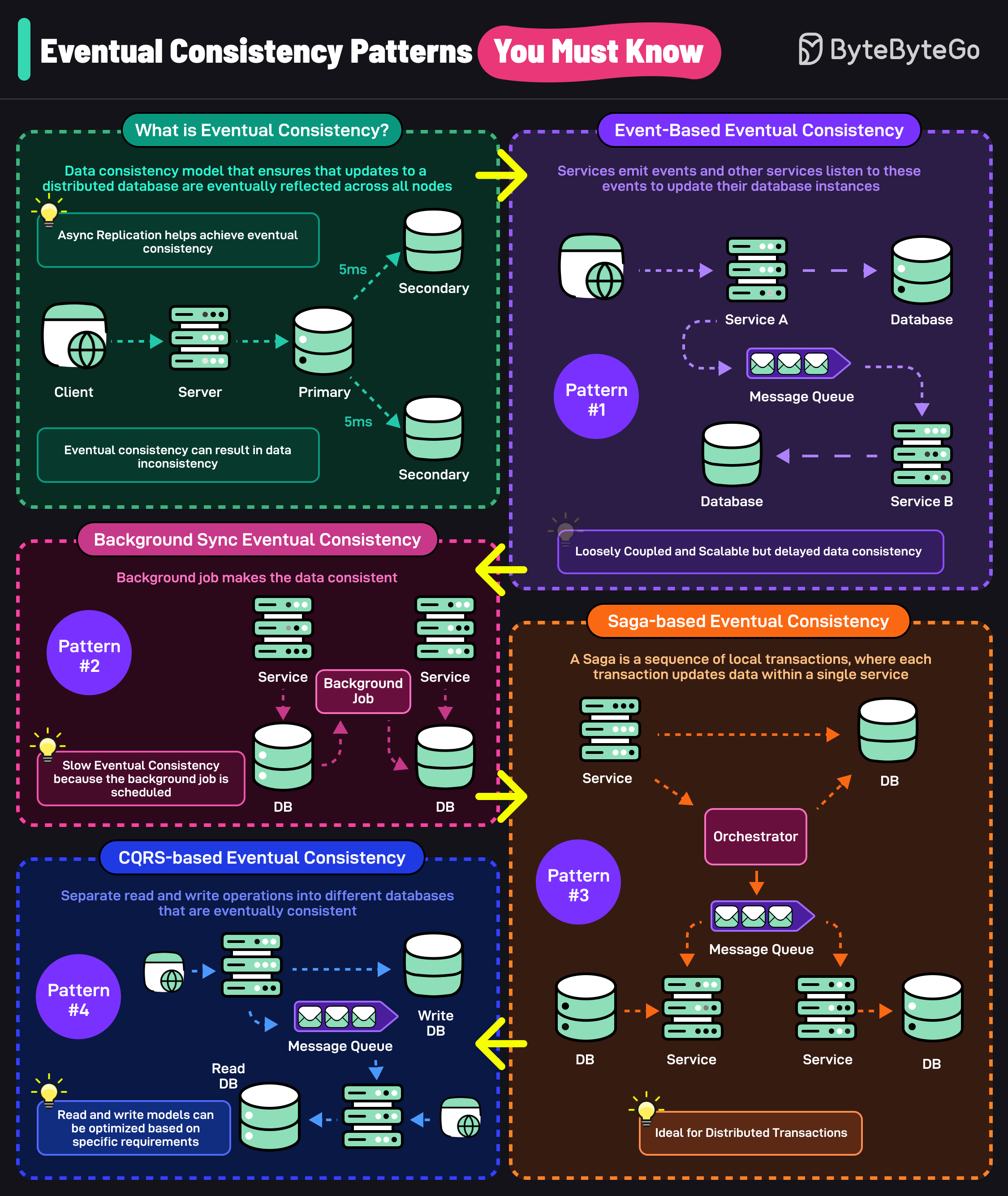
For example, in an e-commerce platform that uses event-driven architecture (as discussed in the IJSRA paper LINK), when an order is placed:
- The
Order Servicecommits the order to its own database and publishes anOrderPlacedevent. This is strongly consistent within its own boundary. - The
Notification ServiceandInventory Servicesubscribe to this event. They process it asynchronously. - For a brief period, the order exists, but the inventory count hasn't been decremented, and the confirmation email hasn't been sent. The overall system state is temporarily inconsistent.
- Eventually, both services process the event, the inventory is updated, the email is sent, and the system converges to a consistent state.
This approach, often managed with patterns like the Saga Pattern or Outbox Pattern, allows services to be decoupled and highly available, at the cost of eventual consistency across service boundaries.
Conclusion
You now have a robust framework for understanding and discussing eventual consistency. It's not a flaw, but a powerful tool for building scalable and highly available systems when the business context allows for it.
Key Takeaways:
- Definition: Eventual consistency guarantees that, without new writes, all replicas will eventually hold the same data. It prioritizes availability by allowing temporary inconsistencies.
- Decision Framework: The choice depends on the impact of stale data on reliability, functional correctness, and user experience.
- Good Use Cases: High-volume, non-critical data like social media metrics, analytics, and user profile information.
- Bad Use Cases: Critical data requiring absolute accuracy, such as financial transactions, inventory control, and reservations.
- Advanced Nuances: There is a spectrum of consistency within the "eventual" model (e.g., Read-Your-Writes) that can improve the user's perception of the system.
- Implementation: Event-driven architectures and patterns like Saga and CQRS are common ways to implement eventual consistency in microservices.
Preview of the Next Lesson:
We've seen that some operations, even within an eventually consistent system, require temporary strong consistency (like processing an order or taking a username). How do you ensure that only one service performs a critical action at a time in a distributed environment? In our next lesson, we will tackle this by exploring distributed locking, discussing how to implement it using tools like Redis and the challenges you'll face.