Introduction
In our previous lesson, we designed a robust failure handling mechanism using Dead-Letter Queues (DLQs). This was a crucial step in building resilient asynchronous systems, showing how to handle failures at the component level. Now, we're going to zoom out and explore one of the most fundamental principles that governs the architecture of all distributed systems: the CAP Theorem.
Understanding the CAP theorem is non-negotiable for a senior backend engineer. It's the theoretical foundation that explains the trade-offs you've likely encountered implicitly when choosing between databases or designing replicated services. Today's goal is to apply the CAP theorem to analyze real-world distributed systems (e.g., a database, a cache) and explain their consistency/availability trade-offs. This will equip you to justify high-level architectural decisions, a key expectation in a senior-level interview.
1. The Inescapable Choice: Understanding CAP
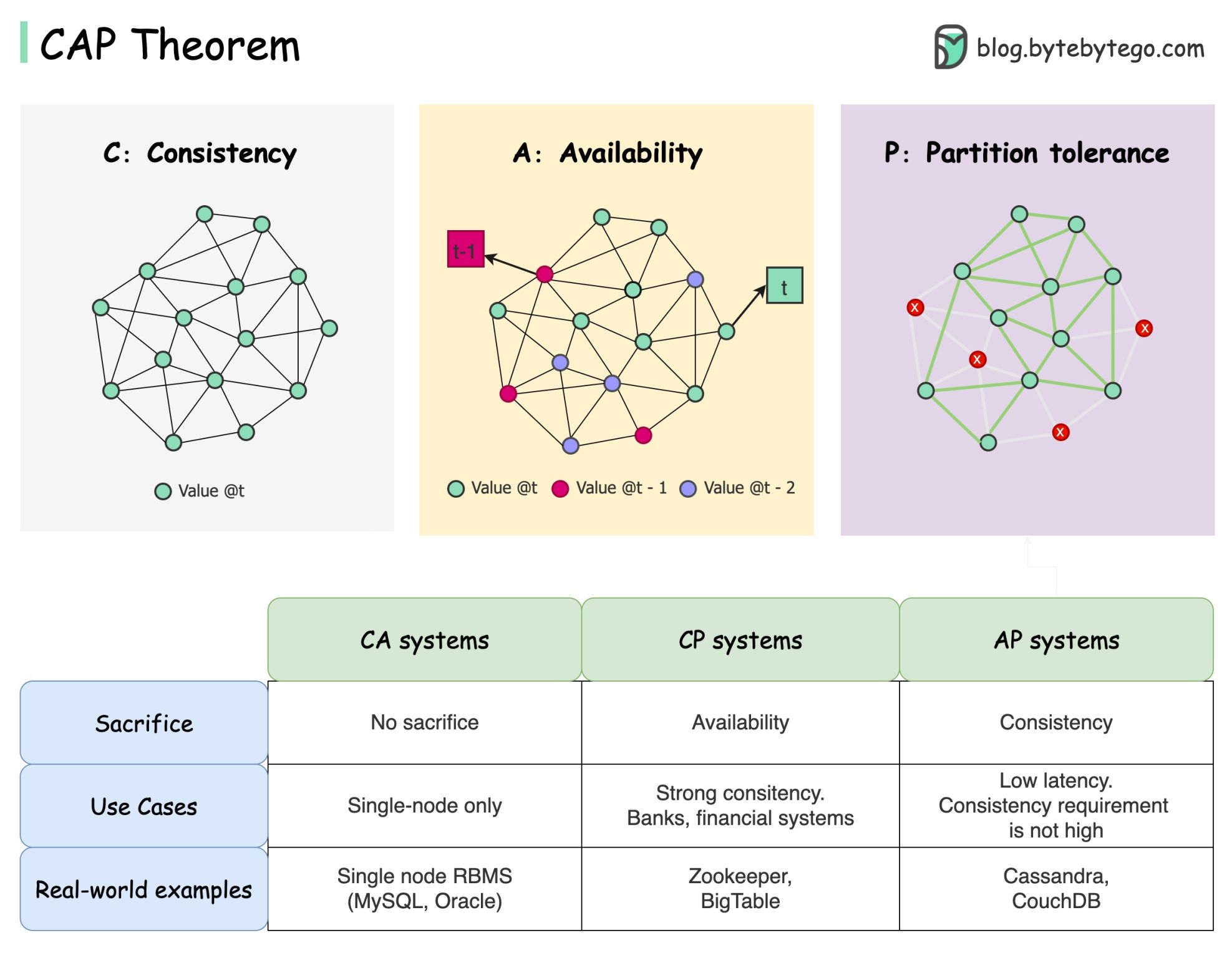
At its core, the CAP Theorem, first conjectured by Eric Brewer, states that a distributed data store can only provide two of the following three guarantees simultaneously:
- Consistency (C): Every read receives the most recent write or an error. All nodes in the system have the same view of the data at the same time.
- Availability (A): Every request receives a (non-error) response, without the guarantee that it contains the most recent write. The system is always up to handle requests.
- Partition Tolerance (P): The system continues to operate despite an arbitrary number of messages being dropped (or delayed) by the network between nodes. In simple terms, the system works even when parts of it can't communicate with each other.
To start, let's watch a concise video that defines these terms and explains the core dilemma.
CAP Theorem in System Design Interviews
The video 'CAP Theorem in System Design Interviews' from Hello Interview provides a clear and interview-focused introduction to the theorem.
Watch the segment from 00:39 to 02:15. Focus on understanding: The definitions of C, A, and P. The critical insight for any distributed system: why is Partition Tolerance (P) considered a must-have, forcing a choice between Consistency (C) and Availability (A)?
The key takeaway is that in any real-world distributed system (which by definition involves multiple machines communicating over a network), network partitions are a fact of life. Routers fail, data centers lose connectivity. You cannot choose to sacrifice partition tolerance.
Therefore, the practical application of the CAP theorem is: When a network partition happens, you must choose between consistency and availability.
2. Applying the Theorem: CP vs. AP in the Real World
This choice between Consistency and Availability isn't just theoretical; it has massive implications for user experience and business logic. Let's make this concrete.
The GitHub Outage: A Real-World CP Choice
On October 21, 2018, GitHub faced a massive network partition that caused replication lag between their database clusters. They made a deliberate choice: they froze all write operations for over five hours to prevent data corruption and inconsistency. They chose Consistency over Availability (CP).
CAP Theorem: What Senior Engineers Actually Need to Know
The article 'CAP Theorem: What Senior Engineers Actually Need to Know' opens with this powerful GitHub incident. It's a perfect example of CAP trade-offs in a high-stakes production environment.
Read the first three sections: 'When GitHub Chose Consistency Over Your Pull Request', 'The Theorem in 30 Seconds', and 'Why This Matters: The Coffee Shop Test'. Focus on how the abstract theorem translates into concrete business decisions and user impact.
The Decision Framework
The GitHub example and the "Coffee Shop Test" from the article highlight the core decision framework. Now, let's see more examples to solidify this mental model.
CAP Theorem in System Design Interviews
Let's return to the 'CAP Theorem in System Design Interviews' video, which provides excellent, interview-ready examples of when to choose C over A, and vice-versa.
Watch the segment from 02:15 to 06:45. As you watch, create two lists: Systems that must choose Consistency (CP): What is the common theme among them? Systems that can choose Availability (AP): What makes them different?
Your lists should look something like this:
-
Choose CP (Consistency > Availability) when incorrect data is catastrophic:
- Financial Systems: Double-spending money is unacceptable.
- Inventory Management: Selling an item you don't have leads to angry customers and broken promises.
- Ticket Booking: Double-booking a seat on a flight is a major failure.
- The Pattern: The cost of being wrong is higher than the cost of being temporarily down.
-
Choose AP (Availability > Consistency) when downtime is worse than temporary staleness:
- Social Media Feeds: Seeing a slightly old "like" count or a delayed post is not critical.
- Product Reviews (like Yelp): It's better to show slightly outdated business hours than to show an error page.
- Video Streaming Catalogs (Netflix): If a new movie description takes a few seconds to update across the globe, no one will notice.
- The Pattern: The cost of being unavailable to users is higher than the cost of data being slightly out-of-date.
3. Case Study: How Databases Embody CAP
The most common place you'll apply the CAP theorem is in choosing a database. Different databases are explicitly designed around these trade-offs. Given your background with PostgreSQL, let's see how it compares to other popular NoSQL systems.
MongoDB (Leaning CP) vs. Cassandra (Leaning AP)
This next video provides a fantastic comparison of two major NoSQL databases, showing how their underlying architectures reflect different CAP priorities.
MongoDB vs. Apache Cassandra - Who Wins? | Systems Design Interview 0 to 1 with Ex-Google SWE
In 'MongoDB vs. Apache Cassandra', Jordan has no life breaks down the architectural differences that make one prioritize consistency and the other availability.
Watch the three highlighted segments: MongoDB's Architecture (00:27 - 02:01): Note the use of single-leader replication and ACID transactions. How does this align with traditional SQL databases and favor consistency? Cassandra's Architecture (04:32 - 06:32): Pay close attention to 'leaderless replication', 'quorums', and 'last-write-wins'. Why do these features make it highly available but only eventually consistent? Conclusion (08:12 - 10:18): The summary crystallizes the use cases. When would you pick MongoDB over Cassandra, and vice-versa?
The Database Spectrum and "Tunable Consistency"
As you saw, it's not always a binary choice. Many modern systems offer tunable consistency, allowing you, the developer, to make the trade-off on a per-request basis. This is a critical point to raise in a senior interview.
CAP Theorem: What Senior Engineers Actually Need to Know
Let's revisit the 'Senior Engineers' article to see how this tuning works in practice.
Read the sections 'Code: Seeing the Choice' and 'The Hybrid Reality: Tunable Consistency'. Notice how DynamoDB's ConsistentRead flag and Cassandra's quorum settings allow you to slide between the 'A' and 'C' poles of the theorem.
Here's a quick summary of where common databases sit:
- CP Systems:
- Single-Node SQL (Postgres, MySQL): Before replication, they are inherently consistent. In a replicated setup (Primary-Replica), if you only read and write from the primary, you get strong consistency.
- Google Spanner, CockroachDB: Designed from the ground up to be globally consistent.
- AP Systems:
- Cassandra, Riak: Designed for massive scale and high availability, using leaderless replication.
- DynamoDB (default mode): Optimized for availability, offering eventual consistency on reads by default.
- Tunable:
- DynamoDB: Can request strongly consistent reads (
ConsistentRead: true), which costs more and has higher latency. - Cassandra: You can configure the number of nodes that must acknowledge a read/write (the "quorum"), trading latency/availability for consistency.
- MongoDB: With "majority" write concern, it behaves like a CP system.
- DynamoDB: Can request strongly consistent reads (
4. The Interview Playbook
In a system design interview, you must be able to articulate these trade-offs clearly.
Interviewer: "You're designing a shopping cart service for an e-commerce site. What are its availability and consistency requirements?"
Your Thought Process & Answer Structure:
- Clarify and Deconstruct: "That's a great question. A shopping cart service has different components with different needs. Let's break it down using the CAP theorem."
- Apply CAP to Sub-systems (Senior-level Nuance):
- Adding an item to the cart: "When a user adds an item, availability is key. If there's a network partition, we should still let the user add the item to their local session or a locally-replicated cart. It's better to risk a minor sync issue later than to fail the 'add to cart' action. So for this part, I'd lean towards an AP system. Eventual consistency is acceptable."
- Checking inventory during checkout: "However, when the user clicks 'Checkout', we absolutely must have the correct inventory count. We cannot sell an item we don't have. At this moment, we need strong Consistency. I would design this part of the flow to query the primary inventory database, even if it means higher latency or a potential failure if the database is unavailable. This is a classic CP requirement."
- Connect to Technology: "Based on this, I might use a highly available cache like Redis for the cart-building phase (AP), but the final checkout process would involve a transaction against a strongly consistent database like PostgreSQL or a CP-configured NoSQL store."
This nuanced answer, which applies different CAP priorities to different parts of the same system, is what distinguishes a senior candidate.
Conclusion
Today, you've moved from simply knowing about distributed systems to understanding the fundamental laws that govern them. The CAP theorem isn't just an academic concept; it's a practical tool for reasoning about and justifying architectural decisions.
Key Takeaways:
- The Rule: A distributed system can only guarantee 2 of 3 properties: Consistency, Availability, and Partition Tolerance.
- The Reality: Since network Partitions are inevitable, the real choice is between Consistency (CP) and Availability (AP).
- The Decision: The choice depends on the business cost of being wrong vs. the cost of being down. Choose CP for financial/inventory systems; choose AP for social media/analytics.
- The Application: Database architectures (e.g., MongoDB vs. Cassandra) are real-world embodiments of CAP trade-offs.
- The Nuance: Modern systems often provide tunable consistency, and a single product may use both CP and AP patterns for different features.
Preview of the Next Lesson:
We've repeatedly mentioned that AP systems rely on "eventual consistency." But what does that actually mean, and what are its different flavors? In our next lesson, we will do a deep dive into eventual consistency, exploring models like "read-your-own-writes" and identifying scenarios where it is a powerful and acceptable design choice for building highly available systems.