Hello! Welcome to our next lecture.
In our last lesson, we explored process reliabilism, a key example of an externalist theory. We saw that for reliabilists, justification isn't about reasons you can access in your mind, but about whether your belief was formed by an objectively reliable process. The focus was on the process, not the person.
Today, we're going to examine another major shift in epistemological thinking. What if the most fundamental aspect of knowledge isn't the belief itself, or the process that formed it, but the intellectual character of the person who holds the belief? This brings us to virtue epistemology.
Our goal for this lesson is to describe virtue epistemology and its focus on the agent's intellectual character and habits. We will explore how this approach reframes the central questions of epistemology and what it means to be an "intellectually virtuous" person.
A New Focus: From Beliefs to Believers
So far, the theories we've examined—JTB, foundationalism, coherentism, and even reliabilism—have all tried to identify the properties of a belief that make it justified or count as knowledge. Virtue epistemology takes a different path. It suggests that we should first understand what makes a person a good thinker, and then use that understanding to define what counts as a justified belief or knowledge.
This is very similar to a major movement in ethical theory. To understand this shift, let's watch a short video from Professor John Greco. He draws a clear analogy between virtue ethics and virtue epistemology.
II. What is intellectual virtue? Part 1a: What is virtue epistemology? (John Greco)
To grasp the core idea of virtue epistemology, it's incredibly helpful to see how it mirrors virtue ethics. This video explains that analogy perfectly.
Please watch from 1:00 to 8:19. Focus on how virtue theories (in both ethics and epistemology) make the concept of the 'virtuous person' the most fundamental building block for explaining everything else.
As the video explains, just as virtue ethics defines a "right action" as what a virtuous person would do, virtue epistemology aims to define a "justified belief" as the kind of belief an intellectually virtuous person would hold. The primary object of evaluation is no longer the isolated belief, but the person's intellectual character and habits.
What is Virtue Epistemology?
Now that we understand the shift in focus, let's get a more formal introduction. The following video provides a great overview of the core assumptions behind this approach.
PHILOSOPHY - Epistemology: Virtue Epistemology [HD]
This video from Wireless Philosophy outlines the two basic assumptions of virtue epistemology and introduces a key definition of knowledge from this perspective.
Please watch from the beginning to 4:57. Pay attention to: The idea that epistemology is a normative discipline. The focus on intellectual character traits (virtues and vices). Linda Zagzebski's definition of knowledge.
Let's unpack the key ideas from that video:
- Epistemology is Normative: It's concerned with how we ought to think, inquire, and form beliefs, much like ethics is concerned with how we ought to act.
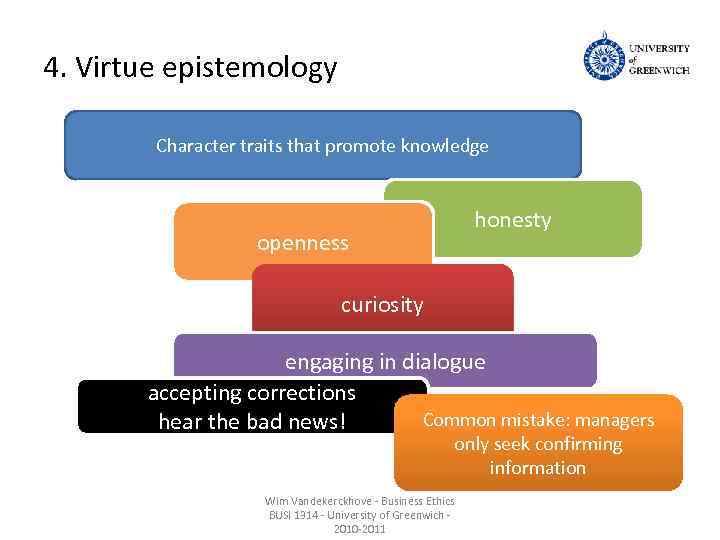
- Character is Fundamental: Instead of asking "What makes a belief justified?", virtue epistemology asks questions like "What is curiosity?", "What does it mean to be open-minded?", and "What makes a person a responsible inquirer?".
- Knowledge is a Product of Virtue: A leading virtue epistemologist, Linda Zagzebski, defines knowledge as a "state of true belief that arises out of acts of intellectual virtue." This definition elegantly connects the truth of a belief to the virtuous character of the person holding it. In a Gettier case, for example, the belief might be true, but it's true due to luck, not because of the agent's intellectual virtue.
Two Flavors of Virtue: Reliabilism and Responsibilism
When epistemologists talk about "intellectual virtues," they can mean slightly different things. This has led to two main branches of virtue epistemology. A great article from the Internet Encyclopedia of Philosophy (IEP) explains this distinction.
To get a clearer picture, it's important to distinguish the two main schools of thought within virtue epistemology. Please read the following short sections from the IEP article "Virtue Epistemology".
Please read the introductory paragraphs (starting 'Virtue epistemology is a collection...') and the first paragraph of Section 1 ('Virtue epistemology is a collection...'). Then, read the first paragraph of the untitled section that begins 'A second group of virtue epistemologists...'. These sections distinguish between virtue reliabilism and virtue responsibilism.
Here's a summary of that distinction:
- Virtue Reliabilism (e.g., Ernest Sosa): This view sees intellectual virtues as reliable cognitive faculties. Examples include good eyesight, a sharp memory, and sound reasoning. This approach is closely related to the process reliabilism we studied in the last lesson, but it grounds the reliability in the stable dispositions or "virtues" of the agent.
- Virtue Responsibilism (e.g., Linda Zagzebski, Lorraine Code): This view sees intellectual virtues as good intellectual character traits. These are the qualities of a responsible inquirer, such as curiosity, open-mindedness, intellectual humility, and intellectual courage. This is often what people first think of when they hear the term "virtue epistemology."
While distinct, these two views aren't necessarily mutually exclusive. A complete picture of a good thinker likely requires both reliable faculties and responsible character traits.
What are the Intellectual Virtues?
So, what does this "good intellectual character" look like in practice? Let's explore some of the specific virtues that responsibilists focus on. These are the acquired habits that shape how we seek truth and understanding.
The following document, created by philosopher Jason Baehr for educators, provides an excellent and accessible list of key intellectual virtues.
EDUCATING FOR INTELLECTUAL VIRTUES - Jason Baehr
This guide, while intended for teachers, offers one of the clearest breakdowns of the specific traits that constitute intellectual character. It defines nine 'master virtues' that are excellent examples of what virtue epistemology is all about.
Please read the section from the PowerPoint slides on pages 6-8 (labeled with slide numbers 4 through 7 in the document). This section lists nine 'master virtues' and provides a clear definition and slogan for each.
To summarize, here are the nine "master virtues" from the reading, grouped by their function in the process of inquiry:
| Function | Virtues |
|---|---|
| Getting inquiry started | 1. Curiosity: A desire to understand. ("Ask questions!") |
| 2. Intellectual Humility: Owning one's limits. ("Admit what you don't know!") | |
| 3. Intellectual Autonomy: Thinking for yourself. ("Think for yourself!") | |
| Keeping inquiry on track | 4. Attentiveness: Staying focused on details. ("Look and listen!") |
| 5. Intellectual Carefulness: Avoiding errors. ("Avoid errors!") | |
| 6. Intellectual Thoroughness: Going deep. ("Go deep!") | |
| Overcoming challenges in inquiry | 7. Open-mindedness: Thinking outside the box. ("Think outside the box!") |
| 8. Intellectual Courage: Taking intellectual risks. ("Take risks!") | |
| 9. Intellectual Tenacity: Embracing struggle. ("Embrace struggle!") |
Test your understanding!
Think of a time you learned a complex new skill or came to understand a difficult idea, whether in your design work, your studies, or a personal interest. Which two or three of the intellectual virtues listed above were most critical to your success? Briefly explain why.
Show answer
There is no single correct answer here, as it depends entirely on your personal experience. For example, you might say:
- "When learning a new design software, intellectual tenacity was key, because I kept running into frustrating errors and had to resist giving up. Intellectual carefulness was also vital, as I had to pay close attention to the instructions to avoid making mistakes that would ruin the project."
- "When I was trying to understand a complex philosophical argument, intellectual humility was the first step—I had to admit I didn't get it at first. Then, curiosity kept me asking questions, and intellectual thoroughness pushed me to read multiple explanations until I grasped the deeper meaning."
The exercise aims to show how these abstract virtues are, in fact, practical habits we use in real-world learning.
Conclusion
Today we've seen a completely different approach to epistemology. Instead of putting a belief or a process under the microscope, virtue epistemology turns the lens on the person, arguing that knowledge and justification are products of a virtuous intellectual character.
Key Takeaways:
- Virtue epistemology shifts the focus from the properties of beliefs to the intellectual character of the agent.
- It defines knowledge as true belief that is acquired because of the agent's intellectual virtues.
- Intellectual virtues are the character traits and habits of a good thinker, such as curiosity, open-mindedness, intellectual humility, and tenacity.
- The two main schools are virtue reliabilism (virtues as reliable faculties) and virtue responsibilism (virtues as responsible character traits).
Preview of the Next Lesson:
We have now surveyed the main internalist theories, a major externalist theory, and virtue epistemology. Across all these lessons, we've largely assumed that knowledge is possible. But what if it isn't? In our next module, we will confront this question head-on by exploring the powerful arguments for global skepticism, such as the famous "brain-in-a-vat" thought experiment. We will examine why this challenge is so difficult to overcome for any theory of knowledge.