Hello! Welcome back to our exploration of epistemology.
In the past few lessons, we've examined two major theories of justification: foundationalism (the pyramid) and coherentism (the web). Despite their differences, they share a core assumption: that the factors determining whether a belief is justified are internal to your mind. Justification is about your awareness of your own reasons, the logical connections between your beliefs, or your access to self-evident truths.
Today, we take a sharp turn to explore a radically different perspective. What if justification has nothing to do with what's going on inside your head and everything to do with how your belief is connected to the outside world? This brings us to externalism.
Our learning outcome for this lesson is to explain process reliabilism as a primary example of an externalist theory of justification. We will see why philosophers developed externalist theories and how reliabilism defines justification in a way that challenges many of our common-sense intuitions.
The Internal vs. External Divide
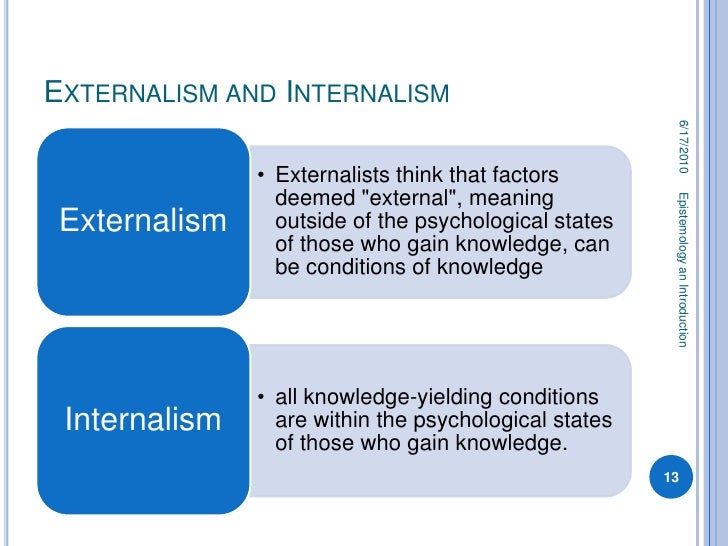
Before we dive into reliabilism, it's crucial to solidify the distinction between internalism and externalism.
Why would philosophers feel the need to look "outside the mind" for justification? Internalism, with its focus on conscious reflection, seems to struggle with a few common cases:
- Knowledge in Children (and Animals): A young child seems to know that the person in front of them is their mother. A dog seems to know the sound of its owner's car. Yet, it's unlikely they can articulate or reflect upon the reasons or evidence that justify these beliefs. Internalism seems to set the bar for justification too high for them.
- Unconscious Skills: Consider a "chicken sexer," a person trained to rapidly and accurately sort newborn chicks by gender. They are incredibly reliable (often over 99% accurate), but famously, they cannot explain how they do it. The cues are too subtle for conscious identification. Their belief about any given chick's sex seems justified, but they have no internal access to the justification.
- The Link to Truth: There's a strong intuition that a justified belief should be more likely to be true. Externalist theories aim to build this connection directly into the definition of justification, making it a matter of a belief's objective connection to reality.
These examples motivate the search for a theory where justification doesn't depend on a person's ability to perform complex self-reflection.
From a Causal Chain to a Reliable Process
One of the most influential externalist theories is process reliabilism, developed by philosopher Alvin Goldman. To understand it, it's helpful to see the theory it evolved from. Goldman's first attempt was a simpler idea called the "causal theory of knowledge."
The following video from Wireless Philosophy explains the causal theory and a famous thought experiment that revealed its critical flaw, paving the way for reliabilism.
PHILOSOPHY - Epistemology: Analyzing Knowledge #3 (Causal and Reliabilist Theories) [HD]
To understand reliabilism, it helps to see the theory it grew out of. Let's watch this video to see what the causal theory was and what problem led Goldman to revise it.
Please watch from the beginning to 6:16. Pay attention to two key things: The simple idea behind the causal theory (a belief is knowledge if it's caused by the fact). The 'Fake Barn County' example and why it shows that a correct causal chain isn't enough for knowledge.
Let's break down what we just saw:
- The Causal Theory proposed that you know something if your true belief is caused in an appropriate way by the fact itself. For example, you know there's a glass on the table because the glass reflects light, which causes a perception in your eyes, which causes you to form the belief.
- The Fake Barn County problem torpedoes this simple idea. Henry has a true belief ("that's a barn") that is directly caused by a real barn. The causal chain is perfect. However, our intuition is that he doesn't know it's a barn, because he is in an environment where his method of forming that belief (glancing from the road) is extremely unreliable. He was just lucky.
The key takeaway is this: the problem with Henry's belief isn't the causal chain, but the unreliability of the process he used in that specific context. This insight is the very foundation of reliabilism.
Defining Process Reliabilism
Process reliabilism proposes that:
A belief is justified if and only if it is formed by a reliable cognitive belief-forming process.
A reliable process is simply one that produces a high percentage of true beliefs.
- Reliable processes could include vision in good light, simple memory recall, and basic logical deduction.
- Unreliable processes would be things like wishful thinking, emotional reasoning, guessing, or vision in a thick fog.
Crucially, what makes reliabilism an externalist theory is that the believer doesn't need to know, or even have any beliefs about, the reliability of their process. All that matters for justification is the external fact that the process is reliable.
This next video explains this core externalist move very clearly.
Internalism and Externalism - Epistemology Video 13
So, what makes reliabilism a distinctly 'externalist' theory? This clip from a lecture by Victor Gijsbers explains it perfectly.
Please watch from 12:39 to 16:09. The key point is that for a reliabilist, you don't need to know or believe that your process is reliable. All that matters is that it is, in fact, reliable.
This is a profound shift from what we've seen before. For an internalist (both foundationalists and coherentists), if you were challenged on a belief, you'd be expected to provide reasons or show how it fits with your other beliefs. For a reliabilist, the justification of your belief depends on objective facts about the process that produced it, whether you can access those facts or not.
Test your understanding!
Imagine a man named Norman who, without his knowledge, has a perfectly reliable clairvoyant ability. Every time he thinks about the President's location, he spontaneously forms a true belief about where the President is. He has no evidence for this ability and no other reasons for his belief. One day, he forms the belief, "The President is in New York City." It is true.
- According to process reliabilism, is Norman's belief justified? Why?
- What would an internalist likely say about Norman's belief? Why?
Show answer
- According to a pure process reliabilist, yes, Norman's belief is justified. His belief was produced by a process (his unknown clairvoyance) that is, by definition, 100% reliable. For an externalist, the objective reliability of the process is all that matters for justification.
- An internalist would almost certainly say no, Norman's belief is not justified. From Norman's own perspective, the belief is no different from a random hunch or a wild guess. He has no reasons, no evidence, and no awareness of why he should trust this belief. Since he has no internal access to any form of justification, the belief is not justified.
This "Norman the Clairvoyant" thought experiment is a classic objection used to question whether reliability is truly sufficient for justification.
Conclusion
Today, we've stepped outside the mind and into the world of externalist epistemology. We saw how problems with internalist accounts led philosophers to seek a different model of justification, one more directly tied to truth and capable of explaining knowledge in less sophisticated thinkers.
Key Takeaways:
- Externalism locates justification in factors that can be external to a believer's mind, such as the reliability of the cognitive process used.
- Process Reliabilism states that a belief is justified if it's the output of a reliable belief-forming process (one that tends to produce true beliefs).
- The key externalist feature of reliabilism is that the believer does not need to know that their process is reliable. It just has to be reliable.
- This approach helps explain knowledge in cases like young children or those with unconscious skills, but it faces challenges from thought experiments like "Norman the Clairvoyant," which suggest that we intuitively want some kind of internal awareness for a belief to feel truly justified.
Preview of the Next Lesson:
So far, we've looked at the structure of justification (foundationalism/coherentism) and the location of it (internal/external). In our next lesson, we'll shift our focus again, to a theory that is less concerned with individual beliefs and more with the person holding them. We will explore virtue epistemology, which asks: what are the intellectual character traits of a good thinker? This approach suggests that justification arises from the virtuous intellectual habits of the knower.