Hello! Welcome back to our exploration of foundationalism.
In our last lesson, we introduced foundationalism as a solution to the epistemic regress problem. We established that it pictures our knowledge as a structure, with some beliefs (mediately justified) resting on others, which ultimately rest on a foundation of beliefs that are justified without inference (immediately justified, or basic).
Today, we will zoom in on that foundation. The key question is: what gets to count as a foundational belief? We can't just let any belief be foundational, or we could justify anything. So, there must be criteria for a belief to be a legitimate, or "properly basic," part of the foundation. Our learning outcome for this lesson is to define 'properly basic beliefs' and provide examples within a foundationalist framework.
This concept is one of the most interesting and debated areas of foundationalism, and as you'll see, it has significant implications for how we think about knowledge, from simple perception to complex religious beliefs.
The Gatekeepers of Knowledge: Criteria for Basic Beliefs
Let's start by reinforcing the structure we're working with. A belief system, for a foundationalist, is like a pyramid.
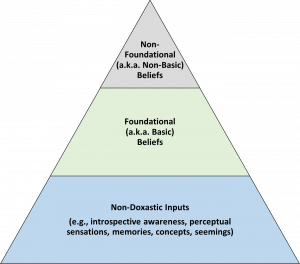
Our focus is on that middle layer: the foundational beliefs. What grants a belief entry into this privileged category?
The Classical Foundationalist's Strict Criteria
Historically, foundationalists like René Descartes set a very high bar. This "classical" or "strong" foundationalism insisted that foundational beliefs must be absolutely certain. If the foundation has any cracks, the whole building could collapse.
To understand these strict criteria, let's turn to a lecture that defines them clearly.
Is Belief in God Basic? pt 2 Plantinga's Critique of Foundationalism
In this segment from a lecture by Professor Matt McCormick, he outlines the traditional criteria for a belief to be considered 'properly basic' according to classical foundationalism.
Please watch the segment from 6:45 to 10:19. Focus on the three specific conditions a belief must meet to be considered properly basic, and the examples given for each.
As Professor McCormick explains, according to classical foundationalism, a belief is properly basic if and only if it is:
- Self-evident: True by definition, graspable just by understanding the proposition (e.g., "Bachelors are unmarried," "A=A").
- Incorrigible: Impossible for you to be mistaken about. You cannot be corrected on it (e.g., "I exist," "I am in pain").
- Evident to the senses: A report of an immediate sensory experience.
Let's now explore these candidates for properly basic beliefs in a bit more detail.
Foundationalism - Epistemology Video 8
The video 'Foundationalism' by Victor Gijsbers offers a great discussion on the two main classes of beliefs proposed as foundational by classical foundationalists.
First, watch from 3:53 to 9:55, which covers self-evident truths like Descartes' Cogito, mathematical truths, and logical laws. Then, skip ahead and watch from 15:19 to 18:51. This part is particularly interesting. It explains how a classical foundationalist has to frame perceptual beliefs to make them incorrigible—not 'I see a table,' but 'I am having a brown, rectangular sense impression.' This move is crucial for meeting the strict criteria.
The key takeaway here is that classical foundationalism is extremely restrictive. To ensure the foundation is infallible, it allows only beliefs about which we supposedly cannot be wrong. The problem, as Gijsbers notes, is that this foundation is so narrow it's difficult to see how you could build our vast knowledge of the external world on top of it. If your foundation only includes "A=A" and "I seem to be seeing blueness," it's a long, difficult road to justifying a belief like "My friend is wearing a blue coat."
Test your understanding!
Consider the belief "The sun is a star." According to a classical foundationalist, would this belief be considered properly basic? Why or why not?
Show answer
No, it would not be properly basic. It fails all three classical criteria:
- It is not self-evident; its truth isn't known just by understanding the words.
- It is not incorrigible; you could be mistaken (e.g., if you were part of a massive deception or simulation).
- It is not evident to the senses; you don't directly perceive it being a star in the same way you perceive a color. It's a scientific fact you learned through inference and testimony.
For a foundationalist, this belief would be a non-basic belief, part of the superstructure, justified by many other beliefs about physics, astronomy, and the reliability of scientific sources.
Broadening the Foundation: Modest Foundationalism
The strictness of classical foundationalism led many contemporary philosophers to propose a more "modest" or "weak" foundationalism. They argue that we are justified in holding many beliefs in a basic way, even if they aren't infallible.
Think about it: do you need to prove that the world outside your mind exists? Or that other people have minds? Or that your memory is generally reliable? Most of us take these for granted. Modest foundationalists suggest that we are right to do so—that these are also properly basic beliefs.
Let's read a short text from theologian Ronald Nash that explores this idea, drawing on the work of 18th-century philosopher Thomas Reid. It gives excellent examples of beliefs we hold without proof.
Please read the section that begins, 'Let me approach this from a somewhat different position.' and ends '...without the ability to prove them.' Focus on the three key examples given: belief in an external world, belief in other minds, and belief in the reliability of memory.
This view proposes that humans are simply constituted to form these beliefs under normal circumstances. Seeing a tree triggers the belief "there is a tree." Remembering breakfast triggers the belief "I ate breakfast." These beliefs are considered "innocent until proven guilty." They are properly basic, but they are also defeasible—meaning, they can be defeated or overturned if strong counter-evidence comes along.
A Modern Application: Belief in God as Properly Basic
This move to broaden the category of properly basic beliefs has had its most significant impact in religious epistemology, a topic you expressed a particular interest in. The philosopher Alvin Plantinga is the central figure here. He developed a position known as Reformed Epistemology.
Plantinga argues that if beliefs about trees, memories, and other minds can be properly basic, why not belief in God?
“Properly Basic” Belief in God: Believing in God Without An ...
This short article from '1000-Word Philosophy' provides a concise introduction to Plantinga's idea that belief in God can be 'properly basic.'
Please read the first three sections (up to '3. Objections'). Note how the author clarifies that 'basic' means not inferred from other beliefs, and 'properly' means it is rational to hold it. The key move is comparing it to ordinary perceptual beliefs.
The core idea is that certain experiences—seeing a starry night, experiencing the beauty of a mountain range, holding a newborn child—can directly trigger a belief in God, without any logical argument or inference. For the person having the experience, the belief "God created this" or "God is present" can be basic in the same way that seeing a chair triggers the basic belief "there is a chair."
Let's return to Professor McCormick's video to see exactly how this expansion of 'properly basic' works.
Is Belief in God Basic? pt 2 Plantinga's Critique of Foundationalism
This segment explains Plantinga's revised, 'neo-foundationalism,' which allows defeasible (revisable) beliefs into the foundation.
Please watch from 15:16 to 18:08. Pay close attention to the new types of beliefs allowed into the foundation ('I see a tree,' 'that person is angry') and the key property they have: they are immediate and non-inferential, but also defeasible.
This is the crucial distinction:
- Classical Foundationalism: Basic beliefs must be infallible.
- Plantinga's Foundationalism: Basic beliefs can be fallible and defeasible.
For Plantinga, the belief "I see a tree" is properly basic. But if you get closer and realize it's a very convincing movie prop, you have a "defeater" for that belief, and you must give it up. Similarly, he argues that an experience of God's presence can make belief in God properly basic, but that belief could, in principle, be defeated by other evidence.
Following the Protestant reformer John Calvin, Plantinga suggests humans might have a sensus divinitatis, or a "sense of the divine," a natural faculty that produces belief in God in appropriate circumstances.
The text by Ronald Nash, which we looked at earlier, also explains this concept quite well, explicitly linking it to Plantinga's work.
Please read the section that begins, 'He says, among the many dispositions...' and ends '...what many will see as a new twist to some old arguments for God's existence.' This directly connects the idea of innate dispositions to the 'sense of deity' that grounds basic belief in God.
This framework provides a way for a religious believer to claim their belief is rational and justified without needing to provide philosophical proofs for God's existence. The justification comes directly from experience, placing it in the foundation of their belief system.
Conclusion
Today we have examined the crucial concept of "properly basic beliefs." We saw that what gets to count as foundational is a major point of division among foundationalists.
Key Takeaways:
- Properly basic beliefs are the non-inferential beliefs that form the justified foundation of a belief system.
- Classical foundationalists enforce strict criteria: a belief must be self-evident, incorrigible, or a direct report of sense-data to be properly basic. This creates a secure but very narrow foundation.
- Modest or contemporary foundationalists broaden the criteria to include fallible, defeasible beliefs, such as those from perception ("I see a tree"), memory ("I had breakfast"), and testimony.
- Reformed Epistemology (most famously Alvin Plantinga) applies this broader view to religious belief, arguing that belief in God can be properly basic, triggered by experiences via a sensus divinitatis.
Preview of the Next Lesson:
Foundationalism, with its pyramid-like structure, is a very intuitive model. But it's not the only one. What if justification doesn't work like a pyramid at all? In our next lesson, we will explore coherentism, a fascinating alternative that rejects the need for foundations altogether. Coherentism proposes that beliefs are justified by being part of a mutually supporting web, like a raft where every plank helps keep the others afloat.