Introduction
Welcome to our final lesson in the module on Social Epistemology. In our previous session, we focused on how we, as novices, can rationally evaluate the claims of individual experts. We saw that our knowledge often depends on "vulnerable reliance"—a foundational trust in others.
Today, we will scale up from the individual to the collective. We'll explore how beliefs—both true knowledge and harmful misinformation—travel through the vast social and testimony networks that connect us. You'll learn to distinguish between different kinds of informational environments, such as "epistemic bubbles" and "echo chambers," and understand the underlying mechanics that can either lead a community toward truth or trap it in falsehood. This is a critical topic for navigating our modern, hyper-connected world.
Part 1: How Beliefs Travel Through a Network
Most of what we know comes to us through testimony, passed from person to person. Social epistemologists model this flow of information using networks, where people (nodes) are connected by social ties (links). These models help us visualize and understand how beliefs spread.
The simplest model treats belief spread like a virus—an idea infects one person and spreads to their connections. However, a more sophisticated approach, known as the network epistemology framework, treats individuals as rational agents who update their beliefs based on evidence from their neighbors.
Social Epistemology - Stanford Encyclopedia of Philosophy
To understand this more powerful framework, let's read a section from the Stanford Encyclopedia of Philosophy's entry on Social Epistemology. It explains how these models work and reveals a surprising insight about how network structure affects a community's search for truth.
Please read the section titled '4.3 Network Epistemology Models'. Start from the paragraph beginning 'In these diffusion/contagion models...' and read until the end of the paragraph discussing the 'independence thesis' (ending with '...constitute irrational groups'). Pay close attention to the description of the 'Zollman effect'.
As you read, the key takeaway is that the structure of our social connections profoundly impacts our collective knowledge. The "Zollman effect" is a fascinating example: sometimes, a less connected community is more likely to find the truth because it prevents a single piece of misleading early evidence from spreading too quickly and causing everyone to settle on the wrong conclusion prematurely. This shows that when it comes to social networks, more communication isn't always better.

Part 2: When Networks Go Wrong: Bubbles and Echo Chambers
While network structure can passively hinder the search for truth, some structures are more actively pernicious. They don't just slow down the spread of good information; they systematically promote and protect falsehoods. Philosopher C. Thi Nguyen has drawn a crucial distinction between two such structures: epistemic bubbles and echo chambers.
Understanding this distinction is one of the most powerful tools for analyzing our modern information landscape.
Epistemic Bubbles: Exclusion by Omission
An epistemic bubble is an information network where you simply don't hear from people on the other side of an issue. It's a network that has inadequate coverage because certain voices have been omitted.
C. Thi Nguyen - Echo Chambers and Epistemic Bubbles
Let's watch a video by philosopher Victor Gijsbers that clearly explains C. Thi Nguyen's concept of an epistemic bubble.
Please watch from 02:01 to 09:06. Focus on the definition of an epistemic bubble as a social structure with 'inadequate coverage through a process of exclusion by omission'.
As the video explains, you can get into an epistemic bubble by curating your social media feed to only include friends who agree with you, or through algorithmic filtering that shows you more of what it thinks you want to see. The key feature of a bubble is its fragility: it tends to pop as soon as you are exposed to the information and arguments you were missing.
Echo Chambers: Exclusion by Discrediting
Echo chambers are far more robust and dangerous. An echo chamber is a social structure that actively works to make you distrust sources from outside the group. It isn't just about missing information; it's about manipulating trust.
C. Thi Nguyen - Echo Chambers and Epistemic Bubbles
Now, let's see how Nguyen defines an echo chamber and why it's so different from a bubble.
Please continue watching the same video from 09:06 to 15:49. Pay close attention to the four-part definition of an echo chamber and the concept of a 'disagreement reinforcement mechanism'.
The core mechanism of an echo chamber is that it isolates its members not by omitting outside sources, but by systematically discrediting them. The chamber tells its members, "Don't trust the mainstream media," or "Those scientists are part of a conspiracy."
This leads to the "disagreement reinforcement mechanism": when a member of an echo chamber encounters evidence that contradicts their beliefs, it doesn't challenge them. Instead, it confirms their belief that outsiders are untrustworthy and malicious, thereby strengthening their adherence to the chamber's views. This is why simply presenting facts and evidence often fails to persuade someone inside an echo chamber. Their entire epistemic framework has been rewired to reject that evidence from the outset.
Test your understanding!
A person gets all their news from a single cable news channel that aligns with their political views. They rarely encounter opposing arguments. Another person is part of an online community that claims all mainstream climate science is a hoax perpetrated by a global cabal; they are told that any scientist who disagrees is part of the conspiracy.
Which person is in an epistemic bubble, and which is in an echo chamber? Why?
Show answer
The first person is likely in an epistemic bubble. They are isolated from opposing views by omission—their information diet simply lacks them. If they were to encounter well-reasoned opposing arguments, their bubble might pop.
The second person is in an echo chamber. The community doesn't just omit outside information; it actively discredits it by attributing it to a conspiracy. Encountering mainstream scientific consensus would likely reinforce their belief in the hoax, demonstrating the "disagreement reinforcement mechanism."
Part 3: The Active Audience and Misinformation
The concepts of bubbles and chambers show how network structures can shape belief. However, we should also avoid a simplistic model where misinformation is a "magic bullet" that automatically infects anyone it hits. Your background in marketing and communication will give you an appreciation for the "active audience" theory, which recognizes that people interpret and react to messages in diverse ways.
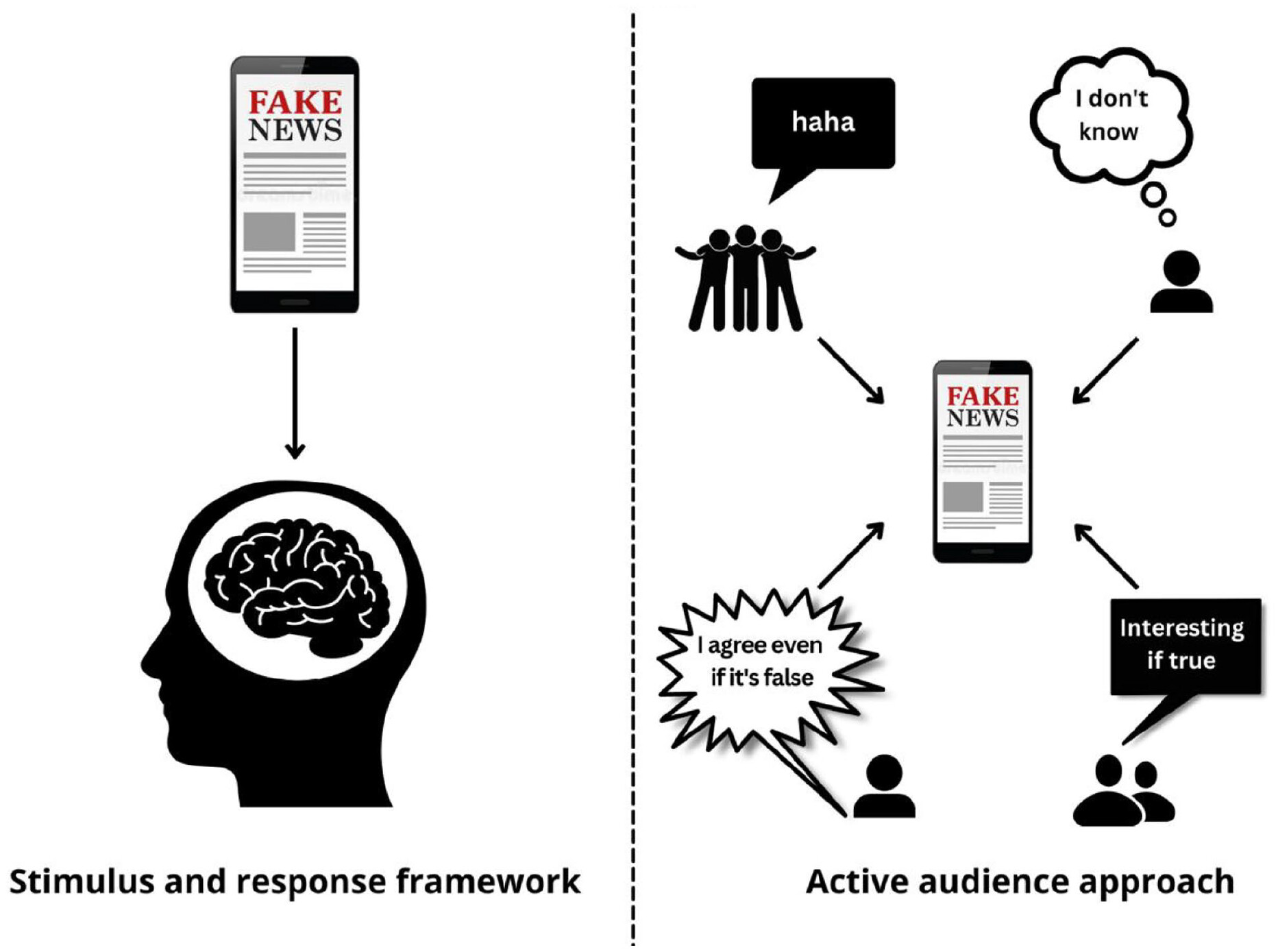
This complexity doesn't change the fact that misinformation is a serious problem, especially online. The speed and scale of social media networks have created new challenges for our collective ability to distinguish truth from falsehood.
Social Epistemology - Stanford Encyclopedia of Philosophy
Let's return one last time to the Stanford Encyclopedia of Philosophy to read about the specific challenges posed by online misinformation.
Please read the short section titled '5.2 Misinformation on the Internet'.
The fight against misinformation is an ongoing "arms race." As platforms develop tools to fight it, those who wish to spread disinformation develop new tactics. This underscores the importance of being critical consumers of information and understanding the social dynamics that can make us vulnerable.
Conclusion
Our journey through social epistemology has shown that knowing is a fundamentally collective enterprise. We depend on each other, and the structure of that dependence—our social networks—has a powerful effect on what we come to believe.
Key Takeaways:
- Beliefs spread through social networks via testimony. The structure of these networks can help or hinder a community's search for truth.
- An epistemic bubble is an information network where you are isolated from opposing views by omission. They are fragile and can be popped by new information.
- An echo chamber is a more robust structure that isolates members by actively discrediting outside sources. They manipulate trust and can be strengthened by disagreement.
- Understanding these dynamics is essential for making sense of contemporary phenomena like political polarization and the spread of online misinformation.
Preview of the Next Module:
This concludes our module on social epistemology. We have explored how knowledge is shaped by testimony, experts, and community structures. These themes are deeply relevant to your interest in theology. In fact, many religious traditions can be seen as powerful testimony networks. Philosophers in the field of religious epistemology explicitly study these connections, with topics like "Religious Belief and the Epistemology of Testimony" being a focus of active research.
In our next module, Religious Epistemology, we will dive directly into these questions. We will begin by looking at a deeply personal source of belief—religious experience—and then explore how it interacts with the social dimensions of faith, such as community, revelation, and testimony, which we have just been discussing.