Hello! Welcome to the first lecture in our module on the Challenge of Skepticism.
Introduction
In our previous discussions, we explored various theories of justification—foundationalism, coherentism, reliabilism—all of which operate on the assumption that knowledge is, at least in principle, attainable. Today, we confront the philosophical position that throws this fundamental assumption into question: skepticism.
You've mentioned having a decent understanding of skepticism, which is a great starting point. Our goal today is not just to understand the general idea of doubting things, but to precisely outline the logical structure of a classic global skeptical argument. These are powerful thought experiments designed to show that we might not know anything about the external world at all. By dissecting their structure, you'll gain a deeper appreciation for the profound challenge they pose to epistemology.
From Everyday Doubts to Radical Skepticism
We all practice a healthy, everyday form of skepticism. You might doubt a politician's promise or a "too good to be true" advertisement. The 17th-century philosopher René Descartes took this process of doubting to its logical extreme. His goal was to find a belief so certain it could not possibly be doubted, and to use it as a foundation for all knowledge.
To do this, he adopted a "method of doubt," deciding to systematically discard any belief that could be false. To see how this method escalates from simple doubts to a radical, all-encompassing skepticism, let's watch a segment from Crash Course Philosophy.
Cartesian Skepticism - Neo, Meet Rene: Crash Course Philosophy #5
This video, "Cartesian Skepticism - Neo, Meet Rene," introduces Descartes' project. It starts with his famous analogy of inspecting a basket of apples for rot and moves through his increasingly powerful reasons for doubt.
Please watch from 01:46 to 04:54. As you watch, pay close attention to the three stages of doubt: The unreliability of our senses. The dream argument (how can you be sure you're not dreaming?) The distinction between 'local doubts' and 'global doubt.'
As the video explains, Descartes moves from local doubts (e.g., my senses might be mistaken in this particular instance, but I can check) to a much more profound global doubt. The dream argument is a powerful step in this direction: if you can't be 100% certain you aren't dreaming right now, how can you trust any of your current beliefs about the world around you?
But Descartes realized that even in a dream, some truths, like mathematical truths (e.g., ), seem to hold. To challenge even these, he devised the ultimate skeptical scenario.
The Ultimate Skeptical Scenarios: The Evil Demon and The Brain in a Vat
To achieve a state of total doubt, Descartes imagined a hypothesis so powerful it could undermine all of his beliefs about reality. This is the classic "Evil Demon" argument. More recently, philosophers have updated this idea with a science-fiction twist: the "Brain in a Vat" scenario.
These two scenarios serve the exact same purpose in the argument. Let's get a clear definition of them from our course text.
7.4 Skepticism - Introduction to Philosophy
The following sections from the OpenStax "Introduction to Philosophy" text clearly describe Descartes's Evil Demon argument and its modern counterpart, the Brain in a Vat.
Please read the two sections titled "The Evil Demon Argument" and "Putnam’s Brain in a Vat." Focus on what makes these scenarios so powerful: the idea that your experiences would be indistinguishable from reality.
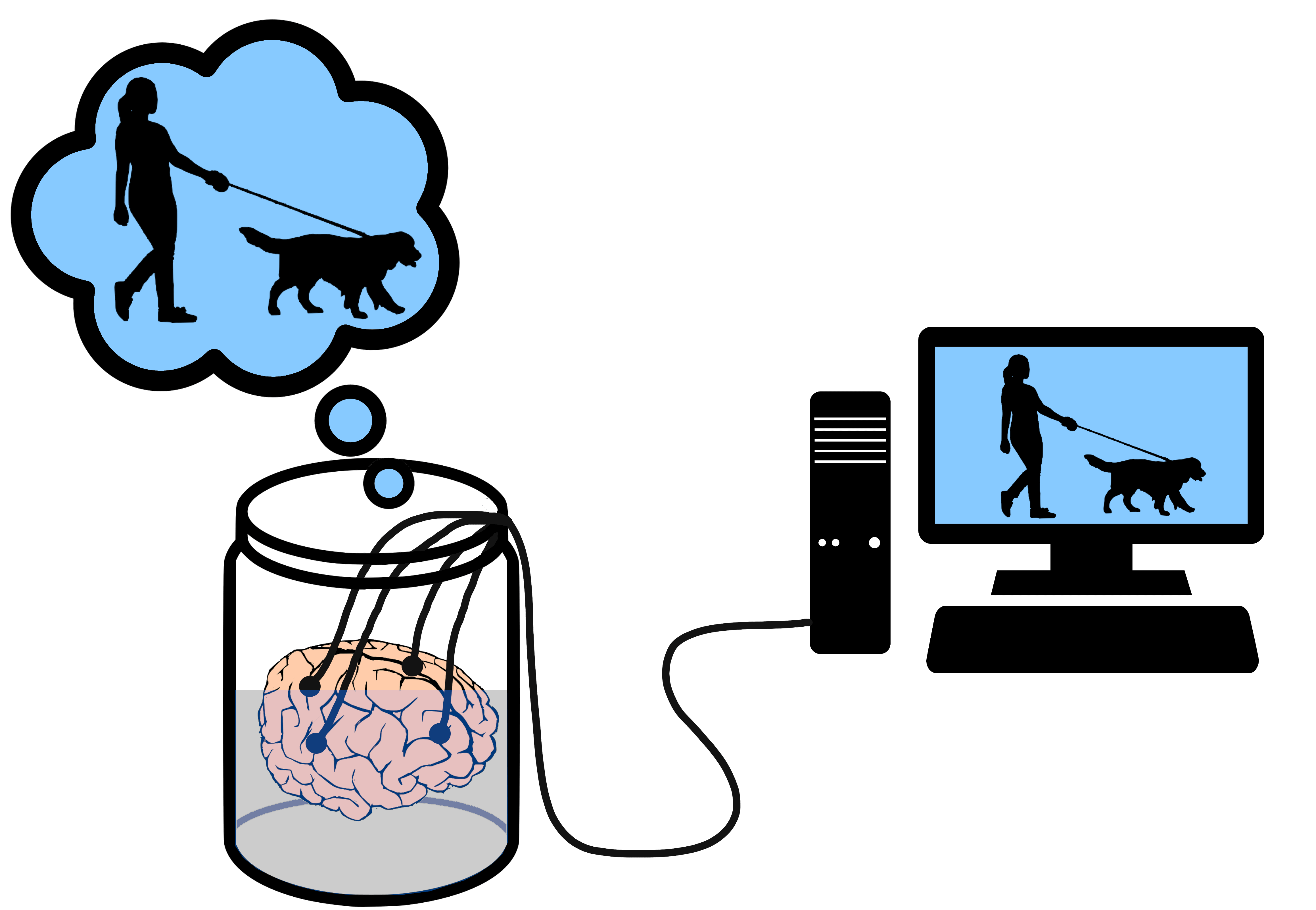
The key to both the Evil Demon and the Brain in a Vat (BIV) is that they posit a world where your subjective experience is completely disconnected from reality, yet you have no way of knowing it from the "inside."
Given your background in visual design, this illustration might help solidify the BIV concept.
The Formal Structure of a Global Skeptical Argument
Now we can get to the heart of today's learning outcome: outlining the formal structure of these arguments. Whether using an Evil Demon or a Brain in a Vat, the logical steps are the same.
Let's use the Brain in a Vat (BIV) as our skeptical hypothesis.
Let p stand for any common-sense belief you have about the external world. For example:
- p = "I have hands."
The skeptical argument then proceeds in three steps:
- Premise 1: If I know that I have hands, then I know that I am not a brain in a vat.
- Premise 2: I do not know that I am not a brain in a vat.
- Conclusion: Therefore, I do not know that I have hands.
This is a logically valid argument. If the two premises are true, the conclusion must also be true. The power of the argument comes from how convincing the premises are.
-
Why is Premise 1 convincing? It seems obvious. The state of "having hands" and the state of "being a handless brain in a vat" are mutually exclusive. If you truly know the first is true, you must also know the second is false. This relies on a widely accepted idea in epistemology called the closure principle: if you know something, and you know it entails something else, then you also know that something else.
-
Why is Premise 2 convincing? This is the core of the skeptical challenge. By design, the BIV scenario makes it impossible to find any evidence that would prove you are not in it. Any test you could perform, any evidence you could look for, would be perfectly simulated by the supercomputer. Since you cannot gather evidence to rule out the BIV hypothesis, the skeptic argues, you cannot know that it's false.
Since the argument works for "I have hands," it also works for "I am reading a lesson," "I live in a house," and any other belief about the external world. This is why it's called global skepticism.
Test your understanding!
Try to formulate the skeptical argument using the Evil Demon hypothesis and the belief "The sky is blue."
Show answer
Let p = "The sky is blue."
Let the skeptical hypothesis (SH) = "An evil demon is deceiving me into thinking the sky is blue."
- Premise 1: If I know that the sky is blue, then I know that an evil demon is not deceiving me.
- Premise 2: I do not know that an evil demon is not deceiving me.
- Conclusion: Therefore, I do not know that the sky is blue.
Conclusion
Today we have dissected the anatomy of one of the most powerful and enduring challenges in philosophy. We've seen how global skeptical arguments work by introducing an unfalsifiable hypothesis that severs the connection between our beliefs and the world.
Key Takeaways:
- Global skepticism questions our ability to know anything about the external world.
- Classic skeptical arguments, from Descartes's Evil Demon to the modern Brain in a Vat, posit a scenario where our experiences are systematically deceptive but internally indistinguishable from reality.
- The formal structure of the argument is: (1) If I know p, I must know I'm not in the skeptical scenario; (2) I can't know I'm not in the skeptical scenario; (3) Therefore, I don't know p.
This raises a crucial question: If the argument is logically valid and its premises seem true, does that mean we really don't know anything? Are we forced to accept skepticism?
Preview of the Next Lesson:
Thankfully, philosophers have not taken this challenge lying down. In our next lesson, we will begin exploring the major philosophical responses to skepticism. We'll start with an ingenious approach called contextualism, which argues that the meaning of the word "know" changes depending on the context, offering a way to disarm the skeptic's powerful argument.