Hello! In our last lesson, we established the fundamental process of cryptography, defining the roles of encryption, decryption, and the all-important key. We ended by questioning a common point of confusion: the difference between a "code" and a "cipher." While these terms are often used interchangeably in spy novels and movies, they represent two distinct strategies for concealing information.
Today, we will clarify that distinction. Understanding the difference between a code and a cipher is crucial because it reveals two fundamentally different ways of thinking about secret communication. This distinction shaped cryptographic history and helps explain why modern systems evolved the way they did.
Two Paths to Secrecy
Imagine you are a spy during the Renaissance and need to send a secret message to an ally. You have two primary methods at your disposal.
- You could create a secret dictionary that you and your ally share, where each sensitive word or phrase is replaced by a pre-arranged substitute.
- You could devise a clever system for scrambling the individual letters of your message according to a secret rule.
These two approaches represent the core difference between codes and ciphers.
The Code: A Dictionary of Secrets
A code is a system that replaces entire words or phrases with other words, numbers, or symbols. The key to a code is a codebook—essentially a secret dictionary shared between the sender and receiver.
Think of it as a large-scale lookup table. To encode a message, you look up each word or phrase in the codebook and write down its corresponding codeword. To decode, the recipient performs the process in reverse.
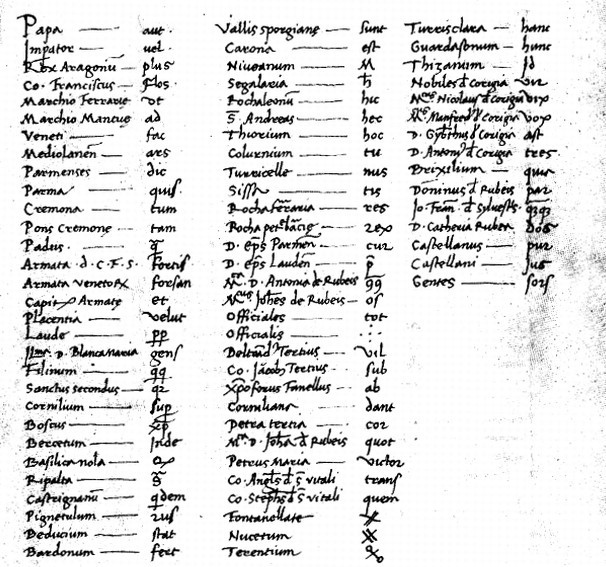
The core principle is substitution at the level of meaning. For a clear definition and example, let's turn to a short reading.
Codes and Ciphers - Crypto Corner
This article from Crypto Corner provides a concise and direct explanation of the difference between codes and ciphers.
Read the first two paragraphs, from the beginning down to the end of the section on codes. Pay attention to the example given ("Burn the City" becomes "Take the rubbish") and the pros and cons of using a codebook.
As the article notes, a major advantage of codes is that they can be used to create messages that appear completely innocent. However, they have significant drawbacks:
- Cumbersome: Codebooks must be very large to be useful, making them difficult to create, distribute, and use.
- Inflexible: If a word isn't in the codebook, you can't encode it.
- Catastrophic if compromised: If the enemy captures the codebook, your entire system is broken, and all past and future messages are compromised.
The Cipher: An Algorithmic Scramble
A cipher, on the other hand, doesn't care about the meaning of words. It works at a lower level, on individual letters or small groups of letters. A cipher uses an algorithm—a specific, repeatable process—to transform the plaintext into ciphertext.
The Caesar cipher we've discussed is a perfect example. The algorithm is "shift each letter forward in the alphabet," and the key is the number of positions to shift. From your background as an analytics engineer, you can think of a cipher as a function f(character, key) that outputs a transformed character.

A cipher scrambles the form of the message, not its underlying words. The result is typically a string of gibberish, which immediately signals that the message is encrypted.
To hear this distinction explained, let's watch a brief video segment.
Secret Codes: A History of Cryptography (Part 1)
This clip from "Secret Codes: A History of Cryptography" clearly articulates the difference and introduces a fascinating historical hybrid.
Watch the section from "in cryptography codes and ciphers". The narrator gives a very succinct summary of the difference and then introduces the concept of a "nomenclature."
Comparing the Two Approaches
Let's summarize the key differences in a table:
| Feature | Code | Cipher |
|---|---|---|
| Unit of Operation | Words or phrases (units of meaning) | Letters or blocks of letters (units of text) |
| Method | A lookup in a shared codebook | An algorithm and a (usually small) key |
| Resulting Message | Can be made to look like an innocent message | Usually an obvious jumble of letters/symbols |
| Flexibility | Limited to the contents of the codebook | Can encrypt any message, as long as the characters are in its alphabet |
As the video mentioned, historical cryptographers often used a hybrid system called a nomenclator. This was primarily a cipher for encrypting most of the message letter-by-letter, but it also included a small codebook for substituting common or important words, like the names of generals or locations. The Milanese codebook pictured earlier is actually a nomenclator, containing both codewords for important people and substitutions for individual letters and syllables.
Conclusion
Today we've drawn a clear line between two fundamental concepts in secret communication. Though often confused in popular language, you now know the specific, technical difference.
Here are the key takeaways:
- Codes operate on words or phrases, substituting them based on a codebook. They change the meaning unit by unit.
- Ciphers operate on individual letters, substituting or rearranging them based on an algorithm and a key. They scramble the text itself.
- Most of what we will study going forward are ciphers, as their flexibility and mathematical nature form the foundation of all modern cryptography.
Now that we know what a cipher is, our next step is to understand the two primary ways a cipher can work. In our next lesson, we will explore the fundamental families of ciphers: substitution ciphers, which replace letters, and transposition ciphers, which rearrange them.