Welcome back! In our last session, we drew a clear line between codes, which substitute meaning, and ciphers, which manipulate the letters of a message itself. We concluded that ciphers, with their algorithmic nature, are the foundation of modern cryptography. Now, we'll take the next logical step.
This lesson explores the two fundamental categories that nearly all classical ciphers fall into: substitution and transposition. Think of these as the two primary moves a cryptographer can make: either swapping out the pieces or shuffling their order. By comparing these two core concepts, you'll gain a foundational understanding that will allow you to identify and analyze the historical ciphers we'll encounter throughout the rest of the course.
The First Move: Substitution
The most intuitive way to obscure a message is to replace its letters with something else. This is the essence of a substitution cipher. In this type of cipher, each letter of the plaintext is swapped for a corresponding letter, number, or symbol in the ciphertext. The key principle is that the identity of the characters changes, but their position in the message remains the same.
The Caesar cipher we've mentioned is a perfect example. The letter 'A' is replaced by 'D', 'B' by 'E', and so on. The 'A' in the first word of a message is treated exactly the same as an 'A' in the last word.

To solidify this concept, let's turn to a brief, clear explanation.
An Introduction to Cryptography – CryptoKait
This article from the blog CryptoKait gives a very clear, high-level overview of the two cipher families.
Please read the two short paragraphs under the heading "Historical Cryptography". The author provides a great analogy for transposition that we'll come back to in a moment.
The Second Move: Transposition
If you don't swap the letters, what else can you do? You can shuffle them. This is the logic behind a transposition cipher. Instead of changing the letters themselves, you change their order. All the original letters of the plaintext are present in the ciphertext, just in a scrambled sequence. The identity of the characters remains the same, but their position changes.
As the CryptoKait article mentioned, this is like a slider puzzle: you have all the same tiles, but you've moved them all around. A common method for this is to write the message into a grid and then read it out in a different order.
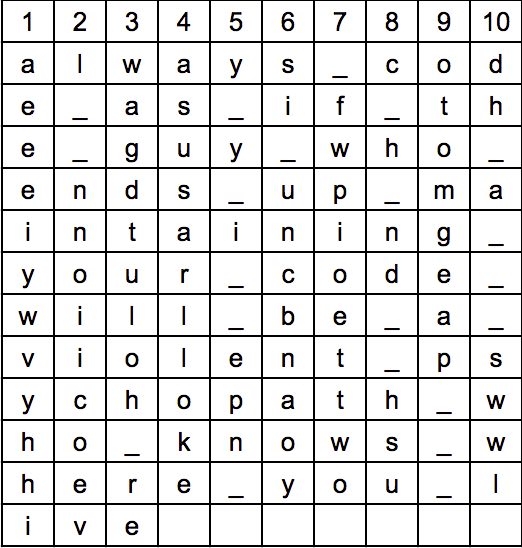
To see how these two techniques are formally defined and contrasted, let's consult a more technical resource.
Difference between Substitution Cipher Technique and ...
This article from GeeksforGeeks provides precise definitions for both cipher types.
First, read the short paragraph under the heading "What is the Substitution...". Then, read the paragraph under "What is the Transposition...".
The Core Contrast: Identity vs. Position
You now have the fundamental distinction:
- Substitution: Changes character identity.
- Transposition: Changes character position.
This difference has a critical consequence that speaks directly to your background in analytics. When you analyze data, you often look for patterns and frequency distributions. Let's apply that thinking here.
Imagine you have a long ciphertext.
-
If it was encrypted with a transposition cipher, all the original letters are still there, just shuffled. If you were to count the frequency of each letter in the ciphertext, you would find the normal distribution for the English language: 'E' would be the most common, followed by 'T', 'A', 'O', and so on. This is a massive clue that you're dealing with a transposition.
-
If it was encrypted with a simple substitution cipher, the letters themselves have changed. If 'E' was replaced with 'X', you would find that 'X' is now the most frequent letter in the ciphertext. The distribution pattern is preserved, but it's mapped to different characters. This tells you it's a substitution cipher and gives you a powerful starting point for breaking it, a technique called frequency analysis which we will master in a future module.
For a comprehensive side-by-side comparison, please review the table in the GeeksforGeeks article.
Difference between Substitution Cipher Technique and ...
This table neatly summarizes the key differences between the two techniques.
Focus on the entire table under the heading "Difference Between". Pay special attention to the rows discussing how character identity and position are changed, and how they relate to frequency analysis.
If you prefer a spoken explanation, the following video segment offers a concise summary of the same concepts.
Classical Encryption Techniques
This clip from Neso Academy clearly articulates the difference between the two techniques.
Watch the segment from the comparison, where the instructor explicitly contrasts what happens to the characters in each type of cipher.
Conclusion
Today, we've broken down the world of classical ciphers into its two most fundamental building blocks. Understanding this distinction isn't just academic; it's the first step a cryptanalyst takes when confronting an unknown encrypted message. By analyzing the ciphertext's properties, they can deduce the type of cipher used, which is essential for mounting a successful attack.
Here are the key takeaways:
- Substitution Ciphers replace plaintext letters with other letters or symbols, changing their identity but not their position.
- Transposition Ciphers rearrange the plaintext letters, changing their position but not their identity.
- This core difference leaves a statistical fingerprint: transposition ciphers retain the original language's letter frequencies, while substitution ciphers transfer those frequencies to different symbols.
In our next module, "Classical Ciphers in Practice," we will move from theory to application. You'll get to use your first pen-and-paper ciphers, starting with an ancient transposition cipher, the Scytale, before moving on to one of history's most famous substitution ciphers, the Caesar cipher.