In our last lesson, we established a foundational understanding of cryptography—the art of hiding the meaning of a message. We journeyed from ancient military tactics to the dawn of the computer age, seeing how scrambled messages have shaped history. Today, we'll explore a different, yet equally clever, method of secret communication: steganography.
Imagine you have a secret you want to protect. You could write it in a diary and lock it (cryptography), or you could write it on a piece of paper and hide the diary itself under a loose floorboard (steganography). In this lesson, we will focus on this second approach. Our goal is to clearly distinguish between hiding a message in plain sight and scrambling it, using fascinating examples from both ancient history and the modern digital world.
The Art of the Hidden Message
While cryptography makes a message unreadable, steganography hides the very existence of the message. The goal is for an observer to see nothing suspicious at all. An innocuous-looking letter, image, or even a piece of music might contain a secret that is completely invisible to the uninformed.
Let's begin with a couple of short video clips that crisply define this core difference.
Secret Codes: A History of Cryptography (Part 1)
First, let's revisit the video "Secret Codes: A History of Cryptography" from our previous lesson. The introduction offers a perfect, concise distinction between the two concepts.
Watch the opening segment from the beginning until the definition of cryptography. Pay attention to how it frames steganography as "covered writing" and cryptography as a solution to its main weakness.
Secrets Hidden in Images (Steganography) - Computerphile
Now, let's watch the beginning of a Computerphile video dedicated to steganography. It uses a simple analogy to make the distinction crystal clear.
Watch from the start until the secret message is uncovered. The comparison to invisible ink is a classic and effective way to think about steganography.
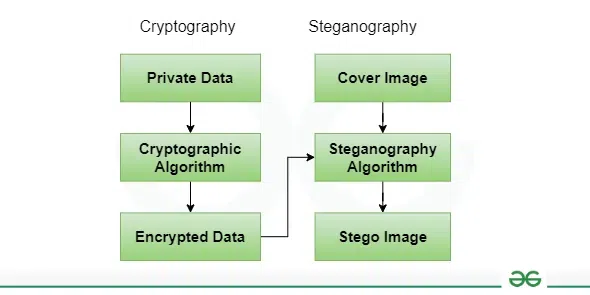
To summarize this fundamental difference, look at the following diagram. It illustrates how cryptography and steganography are two distinct processes that can even be used together for layered security.
Hiding Messages Through History
The need to hide the existence of a message is as old as the need to scramble one. History is filled with ingenious, low-tech methods for achieving this. The image below provides a fantastic visual timeline of these techniques.
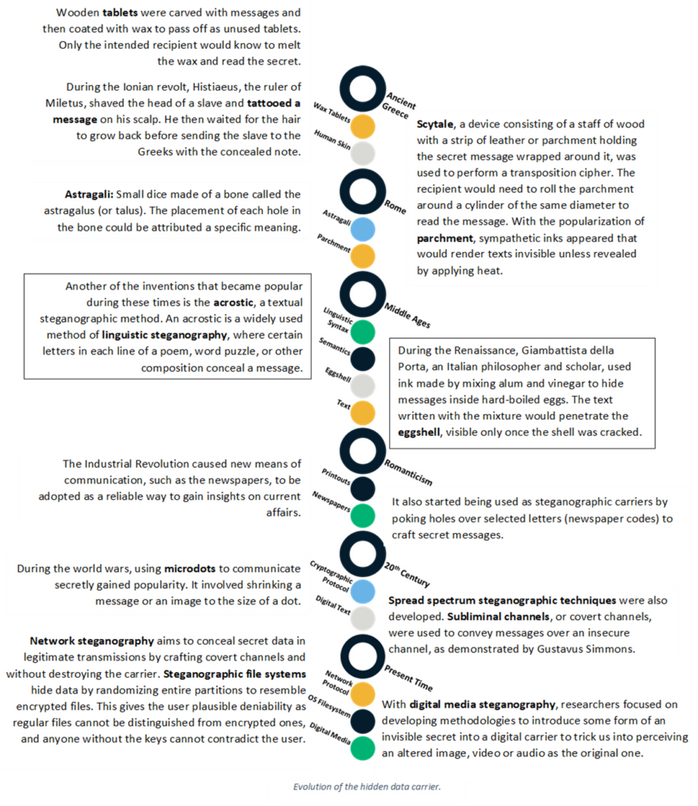
To explore some of these stories, let's turn to an article that details the origins of steganography.
What is steganography and how does it differ from cryptography?
This article from Comparitech provides some of the most famous historical accounts of steganography.
First, read the simple definition under the heading "What is steganography?". Then, continue to the next section, "The history of steganography," and read about the inventive methods described by the Greek historian Herodotus, such as the tattooed messenger and the hidden message on a wax tablet. Also, note the mention of early invisible inks.
These stories highlight the creativity involved in steganography. The goal was always the same: to ensure the message passed through enemy hands without arousing any suspicion.
The Decisive Factor: Your Threat Model
So, when would you choose to scramble a message versus hide it entirely? The answer depends on your "threat model"—what you are trying to protect and from whom.
Let's explore two scenarios that make this choice clear.
What is steganography and how does it differ from cryptography?
The same Comparitech article provides excellent, clear examples of when each method is appropriate.
Read the entire section under the heading "Steganography vs cryptography". Focus on the two contrasting examples: the imprisoned political activist and the diplomat.
As the article explains:
- The Political Activist must use steganography. If they sent an obviously encrypted message (ciphertext), the guards would know they were attempting secret communication, leading to severe consequences. The mere act of communicating is what needs to be hidden.
- The Diplomat should use cryptography. It is perfectly normal for a diplomat to communicate with their home country. An encrypted channel raises no alarms. Here, the content is what must be protected, not the fact of communication.
This distinction is the most important takeaway. Cryptography protects content; steganography conceals communication itself.
Digital Steganography: Hiding in Plain Sight
In the digital age, steganography has evolved from wax tablets to pixels and sound waves. The principle is the same, but the "cover medium" is now a digital file. An image, video, or audio file can be subtly altered to embed a secret message in a way that is imperceptible to the human eye or ear.
Since your work involves data analytics, you might find the mechanism behind this particularly interesting. It’s a clever use of how digital information is stored.
Secrets Hidden in Images (Steganography) - Computerphile
Let's return to the Computerphile video to see how this works in practice. This segment explains the most common and basic form of digital image steganography.
Watch the section that explains Least Significant Bit (LSB) steganography. The presenter does a great job of explaining how changing the least important bits of the color data for each pixel has a negligible effect on the visual appearance of the image, yet allows for a large amount of data to be hidden.
The core idea is that small changes to the vast amount of data in a high-resolution image are statistically insignificant to a human observer, but can be systematically assembled back into a message by a computer program that knows where to look.
Modern applications of this include digital watermarking, where a faint, invisible copyright notice is embedded in an image or video to trace its origin.
Case Study: The Cicada 3301 Mystery
To see how these two fields—cryptography and steganography—interact in the real world, we can look at one of the internet's most famous and elaborate puzzles: Cicada 3301. This mysterious online scavenger hunt, which appeared in 2012, looked for "highly intelligent individuals" by presenting a series of challenges that required expertise in both codebreaking and steganography. It's a perfect example from the world of online mysteries.
Unsolved Mystery: Cicada 3301 Cypher | 60out
This blog post gives a good overview of the puzzle and highlights the different techniques used.
First, read the section "The Beginning: The First Cicada 3301 Puzzle" to understand how the puzzle began. Note how the very first step involved recognizing and solving a steganographic puzzle hidden in an image. Then, skip down and read the section titled "Steganography — Hidden Messages in Images". This shows how steganography served as the gateway to the next set of clues, which were often cryptographic in nature.
The Cicada 3301 puzzle beautifully illustrates a common security practice: layering. The puzzle designers first used steganography to hide the initial clues. Once found, those clues were often encrypted, requiring cryptographic skills to decipher. This two-step process—first find the hidden message, then decrypt its meaning—provides much stronger security than either method alone.
Conclusion
In this lesson, we've drawn a clear line between two related but distinct forms of secret communication. You now have the vocabulary and historical context to understand the difference between hiding a message's meaning and hiding its very existence.
Here are the key takeaways:
- Cryptography scrambles a message to make its content unreadable (e.g., a locked diary).
- Steganography conceals the existence of a message within an ordinary-looking object or file (e.g., a hidden diary).
- The choice between them depends on the threat model: whether the act of communication itself is suspicious.
- Historical examples of steganography include tattooed messages, wax tablets, and invisible inks.
- Modern digital steganography hides data in files by making imperceptible changes, such as modifying the Least Significant Bits (LSBs) of pixels in an image.
- Cryptography and steganography are often combined for enhanced security, as seen in the Cicada 3301 puzzles.
We have now defined both cryptography and steganography, setting the stage for a deeper dive into the mechanics of making and breaking codes. In our next lesson, we will focus on the fundamental components of any cryptographic system: encryption, decryption, and keys. Understanding these three core concepts is the essential next step in our journey.