Welcome to your first lesson in our journey through the world of codes and ciphers! Given your interest in mystery fiction, you've likely encountered a scene where a hero or detective stumbles upon a cryptic message, a series of strange symbols that hold the key to solving the puzzle. Perhaps something like the famous "dancing men" from the Sherlock Holmes story.
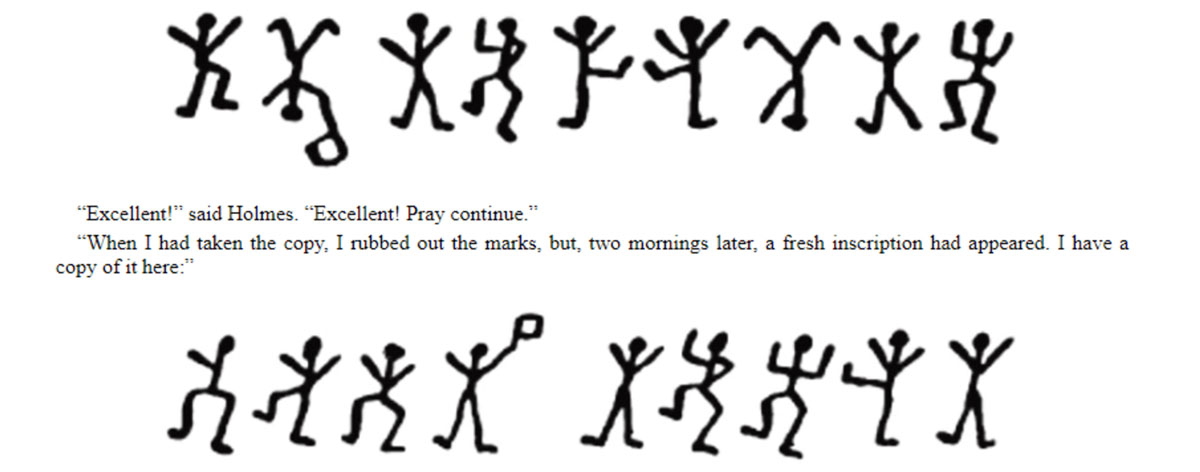
That moment of discovery, the challenge of turning gibberish into meaning, is the essence of cryptography. This lesson serves as our starting point. We will define what cryptography is, introducing the fundamental vocabulary we'll use throughout the course. More importantly, we'll embark on a brief historical tour to understand why this art of secret writing has been a pivotal force in shaping history, from ancient military campaigns to modern digital life.
What is Cryptography?
At its core, cryptography is the practice of securing communication so that it can only be understood by the intended recipients. To get a quick and clear handle on the essential vocabulary, let's start with a short video.
Cryptography Crash Course Computer Science #33
Watch the beginning of this Crash Course Computer Science video on Cryptography. It provides a crisp and clear definition of the key terms we'll be using.
Please watch from the start until the definitions of cryptography, cipher, plaintext, ciphertext, encryption, and decryption.
To solidify those concepts, here is a quick glossary from a more detailed article on the history of cryptography. Think of this as your reference card for the basic terminology.
The Art of Cryptography in Ancient and Medieval History - Traefik Labs
This section from the Traefik Labs blog provides a handy list of definitions.
Please read the short glossary under the heading "Prepare for time travel". This will reinforce the terms you just heard in the video.
To summarize, the key players in any cryptographic system are:
- Plaintext: The original, readable message.
- Ciphertext: The scrambled, unreadable message.
- Encryption: The process of converting plaintext to ciphertext.
- Decryption: The process of converting ciphertext back to plaintext.
- Cipher (or Algorithm): The method or set of rules used for encryption and decryption.
- Key: A piece of secret information (like a password or a physical object) that is used with the cipher to encrypt and decrypt the message.
With this vocabulary in hand, we can now explore why these concepts have been so crucial throughout human history.
The Historical Imperative for Secrecy
The need to send messages that adversaries cannot read is as old as writing itself. The stakes have often been incredibly high, involving the fates of armies, the security of kingdoms, and even the lives of monarchs.
Ancient Origins
Cryptography's roots can be traced back to nearly every major ancient civilization. Its earliest uses were primarily for military and political purposes.
The History of Cryptography | IBM
This article from IBM gives a concise overview of early cryptographic practices.
In the section on "Ancient cryptography," read about the examples from ancient Egypt and Mesopotamia and then the descriptions of the Spartan scytale and the Caesar Cipher. Notice the different contexts: protecting commercial information ("trade secrets"), military communications, and political correspondence.
The Scytale used by the Spartans and the Caesar Cipher used by Julius Caesar are two foundational examples that we will study in more detail later. They illustrate the two basic families of ciphers:
- Transposition Ciphers (like the Scytale), which rearrange the letters of the plaintext.
- Substitution Ciphers (like the Caesar Cipher), which replace each letter of the plaintext with a different letter or symbol.
For centuries, these simple methods were effective enough. But as the tools for encryption evolved, so did the tools for breaking it.
The Great Breakthrough: Cryptanalysis
The history of cryptography is a fascinating "cat and mouse" game between code-makers (cryptographers) and code-breakers (cryptanalysts). A major turning point occurred during the Islamic Golden Age, a period of immense intellectual and scientific progress.
The following video segment explains this breakthrough beautifully, linking it to the study of language itself—a connection that may resonate with your work in analytics, where understanding patterns in data is key.
Secret Codes: A History of Cryptography (Part 1)
This video from The Generalist Papers explains how the first systematic method for breaking substitution ciphers was developed.
Watch the section from the Abbasid Caliphate to the end of the explanation of Al-Kindi's technique. Pay close attention to the concept of frequency analysis. This is arguably the single most important technique in classical cryptanalysis.
Al-Kindi's invention of frequency analysis completely changed the game. It demonstrated that a ciphertext was not an unbreakable enigma but a puzzle that could be solved with logic, statistics, and an understanding of the underlying language. For nearly a thousand years, this technique rendered most simple substitution ciphers vulnerable.
High-Stakes and Royal Intrigue
The constant battle between cryptographers and cryptanalysts had life-or-death consequences. One of the most famous examples comes from 16th-century England and involves Mary, Queen of Scots.
The story has all the elements of historical fiction: a captive queen, a secret plot to assassinate her rival, Queen Elizabeth I, and a trail of encrypted letters.
Secret Codes: A History of Cryptography (Part 1)
The same video continues with the story of cryptography in Renaissance Europe.
Watch the part of the video that discusses the case of Mary Queen of Scots. This short segment vividly illustrates the ultimate historical importance of codebreaking.
Mary's execution, a direct result of her encrypted letters being deciphered, sent a clear message across Europe: the security of a nation could depend on its ability to both create and break secret codes.
The Machine Age and Modern Cryptography
The 20th century saw cryptography evolve from a pen-and-paper art to a mechanized science, most famously with Germany's Enigma machine in World War II. We will dedicate an entire module to the Enigma later, but it stands as perhaps the most significant example of cryptography's impact on modern history. The Allied effort to break Enigma, centered at Bletchley Park, is credited with shortening the war by several years and saving countless lives.
With the advent of computers, the complexity and importance of cryptography exploded. The timeline below shows the rapid development of digital encryption standards that protect everything from your bank transactions to government secrets today.

Conclusion
In this lesson, we have laid the groundwork for our exploration of cryptography. We began by defining the essential terms and then journeyed through history to witness the critical role secret communication has played in war, politics, and commerce.
Here are the key takeaways:
- Cryptography is the art and science of secret writing, involving the encryption of plaintext into ciphertext and its subsequent decryption.
- This process relies on a cipher (the algorithm) and a secret key.
- Historically, cryptography has been vital for military and political dominance. We saw this with the Spartan Scytale and Roman Caesar Cipher.
- The history of cryptography is an arms race between code-makers and code-breakers. The invention of frequency analysis by Al-Kindi was a revolutionary leap for cryptanalysis.
- The real-world consequences can be monumental, as evidenced by the fate of Mary, Queen of Scots, and the impact of codebreaking in World War II.
In our next lesson, we will refine our understanding of secret communication by examining a closely related field: steganography. While cryptography hides the meaning of a message, steganography hides the existence of the message itself. We'll explore its clever techniques and see how it stands apart from the ciphers we've introduced today.