Hello! Welcome back to our journey into the depths of C++.
In our previous lessons, we've focused heavily on compile-time polymorphism, looking at how templates are instantiated, how to specialize them for specific types, and how to use if constexpr to create conditional code paths within a single template. These tools allow the compiler to generate highly specialized, efficient code before your program even runs.
Today, we'll explore one of the most powerful features in the C++ template system: variadic templates. This lesson will show you how to implement functions and classes that accept a variable number of arguments of different types. This is the mechanism that powers fundamental C++ utilities like std::make_unique, std::thread, and std::tuple.
Coming from a C background, you're familiar with functions like printf that can take a variable number of arguments using the <stdarg.h> macros. Variadic templates are C++'s modern, type-safe, and compile-time-based answer to that concept, offering far greater power and safety.
The Core Idea: Parameter Packs
Variadic templates introduce the concept of a parameter pack, which is a placeholder for zero or more template arguments. The syntax uses an ellipsis (...).
template<typename... Args>: Here,Argsis a template parameter pack. It represents a list of types.void func(Args... args): Here,argsis a function parameter pack. It represents a list of arguments corresponding to the types inArgs.
The primary challenge is how to access and process the individual elements within these packs.
The Classic Approach: Recursion (C++11)
The original method for processing a parameter pack, introduced in C++11, is recursion. The pattern involves two parts:
- A recursive function template that processes the first argument in the pack and then calls itself with the rest of the arguments.
- A base case function that handles the final call when the parameter pack is empty, thereby terminating the recursion.
Let's see how this works by implementing a type-safe printf replacement.
C++ Core Guidelines: `myPrintf` Example
The article 'C++ Core Guidelines: Rules for Variadic Templates' by Rainer Grimm contains an excellent, self-contained example of implementing a type-safe myPrintf function. This is a perfect illustration of the recursive pattern and will resonate with your C background.
Read the section titled 'printf'. Pay close attention to how there are two overloads of myPrintf: The base case myPrintf(const char* format) which is called when the argument pack is empty. The recursive template myPrintf(const char* format, T value, Args... args) which processes one argument and then calls itself with the rest of the pack (args...).
This recursive approach is fundamental to understanding how variadic templates were originally designed to be used. As you saw in the article, each recursive call instantiates a new version of the function template with one fewer argument.
Variadic Class Templates
The same recursive principle applies to class templates. This is how std::tuple is conceptually implemented. You define a recursive class structure where each instantiation holds one value and then contains an instance of the class with the rest of the types.
Implementing an Unsophisticated Tuple Class
The article 'C++ Template Story So Far' provides a clear and concise implementation of a simple Tuple class using variadic templates. This will show you the recursive pattern in the context of a class.
Read the sections 'Implementing Unsophisticated Tuple Class' and 'How Does Variadic Class Template Works?'. Observe the pattern: a general template Tuple{} for the base case (empty tuple) and a partial specialization Tuple<T, Rest...> for the recursive case. The visualization clearly shows the nested structure this creates in memory.
From a memory perspective, Tuple<int, char, double> would have a layout roughly equivalent to this C-style struct:
struct Tuple_int_char_double {
    int member1;
    struct {
        char member2;
        struct {
            double member3;
            // empty base case struct here
        } rest;
    } rest;
};
This nesting demonstrates how the type information is encoded in the structure of the object itself at compile time.
The "Under the Hood" Cost of Recursion
Your goal is to understand the deep internals, so let's analyze the consequence of this recursive instantiation. Every recursive call generates a distinct function template instantiation. For a call with N arguments, the compiler generates N+1 functions (including the base case). This can increase compile times and the size of your final executable—a phenomenon known as "code bloat".
C++ Weekly - Ep 6 Intro To Variadic Templates
This C++ Weekly video by Jason Turner provides a brilliant demonstration of this effect. He implements a recursive variadic template and then uses command-line tools to inspect the compiled binary.
Watch from 03:27 to 14:12. First, see how he implements a recursive to_string function. Then, pay close attention when he uses nm and c++filt (around 11:45). This is the key part: you will see the 'mangled' names of all the different function instantiations the compiler created, proving that the recursion is happening at compile time and generating more code.
This analysis with nm directly shows you the result of template metaprogramming on the final binary, connecting the high-level C++ feature to the low-level object file symbols.
Pack Expansion and Perfect Forwarding
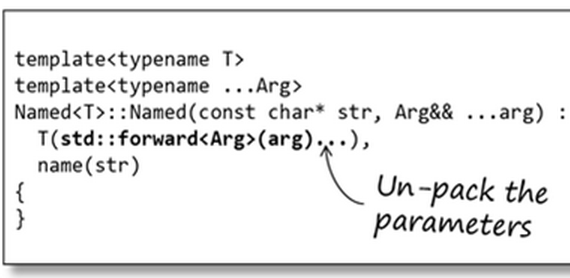
The most common and powerful use of variadic templates is not to process arguments one-by-one, but to forward them to another function. This is called pack expansion. You use the ... operator on the right side of the parameter pack to expand it into a comma-separated list.
This is the key to factory functions like std::make_unique. It needs to accept any set of arguments and perfectly forward them to the constructor of the object it's creating.
C++ Core Guidelines: Building `make_unique`
Let's return to the 'C++ Core Guidelines' article by Rainer Grimm. It builds up a make_unique-like function step-by-step, providing the best explanation of combining variadic templates with perfect forwarding.
Read the sections on 'Perfect Forwarding' and 'Variadic Templates'. Follow the evolution from a single-argument createT to the full variadic version. The crucial syntax is return T(std::forward<Args>(args)...);. The ... after the std::forward call expands the pack, applying std::forward to each argument individually.
The pattern std::forward<Types>(args)... is one of the most important idioms in modern C++. It ensures that if you pass an lvalue, the constructor gets an lvalue, and if you pass an rvalue, it gets an rvalue, preserving the value category perfectly.
Modern C++: Fold Expressions (C++17)
The recursive approach, while fundamental, is verbose and can be inefficient. C++17 introduced fold expressions, a much more concise syntax for reducing a parameter pack over a binary operator.
For example, to sum all arguments in a pack:
Recursive C++11 way:
template<typename T>
T sum(T t) {
    return t;
}

template<typename T, typename... Args>
T sum(T first, Args... rest) {
    return first + sum(rest...);
}
C++17 fold expression:
template<typename... Args>
auto sum(Args... args) {
    return (args + ...); // Unary right fold
}
The fold expression is not only shorter but can also be more efficient, as it avoids the chain of recursive function calls.
Fold Expressions vs Variadic Template
The 'C++ Template Story So Far' article concludes its section on variadic templates by introducing fold expressions as the modern alternative.
Read the section 'Fold Expressions vs Variadic Template'. It shows how a multi-line recursive print function can be reduced to a single line using a fold over the comma operator. This demonstrates the power and elegance of the C++17 syntax.
Test your understanding!
You have a set of objects, and you want to write a single generic function call_update that calls the .update() member function on each of them. The objects can be of different types.
For example: call_update(obj1, obj2, obj3); should result in obj1.update(), obj2.update(), and obj3.update() being called.
How would you implement call_update using a C++17 fold expression and the comma operator?
Show answer
You can implement this using a fold expression over the comma operator. The comma operator evaluates its left operand, discards the result, and then evaluates its right operand. A fold expression can leverage this to execute a statement for each argument in the pack.
#include <iostream>

struct Sensor {
    void update() { std::cout << "Sensor updated.\n"; }
};

struct Display {
    void update() { std::cout << "Display updated.\n"; }
};

template<typename... Devices>
void call_update(Devices&... devices) {
    (devices.update(), ...);
}

int main() {
    Sensor s;
    Display d;
    call_update(s, d);
}
The expression (devices.update(), ...) expands to (s.update(), (d.update())). The comma operator ensures each .update() call is sequenced correctly. We pass the arguments by reference (Devices&...) to ensure we are calling .update() on the original objects, not copies.
Conclusion
You have now learned how to create functions and classes that handle a variable number of arguments, a cornerstone of generic programming in C++.
Key Takeaways:
- Variadic templates use the
...syntax to define parameter packs, which can hold zero or more arguments. - The classic C++11 method for processing packs is recursion, which requires a base case and a recursive step. This method helps understand the underlying instantiation mechanism but can lead to code bloat.
- A primary use case is perfect forwarding of arguments using
std::forward<Args>(args)..., which is essential for writing generic factory functions. - C++17 fold expressions provide a much more concise and often more efficient way to "reduce" a parameter pack over an operator, making recursive implementations unnecessary for many common patterns.
What's Next?
We have now covered templates in significant depth, from their basic instantiation to advanced features like if constexpr and variadic templates. These are the primary tools for compile-time polymorphism in C++.
In the next lesson, we will step back and contrast this entire world of templates with C++'s other pillar of polymorphism: runtime polymorphism, which is based on inheritance and virtual functions. Understanding the fundamental differences, performance trade-offs, and appropriate use cases for each is a critical skill for any serious C++ systems developer.