Hello! Welcome to the final and most exciting module of our course. Over the past several weeks, you've built a strong foundation in C++ internals, from memory layout and object models to advanced concurrency patterns. In our last lesson, we saw how architectural patterns like Half-Sync/Half-Async are composed from smaller, tactical patterns like the Reactor and Active Object.
Now, it's time to put all that knowledge into practice. We are going to build a production-quality C++ Thread Pool library from the ground up. This project is not just a coding exercise; it's a deep dive into API design, systems-level thinking, and performance optimization—all critical skills for the C/C++ roles you're targeting.
Today, we begin with the most crucial step of any library development: defining its public interface. Our learning outcome is to define a clean public API for a thread pool, including methods for task submission and shutdown. A well-designed API is intuitive, powerful, and hard to misuse. It is the contract our library makes with its users, and getting it right is paramount.
Why a Thread Pool?
Before we design the API, let's establish why a thread pool is necessary. You know how to create threads using std::thread, so why not just spawn a new thread for every piece of work?
The answer boils down to two key performance issues:
- Creation/Destruction Overhead: Spawning and tearing down an OS thread is not a free operation. It consumes time and resources. For short-lived tasks, this overhead can dominate the actual work.
- Oversubscription: If you create more threads than your CPU has hardware cores, the operating system's scheduler is forced into excessive context switching. This constant shuffling of threads on and off the cores adds significant overhead and can severely degrade performance.
A thread pool solves these problems by creating a fixed number of worker threads once and reusing them to execute tasks from a queue.
C++ Multithreading [Generic Task Pool]
To start, let's watch a brief segment that clearly explains the motivation for moving from task-specific threads to a generic thread pool. This will solidify the core problem we're aiming to solve.
Watch the first 5 minutes and 47 seconds of this video from the ChiliTomatoNoodle channel. The presenter does an excellent job illustrating the inefficiency of creating numerous threads for different tasks and the problem of oversubscription.
As the video and the introduction to the popular BS::thread_pool library explain, the goal is to manage a group of worker threads that pull tasks from a central queue, ensuring we don't overwhelm the system's resources.
High-Level Architecture
The fundamental design of a thread pool follows the classic Producer-Consumer pattern, which you've seen in our discussions of Monitor Objects and Active Objects.

Our design will consist of three main parts:
- The Task Queue: A thread-safe queue to hold tasks waiting to be executed.
- The Worker Threads: A collection of threads that continuously fetch and run tasks from the queue.
- The Public API: The
ThreadPoolclass itself, which orchestrates these components and provides an interface for the user.
Today, we focus exclusively on designing that ThreadPool class interface.
Designing the Public API
A good API should be minimal but complete. Let's think through the essential operations a user needs.
1. Construction and Destruction (Lifecycle Management)
Constructor: How is a thread pool created? The most critical parameter is the number of worker threads.
- What's a sensible default? If the user doesn't specify, we should default to the number of concurrent threads supported by the hardware. C++ provides
std::thread::hardware_concurrency()for this. This ensures the pool is sized optimally for the system it's running on by default. - What if the user wants fewer threads? We should also provide a constructor that accepts a specific thread count. This is useful if the main thread or other parts of the application also perform computationally intensive work.
// In our future ThreadPool.h
#include <thread>
#include <vector>

class ThreadPool {
public:
    // Creates the pool with a specified number of threads.
    // Defaults to the number of hardware threads if not specified.
    explicit ThreadPool(size_t numThreads = std::thread::hardware_concurrency());

    // ... more to come
};
The explicit keyword here is a good practice to prevent implicit conversions (e.g., from an integer) to a ThreadPool object, which would be nonsensical.
Destructor: What happens when a ThreadPool object goes out of scope or is deleted? It must perform a graceful shutdown. This means:
- Stop accepting new tasks.
- Ensure all tasks currently in the queue are completed.
- Join all worker threads.
- Clean up all resources.
The destructor is a critical part of the API, as it guarantees RAII (Resource Acquisition Is Initialization). The user creates a pool, submits tasks, and when the pool is destroyed, everything is automatically cleaned up.
class ThreadPool {
public:
    explicit ThreadPool(size_t numThreads = std::thread::hardware_concurrency());

    // Gracefully shuts down the thread pool.
    ~ThreadPool();

    // ... more to come
};
We also need to prevent users from copying or moving the thread pool, as it owns unique resources (the threads). A ThreadPool is not a simple value type.
class ThreadPool {
public:
    // ... constructor and destructor

    // A thread pool is a unique entity that manages threads.
    // It cannot be copied or moved.
    ThreadPool(const ThreadPool&) = delete;
    ThreadPool& operator=(const ThreadPool&) = delete;
    ThreadPool(ThreadPool&&) = delete;
    ThreadPool& operator=(ThreadPool&&) = delete;

    // ...
};
2. Task Submission
This is the heart of the API. How does a user submit work? The method needs to be incredibly flexible. It should accept any callable target—free functions, lambdas, member functions—with any number of arguments.
Returning Results with std::future
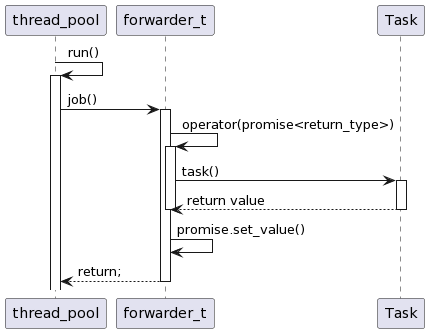
When a task is executed asynchronously on another thread, how does the calling thread get the result? The modern C++ answer is std::future. Our submission function will return an std::future<T>, where T is the return type of the submitted task. The caller can later call get() on this future, which will block until the result is available.
A Generic submit Method
To accept any function with any arguments, we'll use variadic templates and perfect forwarding. This allows us to create a single submit method that captures the function and its arguments and forwards them to be executed by a worker thread.
#include <future>
#include <functional>

class ThreadPool {
public:
    // ... constructor, destructor, deleted members

    // Submit a task for execution.
    // F: The type of the callable.
    // Args: The types of the arguments.
    // Returns a future to eventually get the task's return value.
    template<typename F, typename... Args>
    auto submit(F&& f, Args&&... args) -> std::future<decltype(f(args...))>;

private:
    // ... worker threads, task queue, etc.
};
Let's break down this signature, as it's dense but powerful:
template<typename F, typename... Args>: This makessubmita function template that accepts a callable typeFand a parameter packArgs...for zero or more arguments.F&& f, Args&&... args: These are universal references, allowing us to accept both l-values and r-values and forward them perfectly, avoiding unnecessary copies.-> std::future<decltype(f(args...))>: This is a trailing return type.decltype(f(args...))automatically deduces the return type of calling the functionfwith the argumentsargs.... Thesubmitfunction then returns anstd::futureof that deduced type.
This single function signature allows for all of these use cases:
int some_function(int x) { return x * 2; }

struct MyClass {
    double process(double y) { return y / 2.0; }
};

// --- In main ---
ThreadPool pool;
MyClass my_obj;

// 1. Submit a free function
auto future1 = pool.submit(some_function, 10); // returns std::future<int>

// 2. Submit a lambda
auto future2 = pool.submit([](int a, int b){ return a + b; }, 5, 3); // returns std::future<int>

// 3. Submit a member function
auto future3 = pool.submit(&MyClass::process, &my_obj, 9.8); // returns std::future<double>

// Get results (this will block until the task is done)
std::cout << "Result 1: " << future1.get() << std::endl;
std::cout << "Result 2: " << future2.get() << std::endl;
std::cout << "Result 3: " << future3.get() << std::endl;
To understand exactly how the submit function will be implemented to achieve this, it's worth studying an existing implementation. The following resource provides a line-by-line explanation of how to bind arguments and package the task.
Thread pool implementation using c++11 threads
The article 'Thread pool implementation using c++11 threads' by Manuel Freire provides a fantastic, in-depth explanation of a submit function. It's a perfect example of the 'first principles' approach you appreciate.
Read the sections 'Submit function' and 'Submit implementation'. Focus on how it uses std::bind, std::packaged_task, and std::function to wrap any callable and its arguments into a generic, type-erased task that can be stored in a queue.
The core idea is to wrap the original callable and its arguments into a new, nullary (zero-argument) function object. This object, when called, executes the original function with its bound arguments. std::packaged_task then wraps this object, connecting it to the std::future we return to the user.
Test your understanding!
In the submit implementation from the article, a function and its arguments are wrapped multiple times (std::bind, std::packaged_task, std::function). Why is the final std::function<void()> wrapper necessary before enqueuing the task?
Show answer
The task queue needs to store tasks of different types (e.g., one task might return an int, another a double, another void). To store them in a single container, like std::queue, they must have a common type.
The std::function<void()> wrapper provides this common type through type erasure. It erases the specific return type of the underlying packaged_task. The packaged_task itself still knows how to produce the correct return value and deliver it to its associated std::future, but from the queue's perspective, it's just holding a collection of objects that can be invoked with no arguments and return nothing (void).
3. Shutdown Mechanism (A Deeper Look)
The destructor provides an implicit shutdown, but what does that entail internally? The worker threads run in an infinite loop, pulling tasks. We need a way to tell them to stop.
A common mechanism is a simple std::atomic<bool> stop_flag;. When the destructor is called, it sets this flag to true. The worker threads' loop condition will check this flag. When they see it's true and the task queue is empty, they break their loop and exit. The destructor then join()s all threads to wait for them to terminate.
The introduction of std::jthread in C++20 simplifies this. A jthread automatically requests to stop and joins upon destruction. Its stop_token mechanism is a more robust way to signal shutdown, as it can be integrated with condition variables.
The ChiliTomatoNoodle video you saw earlier continues to explore this, and uncovers a critical bug related to member destruction order when implementing worker logic inside a class. This is an excellent real-world insight.
C++ Multithreading [Generic Task Pool]
Let's revisit the ChiliTomatoNoodle video to see how to handle thread shutdown and the subtle bugs that can arise. This is a practical demonstration of the 'under the hood' issues you're interested in.
Watch the following three segments: 7:31 - 19:06: Focus on the design of the Worker class. Notice the use of std::jthread, std::condition_variable_any, and std::stop_token for the worker's main loop. 29:29 - 31:49: Pay attention to the 'gotcha' when using std::jthread with member functions. This is a very practical C++20 tip. 35:11 - 37:42: This part is crucial. The author discovers and fixes a bug where the std::mutex is destroyed before the thread finishes using it. Understanding this C++ object lifetime rule is vital for writing correct concurrent code.
The key takeaway is that the order of member variable declaration in a class matters! The jthread member must be declared last, so it is destroyed first. Its destructor will signal the stop and wait for the thread kernel to finish, which may still need to access other members like the mutex or condition variable. If those are destroyed before the thread finishes, you get a crash.
Our Final API
Based on this analysis, here is the complete public API for our ThreadPool class. This is the interface we will implement in the coming lessons.
// File: ThreadPool.h
#pragma once

#include <functional>
#include <future>
#include <thread>
#include <vector>
// We will add more includes for the implementation later

class ThreadPool {
public:
    /**
     * @brief Constructs a new thread pool.
     * @param numThreads The number of threads to use. Defaults to the number of
     * hardware cores available.
     */
    explicit ThreadPool(size_t numThreads = std::thread::hardware_concurrency());

    /**
     * @brief Destroys the thread pool, waiting for all queued tasks to complete.
     */
    ~ThreadPool();

    /**
     * @brief Submits a callable task to the queue for execution.
     * @tparam F The type of the callable.
     * @tparam Args The types of the arguments to the callable.
     * @param f The callable object (function, lambda, etc.).
     * @param args The arguments to pass to the callable.
     * @return An std::future that will hold the return value of the task.
     */
    template<typename F, typename... Args>
    auto submit(F&& f, Args&&... args) -> std::future<decltype(f(args...))>;

    // ThreadPools are unique and cannot be copied or moved.
    ThreadPool(const ThreadPool&) = delete;
    ThreadPool& operator=(const ThreadPool&) = delete;
    ThreadPool(ThreadPool&&) = delete;
    ThreadPool& operator=(ThreadPool&&) = delete;

private:
    // Implementation details to be added in the next lesson.
    // This will include the vector of worker threads, the task queue,
    // and synchronization primitives (mutex, condition variable, stop flag).
};

// The implementation of the templated 'submit' function will go here...
For reference, you can look at the complete public interface of the BS::thread_pool library. It's more feature-rich than ours, but you'll see the core components—constructors, task submission, and waiting—are all there.
bshoshany/thread-pool: BS::thread_pool
The 'Complete library reference' section of the BS::thread_pool documentation provides a concise summary of a feature-rich thread pool API. Use it as a reference to see what a mature library might offer.
Quickly skim the list of member functions under 'The BS::thread_pool class template'. Notice methods like submit_task, detach_task, wait, constructors, and the destructor. This will give you a good sense of a complete, real-world API.
Conclusion
In this lesson, we laid the critical groundwork for our portfolio project by defining a clean, modern, and powerful public API for our ThreadPool library.
Key Takeaways:
- API is a Contract: The public interface of a class defines how users interact with it. A good API prioritizes ease of use, correctness, and flexibility.
- Constructor and Destructor Define Lifecycle: Our constructor establishes the pool's resources (worker threads), and the destructor guarantees RAII by ensuring a graceful shutdown and resource cleanup.
- Generic Task Submission is Key: Using variadic templates, perfect forwarding, and a trailing return type with
decltype, we designed a singlesubmitmethod capable of handling virtually any task. std::futurefor Asynchronous Results:std::futureis the standard C++ mechanism for retrieving a result from an operation that runs asynchronously. It is the perfect return type for oursubmitmethod.- Object Lifetime is Critical in Concurrency: The order of member variable destruction is crucial for correctness. Thread-managing objects (like
std::jthread) should be destroyed first so they can safely wait for worker threads that might still be using other class members.
Next Lesson Preview:
With our public API defined, the next step is to build the machinery that makes it work. In our next lesson, we will design the internal architecture, focusing on two key components: a thread-safe, blocking task queue using std::mutex and std::condition_variable, and the main logic for our worker threads.