Hello again! In our last lesson, we designed a clean and powerful public API for our ThreadPool library. We established the contract our library will offer to its users, focusing on ease of use with the generic submit method and guaranteed cleanup through RAII.
Today, we move from the "what" to the "how." Our goal is to design the internal architecture of the thread pool, identifying the key components like the task queue, worker threads, and the synchronization primitives that make them work together safely and efficiently. This lesson is all about the machinery that operates behind the facade of our public API. We'll connect high-level C++ concurrency features to the underlying OS mechanisms, which aligns with your interest in first-principles understanding.
The Heart of the Problem: Producer-Consumer
At its core, a thread pool is a classic Producer-Consumer system.
- Producers: Client code that calls our
submitmethod, "producing" tasks. - Consumers: Our pool's worker threads, which "consume" tasks and execute them.
- Shared Resource: A queue that holds the tasks waiting to be consumed.
Whenever multiple threads access a shared resource, we risk chaos. To see why, let's watch a video that vividly demonstrates the race conditions and undefined behavior that arise from unsynchronized access.
C++ Multi Threading Part 2: Mutex And Conditional Variables
The video 'C++ Multi Threading Part 2' by arisaif provides an excellent explanation of why synchronization is non-negotiable. It covers race conditions, instruction interleaving, and even compiler/CPU optimizations that can corrupt shared data.
Watch the segment from 1:06 to 10:13. Pay close attention to the examples where incrementing a shared counter fails to produce the correct result. This will solidify your intuition for why we need the tools we're about to discuss.
As the video showed, simple operations like counter++ are not atomic. They involve a read-modify-write sequence that can be interleaved between threads, leading to lost updates. Our task queue, with its push and pop operations, faces the exact same problem. We need a way to ensure that only one thread can modify the queue at a time. This brings us to our core architectural components.
The Three Pillars of our Internal Architecture
Our thread pool's internal architecture will be built on three pillars:
- A Task Queue: To hold the
std::function<void()>objects that oursubmitmethod generates. - A Pool of Worker Threads: A
std::vector<std::thread>that will be created when the pool is constructed. - Synchronization Primitives: The tools that allow the threads and the queue to interact safely. These are the most critical part of the design.
Let's model the components that will live inside our ThreadPool class. A well-structured implementation, like the one presented in the article "Building a Thread Pool with C++ and STL", clearly lays out these private members.
Building a Thread Pool with C++ and STL
This article by 'nixiz' shows a concise, modern C++ thread pool. We'll look at the class definition to get a clear picture of the internal state we need to manage.
Read just the thread_pool class definition in this section. Identify the private member variables: is_active, pool, cv, guard, and pending_jobs. These are the components we're about to design in detail.
Based on that structure, our internal state will look something like this:
// Inside our ThreadPool class
private:
    std::vector<std::thread> workers_;
    std::deque<std::function<void()>> tasks_; // std::deque is efficient for queue operations

    std::mutex queue_mutex_;
    std::condition_variable condition_;
    std::atomic<bool> stop_ = false;
Now, let's dissect the roles of the mutex and condition variable.
Pillar 1 & 2: The Synchronization Primitives
std::mutex: Enforcing Mutual Exclusion
A std::mutex (Mutual Exclusion) is our tool for creating a critical section—a block of code that only one thread can execute at a time. By protecting our task queue with a mutex, we can prevent race conditions.
The basic usage is mutex.lock() before accessing the shared data and mutex.unlock() after. However, manually calling unlock is risky; if an exception is thrown, the mutex might remain locked forever, causing a deadlock.
C++ provides RAII (Resource Acquisition Is Initialization) wrappers to manage this automatically:
std::lock_guard: Locks the mutex in its constructor and unlocks it in its destructor. Simple and effective.std::unique_lock: More flexible. It also uses RAII but allows for manual unlocking and re-locking. We need this flexibility to work with condition variables.
C++ Multi Threading Part 2: Mutex And Conditional Variables
Let's return to the arisaif video, which now explains how to use mutexes and these RAII wrappers to solve the race condition problem.
Watch the segments from 10:29 to 15:11 and 15:58 to 23:39. This will explain the concept of a critical section and demonstrate the usage of std::mutex, std::lock_guard, and std::unique_lock.
Under the Hood: How does a mutex work?
Since you're interested in the OS internals, let's look at what happens when you call lock(). It's not magic; it's a careful dance between user space and the kernel.
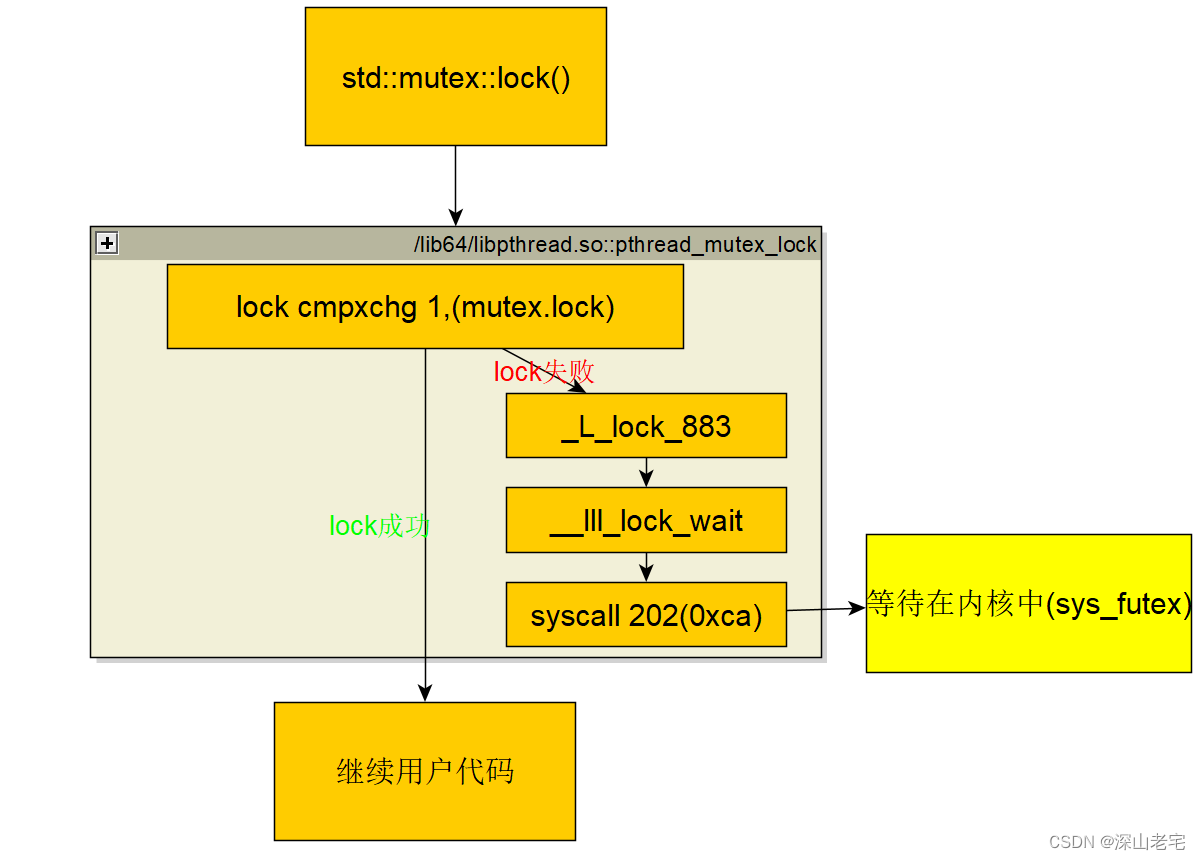
This hybrid approach is key to performance. Uncontended locks are extremely fast. Contended locks are efficient because the OS scheduler takes over, preventing the waiting thread from consuming CPU cycles.
std::condition_variable: Efficient Waiting
A mutex solves the data corruption problem, but it creates another: how does a worker thread wait for a task without wasting CPU?
Bad solution (busy-waiting):
while (true) {
    queue_mutex_.lock();
    if (!tasks_.empty()) {
        // pop and run task
        queue_mutex_.unlock();
        break;
    }
    queue_mutex_.unlock();
    // What now? sleep? spin? This is inefficient.
}
This is called spinning and it burns CPU cycles. A std::condition_variable solves this by allowing threads to sleep until they are notified that a specific condition has been met (e.g., "the queue is no longer empty").
The core interaction is:
- Consumer (Worker Thread):
- Acquires a
std::unique_lockon the mutex. - Calls
cv.wait(lock, predicate). Thepredicateis a lambda that checks the condition (e.g.,return !tasks_.empty();). - Crucially,
wait()does the following atomically:- If the predicate is false, it releases the lock and puts the thread to sleep.
- When woken up, it re-acquires the lock and checks the predicate again. If true,
wait()returns. If false (a "spurious wakeup"), it goes back to sleep.
- Acquires a
- Producer (
submitmethod):- Acquires a lock on the same mutex.
- Adds a task to the queue.
- Calls
cv.notify_one()to wake up one sleeping worker thread. - Releases the lock.
This sleep-wakeup mechanism is far more efficient than busy-waiting. The article "Build Your Own Redis" has a fantastic explanation of this process.
14. Thread Pool | Build Your Own Redis with C/C++
The 'Build Your Own Redis' chapter on thread pools provides a first-principles explanation of why mutexes alone are not enough and how condition variables solve the waiting problem.
Read the sections 'Wait for something to happen' and 'Condition variable'. Pay close attention to the diagram showing how a signal can be missed without a condition variable and why the wait() operation must atomically release the lock and sleep.
Test your understanding!
The article emphasizes that you must always check the condition in a while loop when using a condition variable (i.e., while (condition_is_false) { cv.wait(...); }). Why isn't a simple if statement sufficient?
Show answer
There are two main reasons:
- Spurious Wakeups: A thread waiting on a condition variable can sometimes wake up even if no
notifycall was made. This is a documented behavior related to OS scheduler implementation. If the thread wakes up spuriously, the condition (!tasks_.empty()) will still be false, and thewhileloop ensures it goes back to sleep. Anifstatement would allow it to proceed incorrectly. - Multiple Consumers: When
notify_one()wakes a thread (Thread A), another waiting thread (Thread B) might acquire the lock first, consume the task, and release the lock. When Thread A finally acquires the lock, the queue is empty again! Thewhileloop forces Thread A to re-check the condition and correctly go back to sleep.
Pillar 3: The Worker Thread Logic
Now we can assemble these primitives into the logic for our worker threads. Each worker will execute a loop that forms the heart of its life cycle.
Under the Hood: What is a thread?
When we create a std::thread, we are asking the OS to create a new, independent path of execution. In Linux, this is managed by the kernel, which creates a task_struct for the new thread. This structure holds all the information the kernel needs to manage the thread, including its state, priority, and CPU-specific context.
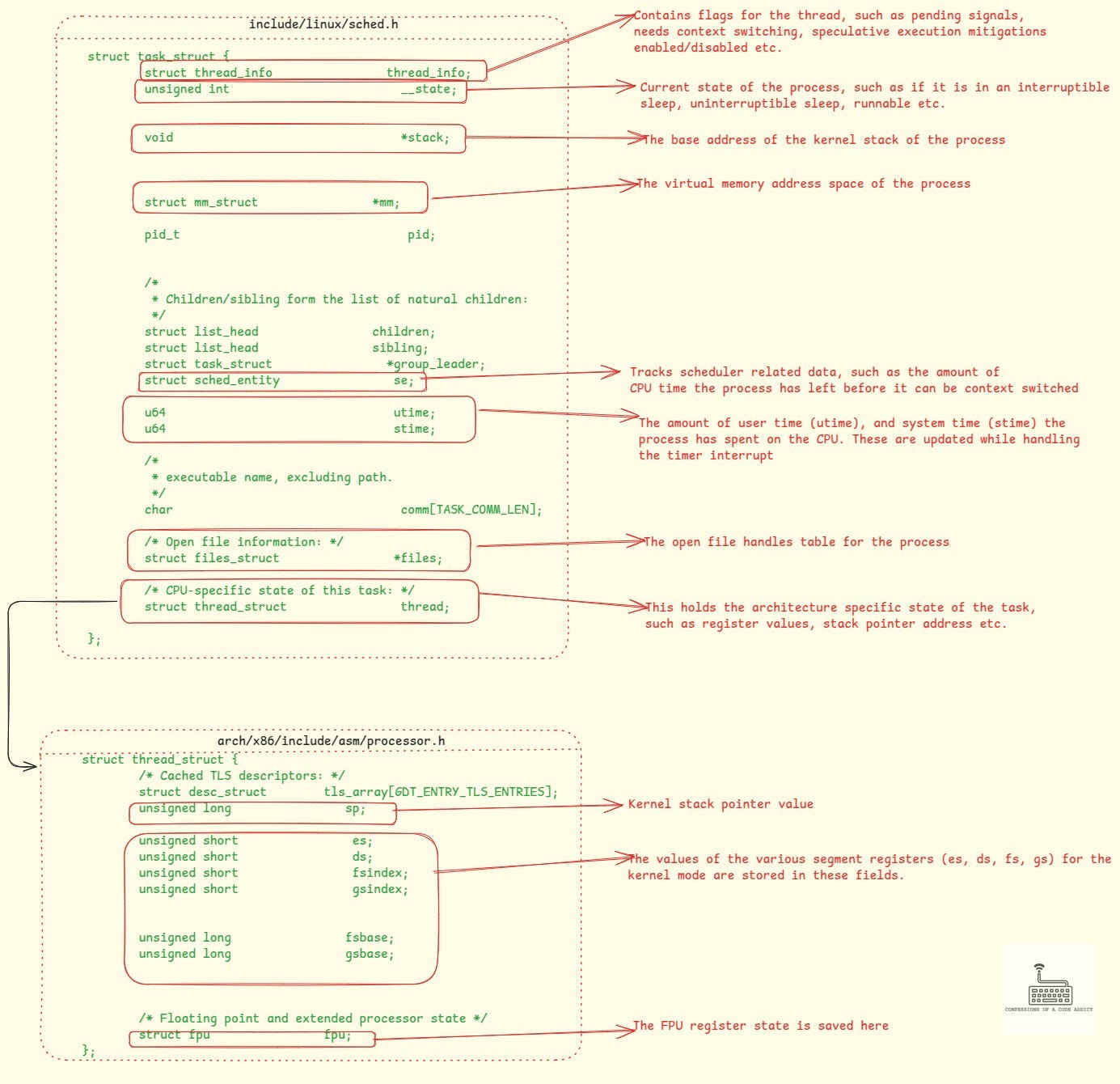
The Worker Loop
The function executed by each std::thread in our pool will look conceptually like this:
How to write Thread Pools in C++
Let's watch a short video that walks through the complete implementation of a thread pool, focusing on the worker's main loop.
Watch from 2:14 to 6:50. The presenter outlines the core components (vector of threads, queue, sync primitives) and then steps through the worker function. Notice how it uses std::unique_lock and std::condition_variable::wait with a predicate to efficiently get tasks.
The logic shown in the video can be translated into our class structure as a private member function:
void ThreadPool::worker_loop() {
    while (true) {
        std::function<void()> task;

        // --- Critical Section Start ---
        {
            std::unique_lock<std::mutex> lock(queue_mutex_);

            // Wait until the queue is not empty OR the pool is stopping.
            condition_.wait(lock, [this] {
                return !tasks_.empty() || stop_;
            });

            // If we woke up because of `stop_` and the queue is empty, exit the loop.
            if (stop_ && tasks_.empty()) {
                return;
            }

            // Otherwise, a task is available. Move it from the queue.
            task = std::move(tasks_.front());
            tasks_.pop_front();
        }
        // --- Critical Section End ---

        // Execute the task outside the lock to allow other workers
        // to access the queue concurrently.
        task();
    }
}
This loop beautifully integrates all our components:
- It locks the
queue_mutex_to safely check the queue. - It uses
condition_.waitto sleep efficiently until there's work to do or it's time to shut down. - It correctly handles the shutdown signal (
stop_). - It grabs a task, unlocks the mutex, and then executes the task, minimizing the time the lock is held and maximizing concurrency.
Conclusion
Today we've designed the entire internal architecture of our thread pool. We've moved beyond the public API to define the private state and the core logic that will power our library.
Key Takeaways:
- Internal Architecture: A thread pool consists of a task queue, a group of worker threads, and synchronization primitives (
std::mutex,std::condition_variable) to manage their interaction. - Producer-Consumer: This is the fundamental pattern.
submitproduces tasks, and workers consume them from a shared, thread-safe queue. - Synchronization is Key:
std::mutexprovides mutual exclusion to prevent data races, whilestd::condition_variableprovides an efficient sleep/wakeup mechanism to prevent busy-waiting. - Worker Logic: The worker's main loop is built around
cv.wait(), which waits on a condition (!tasks_.empty() || stop_) while atomically managing the lock. - Performance: Releasing the lock before executing a long-running task is a critical optimization that reduces lock contention and improves throughput.
Next Lesson Preview:
We have the complete blueprint. In our next lesson, we will begin the implementation. We will start by creating a self-contained, thread-safe blocking queue class. This will encapsulate the std::deque, std::mutex, and std::condition_variable and will become the backbone of our ThreadPool. This step will solidify your hands-on understanding of these crucial synchronization primitives.