Hello! Welcome to your next lesson in the Foundations of Data Management module.
In our last lesson, we identified the "who" of data management by exploring the roles and responsibilities of professionals like Data Owners, Stewards, and Custodians. Now, we'll take a step back to clarify the fundamental "what" they are managing.
Today's learning outcome is to distinguish between data, information, and knowledge in organizational contexts. This distinction isn't just academic; it's the foundation for transforming raw organizational inputs into valuable, actionable insights. Understanding this hierarchy is essential for everything from building a report to creating a business strategy, and it's a core concept in the DAMA DMBOK.
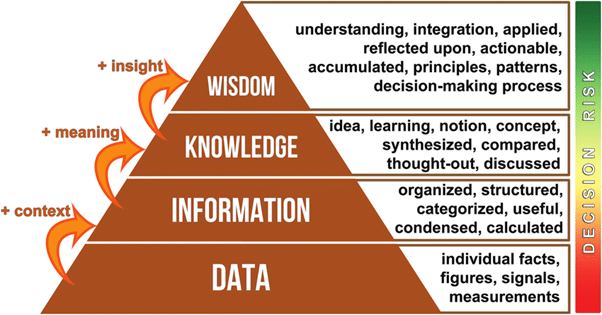
We will use a well-known model called the DIKW Pyramid to structure our thinking, moving from raw facts at the bottom to actionable understanding at the top.
The DIKW Pyramid: A Model for Understanding
The DIKW pyramid—which stands for Data, Information, Knowledge, and Wisdom—is a popular framework for representing the relationships between these concepts. It shows how we can build upon raw facts to create ever more valuable insights.
To get an overview of this model, please watch this short video.
DIKW Pyramid - Knowledge Management | Information Technology Service Management | ITSM | CT Academy
The following video from CT Academy introduces the DIKW pyramid and explains how each level adds value to the one before it.
Watch the video from the beginning to end (0:05 - 3:39). Pay attention to how it defines each of the four levels and the questions each level answers (e.g., 'what' vs. 'how' vs. 'why').
Now that you have a high-level view, let's break down each component, focusing on the three key elements from our learning outcome: data, information, and knowledge.
Level 1: Data — The Raw Facts
At the base of the pyramid is data. Data consists of raw, unorganized facts, figures, signals, or symbols. By itself, data lacks context and meaning. It represents discrete, objective observations of events, but it doesn't tell a story.
Consider these examples:
120.50Supplier B2024-10-15Approved
These are all individual data points, or datums. They are facts, but without context, they aren't very useful.
To solidify this foundational concept, let's look at a clear definition and another example.
This document from Data Action Lab provides a straightforward explanation of data and an excellent example of the DIKW pyramid using bank transactions.
Please read the two slides under the heading 'DATA IS A FOUNDATION'. The first introduces the pyramid, and the second provides a clear, practical example of the different levels.
Level 2: Information — Data in Context
The next level up is information. We create information by processing, organizing, and structuring data. Information has context, relevance, and purpose. It answers fundamental questions like "who?", "what?", "where?", and "when?".
Let's revisit our data points and give them context:
- Data:
120.50,Supplier B,2024-10-15,Approved - Information: "The payment of €120.50 to Supplier B was approved on October 15, 2024."
As the document you just read showed, a list of individual bank transactions is data. When you organize those transactions by month to see your total spending, you have created information.
Level 3: Knowledge — Information in Action
The third level is knowledge. Knowledge is created when we synthesize information, often from different sources, and apply our own experience and expertise to it. It represents a deeper level of understanding. Knowledge answers the "how?" question. It allows us to form patterns, make predictions, and understand the principles behind the information.
- Information: "Our profit was €500k last quarter."
- Knowledge: "Based on the last four quarters' profit trends and the seasonal drop in customer demand we see every winter, we know how to adjust our inventory levels to maintain profitability in the upcoming quarter."
Knowledge is often what separates an expert from a novice. A junior quantity surveyor might have the information from a Bill of Quantities, but a senior quantity surveyor has the knowledge to recognize that the specified material has long lead times and knows how to propose a more readily available alternative to keep the project on schedule.
Test your understanding!
A project manager is reviewing a report. Which of the following statements represents knowledge rather than just information?
- "The project is 15% over budget as of today."
- "The structural steel workstream has exceeded its allocated budget by 30%."
- "The consistent budget overruns on structural steel across our last three projects are due to inaccurate initial estimates that don't account for price volatility. We need to revise our estimation process by incorporating a risk premium for steel."
Show answer
Statement 3 represents knowledge. It connects information from multiple sources (budget reports from three projects), identifies a pattern (consistent overruns), analyzes the root cause (inaccurate estimation process), and proposes a solution based on this understanding. Statements 1 and 2 are pieces of information.
Application: The DIKW Pyramid in Construction and Engineering
Given your background, it's useful to see how this abstract model applies directly to the world of engineering and construction. Building Information Modeling (BIM) provides a perfect example of the DIKW pyramid in action.
BIM and the DIKW Pyramid: From Data to Wisdom
The following article explores how the DIKW pyramid helps construction professionals extract value from the vast amount of data generated by BIM.
Please read the section titled 'BIM and the DIKW Pyramid: A Powerful Combination'. Focus on the specific examples given for each level: Data (raw model properties), Information (quantity takeoffs), and Knowledge (structural simulations).
As the article illustrates:
- Data is the raw geometric and property information for every single component in a BIM model (e.g., a specific steel beam's dimensions and material grade).
- Information is generated when this data is organized into quantity takeoffs, clash detection reports, or construction schedules. You can now answer, "How many tons of steel do we need?"
- Knowledge is gained by analyzing this information. An engineer can run structural simulations or energy efficiency analyses to understand how the design will perform and how to optimize it for cost, safety, or sustainability.
This progression shows how data management transforms raw numbers in a model into the deep project understanding needed for successful delivery.
Conclusion
In this lesson, we have dissected the fundamental building blocks of business intelligence. You can now distinguish between the core concepts of data, information, and knowledge within an organizational setting.
Key Takeaways:
- Data is raw, uncontextualized facts (the "what").
- Information is data that has been organized and processed to provide context and answer who, what, when, and where questions.
- Knowledge is synthesized information combined with experience that provides understanding and answers "how" questions, enabling effective action.
- The DIKW pyramid provides a powerful model for visualizing this hierarchy and understanding how to add value at each stage, ultimately reducing decision risk.
Preview of the next lesson: Now that we understand what we are managing at this fundamental level, our next lesson will explore how we manage it over its lifespan. We will apply the data lifecycle concept to organizational scenarios, looking at the stages data goes through from creation to archival or deletion.