Hello and welcome to your first lesson in our course on the DAMA Data Management Body of Knowledge (DMBOK).
In this introductory lesson, we will explore the fundamental "why" behind data management. You will learn to explain the business drivers that compel organizations to invest in managing their data and articulate the value they expect in return. This is the cornerstone of the entire DAMA framework and a crucial first step toward your goal of mastering data management and preparing for the CDMP certification.
We'll start by defining what data management is from a business perspective and then connect it directly to strategic goals like increasing revenue, improving efficiency, and reducing risk. Throughout the lesson, we will draw connections to your background in engineering and contract management to make these concepts tangible and immediately applicable.
1. Data as a Strategic Business Asset
Traditionally, many organizations viewed data as a simple byproduct of their operations—something to be stored and forgotten. However, in today's economy, this view has been completely overturned. Data is now widely recognized as a critical enterprise asset, just as important as financial capital, physical infrastructure, or human resources.
Effective data management is the practice of controlling, protecting, delivering, and enhancing the value of this data asset throughout its lifecycle. It's not just an IT function; it's a core business capability.
To understand why this shift in perspective is so important, let's start with a foundational reading.
These notes from a CDMP preparation guide clearly define data as an organizational asset and outline the primary goals of data management. This will establish the core concepts for our lesson.
Please read the following sections: '1. Introduction' through '1.2 Goals', the section '2.3 Data as an Organizational Asset', and the 'Important Notes' numbers 2 and 16. As you read, focus on how the text frames data not as a technical item, but as a source of business value.
As the reading highlights, data has a unique characteristic: unlike a physical asset, it is non-depletable. Multiple people and processes can use the same data simultaneously without diminishing its availability. This property is what makes it such a powerful engine for creating value.
However, without a structured approach to manage it, data can quickly become a liability instead of an asset—leading to inefficiencies, poor decisions, and significant risks.
2. The Business Drivers for Data Management
If data is an asset, then like any asset, it needs to be managed to generate a return. The push to do this comes from specific business needs or pressures, which we call business drivers.
A data strategy starts by understanding these drivers. Let's watch a short clip from IBM that introduces this idea.
This video from IBM Technology explains how a data strategy connects directly to business objectives. The first part clearly outlines the primary business drivers that data leaders focus on.
Watch the section titled 'Step one is understanding your business objectives by listening.' from 00:50 to 01:23. Pay close attention to the three main objectives mentioned.
As the video explains, the primary business drivers for data management typically fall into three categories:
- Increasing Revenue: Using data to find new market opportunities, create innovative products, or personalize customer experiences to boost sales.
- Improving Operational Efficiency: Streamlining internal processes, automating tasks, and optimizing resource allocation to reduce costs and save time.
- Decreasing Risk: Ensuring compliance with regulations (like GDPR), enhancing data security to prevent breaches, and improving the quality of data to make more reliable decisions.
A Practical Look at Business Drivers in Engineering and Construction
Your background in quantity surveying and contract management provides a perfect context for understanding these drivers. The Engineering & Construction (E&C) sector, while traditionally slow to adopt digital technologies, faces immense pressure to deliver complex projects on time and on budget—a classic efficiency driver.
The following report from KPMG details how data and analytics can address key challenges in the E&C industry.
Part 1 of our Engineering & Construction series
This KPMG report on data and analytics in the Engineering & Construction industry provides real-world examples of business drivers relevant to your field.
Please read the 'Introduction' (first page), the section 'Unlocking data’s potential', and pay close attention to the table 'Industry challenges and data-driven solutions'. This table directly maps common industry problems to potential data-driven solutions.
The table in the KPMG report is particularly insightful. Think about a process like "Subcontractor Selection." A typical approach might rely on past relationships or simple cost comparisons. A data-driven approach, however, would analyze historical performance data on cost, schedule, and quality to make a far more informed and less risky decision. Here, the driver is both improving efficiency (selecting a subcontractor less likely to cause delays) and reducing risk (choosing a partner with a proven track record of quality).
Test your understanding!
Imagine a large construction firm that has data from hundreds of past projects stored in various disconnected systems (financial software, project management tools, Excel spreadsheets). They find it very difficult to accurately estimate costs and timelines for new bids.
Based on this scenario, identify:
- A primary business driver for implementing a data management program.
- One specific question from the "Unlocking data's potential" section of the KPMG report that this program could help answer.
Show answer
- The primary business driver is improving operational efficiency. The firm is losing time and potentially money due to inaccurate estimations. A secondary driver is decreasing risk, as poor bids can lead to unprofitable projects.
- A data management program could help answer questions like: "Which projects should we pursue?", "What industries are most profitable?", or it could enable a "Model that determines most profitable opportunities" as mentioned in the report's table under "Pursuit Analysis."
3. The Value Proposition of Data Management
The value proposition is the other side of the business driver coin. If a driver is the problem or need, the value proposition is the promised solution or benefit. It answers the question: "What tangible value will we get from investing in data management?"
This value can manifest as:
- Competitive Advantage: Making smarter, faster decisions than competitors.
- Increased Profitability: A direct result of increased revenue and decreased costs.
- Enhanced Customer Satisfaction: Through better products and more responsive service.
- Improved Risk Posture: Through better compliance and security.
A well-executed data management strategy makes this value visible and measurable. For instance, in your contract management work, a simple dashboard can transform raw data into actionable insights.
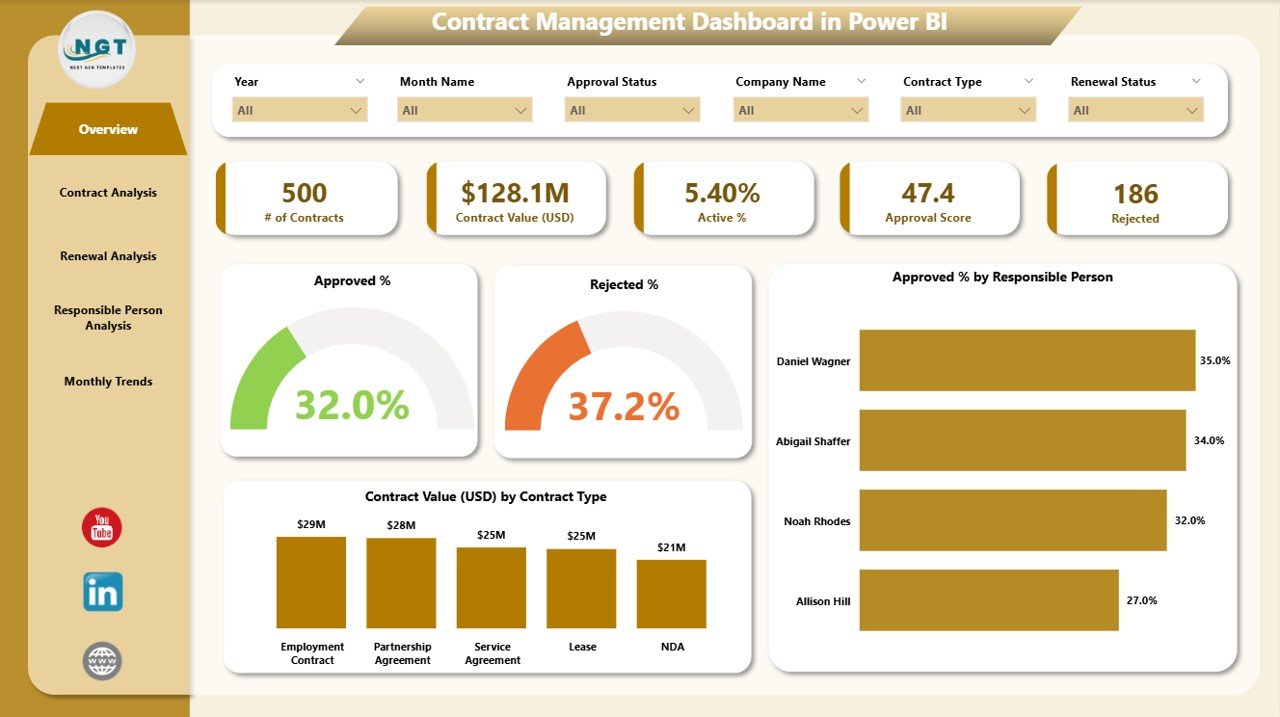
Looking at this dashboard, you can instantly see the value:
- Efficiency: Instead of manually chasing approval statuses, you have a real-time overview. You can quickly identify bottlenecks (e.g., a person with a low approval percentage).
- Risk Reduction: You can monitor the number of rejected contracts or track compliance against targets.
- Strategic Insight: You can analyze which contract types hold the most value or which departments are most active.
This is the value proposition in action: turning scattered data points into a clear picture that supports better business outcomes.
Conclusion
In this lesson, we established the fundamental business case for data management. You are now equipped to explain why organizations must treat data as a strategic asset.
Here are the key takeaways:
- Data is a vital, non-depletable enterprise asset. Its value can be magnified when managed effectively.
- Data management is driven by core business objectives: the need to increase revenue, improve operational efficiency, and decrease risk.
- The value proposition of data management is the delivery of tangible benefits like competitive advantage, cost savings, and better decision-making, which can be visualized through tools like dashboards.
Understanding these foundational concepts is the first and most critical step. Without a clear link to business drivers and value, any data management initiative is likely to fail.
Preview of the next lesson: Now that we've covered the "why," our next lesson will address the "what." We will introduce the DAMA-DMBOK framework, exploring its structure and the eleven key knowledge areas that constitute the full scope of data management.