Hello! Welcome back to our course on the DAMA Data Management Body of Knowledge (DMBOK).
In our last lesson, we explored the "why" of data management, focusing on the business drivers and the value it brings to an organization. We established that data is a critical business asset that needs to be managed strategically.
Today, we'll build on that foundation by exploring the "what" and "how." This lesson introduces the DAMA-DMBOK framework, the internationally recognized standard for data management. By the end of our session, you'll be able to describe this framework and, crucially, explain how its different components—the Knowledge Areas—interact with each other. This framework will serve as our map for the rest of the course and is central to your goal of achieving CDMP certification.
1. Introducing the DAMA-DMBOK Framework
The DAMA Data Management Body of Knowledge (DMBOK) is not a rigid methodology or a specific technology. Instead, think of it as a comprehensive guide that provides a common vocabulary, a set of best practices, and a structured way of thinking about all the activities involved in managing data.
What Is DAMA-DMBOK? A Complete Data Governance ...
For a clear, high-level introduction, this article from OvalEdge explains what the DAMA-DMBOK framework is and why it's so important for data governance.
Please read the section 'What is DAMA-DMBOK?'. Focus on how it's described as a reference model that defines 'what good data management looks like' rather than prescribing a single way to do things.
As the article notes, the framework helps organizations treat data as a managed asset by standardizing definitions, clarifying ownership, and supporting better decision-making.
2. The 11 Knowledge Areas
The framework is organized around eleven Knowledge Areas (KAs). Each KA represents a specific discipline within the broader field of data management. Let's look at the official source to see what they are.
This document from DAMA International outlines the official structure for the DMBOK 2nd edition. It presents the eleven Knowledge Areas that form the core of the framework.
Please read section 4.1 'Knowledge Areas' on pages 8-10 of the PDF. Pay close attention to the list of the 11 Knowledge Areas and their brief definitions. Also, take a look at Figure 1, 'The DAMA-DMBOK2 Guide Knowledge Area Wheel'. We will be referring to this visual model throughout the lesson.
As you saw, the framework is often visualized as a wheel. This is a powerful metaphor that we will unpack in the next section.
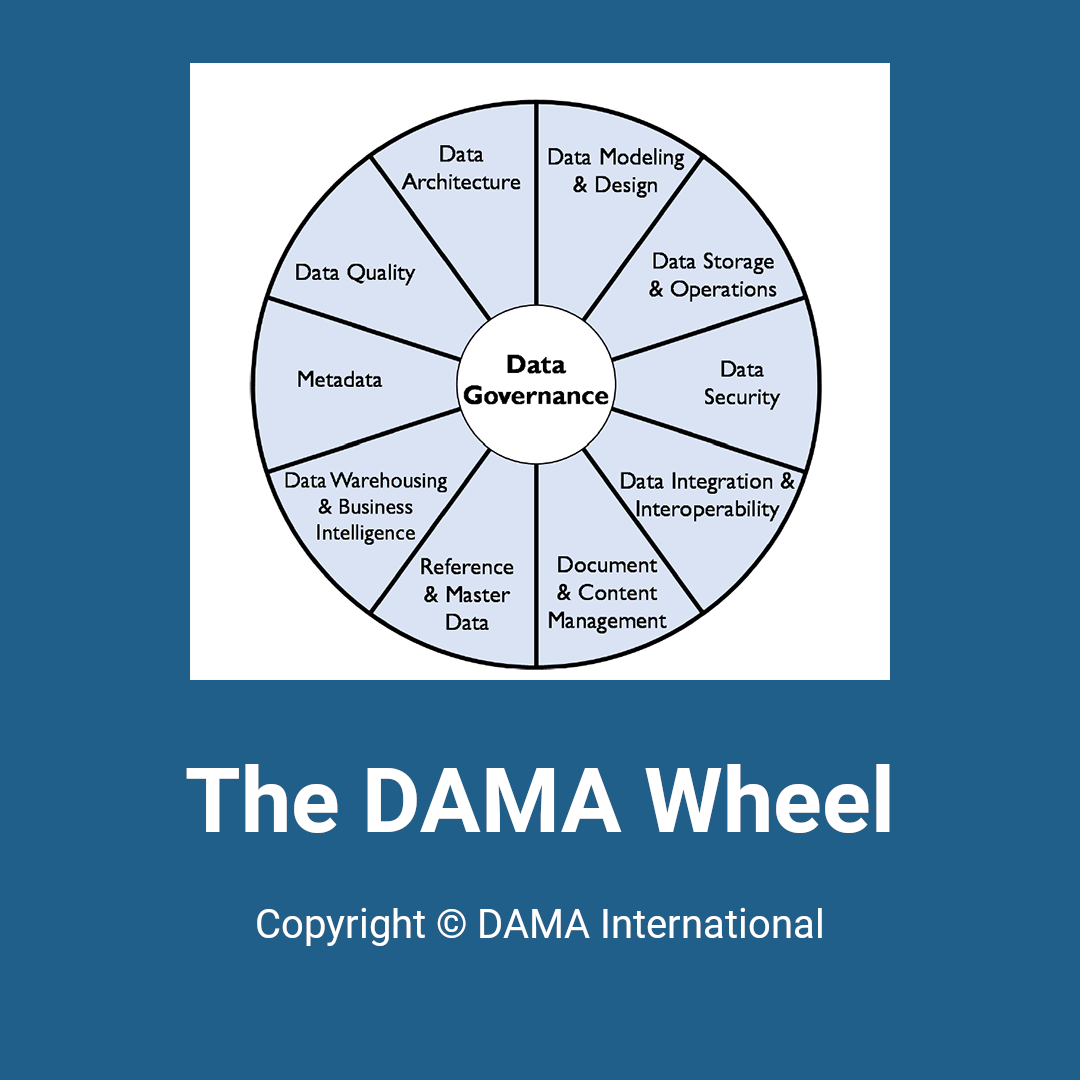
Here are the 11 Knowledge Areas presented on the wheel:
- Data Governance: The core practice of planning, oversight, and control over data management.
- Data Architecture: The overall structure of data and how it aligns with enterprise strategy.
- Data Modeling & Design: The process of creating representations of data entities and their relationships.
- Data Storage & Operations: Managing the physical storage, backup, and recovery of data.
- Data Security: Ensuring data privacy, confidentiality, and appropriate access.
- Data Integration & Interoperability: Moving and consolidating data across different systems.
- Documents & Content: Managing data found in unstructured sources like documents, emails, and images.
- Reference & Master Data: Managing critical, shared data like Customer, Product, or Vendor information to ensure consistency.
- Data Warehousing & Business Intelligence: Providing data for reporting, analytics, and decision support.
- Metadata: Managing "data about data"—its definition, lineage, and usage.
- Data Quality: Defining, measuring, and improving the accuracy, completeness, and reliability of data.
Over the coming modules, we will dedicate lessons to each of these areas. For now, the goal is to understand how they fit together.
3. How the Knowledge Areas Interrelate
The DAMA Wheel isn't just a list; it's a model of an integrated system. No single Knowledge Area operates in a vacuum. They are all deeply interconnected, with Data Governance serving as the coordinating hub.
Let's explore two ways to understand these interrelationships: through the data lifecycle and through a foundational pyramid.
Perspective 1: The Data Lifecycle
One of the most practical ways to see the KAs interact is by following the journey of data through an organization—from its creation to its eventual disposal.
Data Management and Data Ethics | CDMP Study Session | DMBOK ch. 1 and 2
This CDMP study session provides an excellent walkthrough of how the Knowledge Areas apply to different stages of the data lifecycle.
Please watch the segment from 03:40 to 10:13. The speaker connects phases of the data lifecycle (Plan, Design, Create, etc.) directly to specific DMBOK chapters, which correspond to our Knowledge Areas. Note how different KAs become relevant at different stages.
The video illustrates a dynamic flow where multiple KAs work together. Here's a summary of those connections:
| Data Lifecycle Phase | Relevant Knowledge Areas |
|---|---|
| Plan & Design | Data Governance (sets strategy), Data Architecture (defines blueprints), Data Modeling & Design (designs structures). |
| Create & Acquire | Data Integration & Interoperability (brings data in), Reference & Master Data (uses shared data). |
| Store & Maintain | Data Storage & Operations (manages databases), Data Security (protects stored data), Data Quality (cleans and validates). |
| Use & Enhance | Data Warehousing & BI (for analysis), Metadata (to understand what the data means). |
| Archive & Dispose | Data Governance (enforces retention policies), Data Storage & Operations (performs the archival/purging). |
This lifecycle view shows that data management isn't a linear project but a continuous cycle where different disciplines collaborate.
Perspective 2: The Foundational Pyramid
Another way to see the relationships is as a hierarchy of dependencies. Some KAs provide the foundation that enables others.
Data Management and Data Ethics | CDMP Study Session | DMBOK ch. 1 and 2
The Aiken Pyramid is another model that shows the dependencies between data management disciplines. Let's watch an earlier part of the same video to understand this concept.
Watch the clip from 01:01 to 02:46. Focus on the core message: why it's ineffective to pursue advanced initiatives like data science without first establishing a solid foundation in areas like data governance and quality.
The pyramid model reinforces a key principle that aligns with your preference for a logical, step-by-step approach. It shows that you must establish a strong foundation before building more complex capabilities.
- Foundation: Data Governance, Data Quality, Metadata, and Data Architecture. These are the non-negotiable basics.
- Mid-Tier: Once the foundation is solid, you can effectively implement Data Warehousing, Master Data Management, and Data Integration.
- Top-Tier: Only then can you reliably pursue advanced initiatives like Data Science, AI, and complex analytics.
Attempting to build a Business Intelligence dashboard (top tier) using data of unknown quality from poorly governed sources (weak foundation) is a recipe for failure. The insights will be untrustworthy, and the project will lack credibility.
Test your understanding!
Imagine your firm wants to create a central "Subcontractor Master Data" repository to have a single, reliable source of truth for all subcontractors it works with. This falls under the Reference & Master Data Knowledge Area.
Thinking about the DAMA Wheel and the concept of interdependencies, list three other Knowledge Areas that would be critical for this project's success. For each, write one sentence explaining its role.
Show answer
Here are a few possible correct answers. You might have chosen others that are also valid.
- Data Governance: To define ownership of the subcontractor data (e.g., who is responsible for its accuracy?) and set policies for how it is created, updated, and used across the company.
- Data Quality: To establish and enforce rules ensuring that subcontractor information, such as business registration numbers and bank details, is accurate, complete, and consistently formatted.
- Data Integration & Interoperability: To extract existing subcontractor data from various source systems (e.g., the accounting system, project management software, Excel lists) and load it into the new central repository.
- Data Security: To implement access controls to ensure that only authorized personnel can view or modify sensitive subcontractor information, such as payment details.
Conclusion
In this lesson, we transitioned from the "why" of data management to the "what" and "how" by dissecting the DAMA-DMBOK framework. This structure provides the vocabulary and blueprint for all professional data management work.
Here are your key takeaways:
- The DAMA-DMBOK framework consists of 11 interconnected Knowledge Areas, visually represented by the DAMA Wheel.
- Data Governance is the central, coordinating KA that provides planning, oversight, and control for all others.
- The Knowledge Areas interrelate dynamically throughout the data lifecycle, with different disciplines taking the lead at different stages.
- There is a foundational dependency among the KAs; success in advanced areas like BI and analytics relies on a solid base in governance, quality, and architecture.
You now have a map of the data management landscape. This overview is essential for contextualizing each specific topic we will cover and for understanding the holistic nature of the discipline.
Preview of the next lesson: In this lesson, we saw the map of data management. In our next lesson, we will zoom in on the people who navigate this landscape. We'll identify the key roles and responsibilities of data management professionals, including the crucial role of the Data Steward.