Hello! Welcome to the final lesson of our first module, "Foundations of Data Management."
In our last session, we classified data into three fundamental types: structured, semi-structured, and unstructured. We saw how the type of data dictates how it can be stored and processed. Now, we'll explore what happens to that data over its entire lifespan.
Today's learning outcome is to apply the data lifecycle concept to organizational scenarios. Just like a product is designed, manufactured, used, and eventually retired, data also has a lifecycle. Understanding this journey is essential for managing data effectively, ensuring its quality and security, meeting legal requirements, and ultimately, deriving value from it. This concept is a cornerstone of the DAMA DMBOK framework and will be crucial for both your certification goals and practical work.
1. What is the Data Lifecycle?
Let's begin with a straightforward model to understand the core stages of data's existence. The video below introduces the concept using the well-known "CRUD" acronym (Create, Read, Update, Delete) and expands upon it with key considerations for each stage.
Understanding The Data Lifecycle
This video from Projerra, titled 'Understanding The Data Lifecycle', provides a clear and practical introduction to the stages data goes through. It uses a memorable framework to break down the lifecycle.
Please watch the full video (0:00 - 11:27). As you watch, focus on the 'who, what, where, when, why, and how' questions the presenter asks for each of the four main stages: Create, Read, Update, and Delete. Also, take note of the two supporting elements mentioned at the end.
As the video explains, we can think of the data lifecycle in these core stages:
- Create: The moment data is born. This could be manual entry (like a new supplier record), automated capture (like a sensor reading), or acquisition from a third party.
- Read (or Use): The stage where data delivers its value. It is viewed, used in reports, or fed into an application.
- Update: The modification of existing data. This could be correcting an error, adding new information, or reflecting a change in the real world (e.g., a customer's new address).
- Delete (or Destroy): The end of the line. This isn't always a simple deletion; as the video noted, it can mean deactivating, archiving for long-term storage, or permanent destruction.
The video also wisely adds Storage and Security as critical, overarching concerns that apply throughout the entire lifecycle.
2. A Formal Look: The DAMA DMBOK Data Lifecycle
The CRUD model is a great starting point, but for enterprise data management, a more comprehensive framework is needed. The DAMA DMBOK provides a detailed model that is widely accepted in the industry.
Take a look at the official DAMA-DMBOK data lifecycle diagram below.
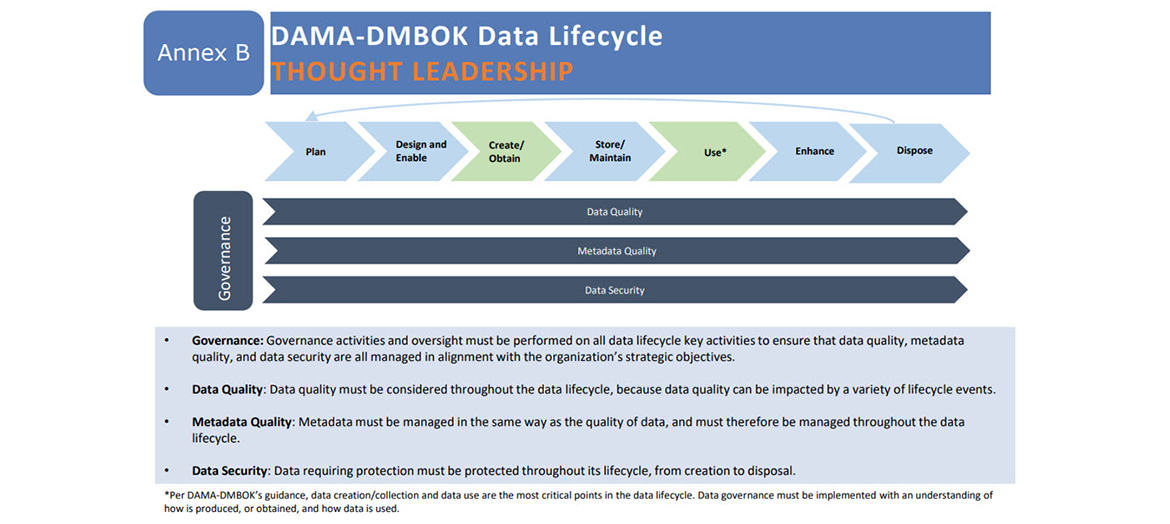
This model is more granular and includes critical preliminary and enhancement stages:
- Plan and Design & Enable: These stages happen before data is even created. They involve defining data requirements, modeling data structures, and architecting the systems that will manage the data.
- Enhance: This stage acknowledges that data is often improved and enriched over time, not just used as-is.
- Governance: Crucially, the diagram shows "Governance" as an umbrella over the entire lifecycle, ensuring quality, security, and metadata are managed at every single step.
To get more detail on what each of these stages involves in a modern organization, let's turn to a more in-depth article. The model presented here aligns well with the DAMA framework.
Data Lifecycle Management and the Role of the Data Catalog
The article 'Data Lifecycle Management and the Role of the Data Catalog' from Alation provides an excellent breakdown of a modern, six-phase data lifecycle.
Please read the sections from 'The phases of the data lifecycle' down to the end of 'Retirement: Secure data destruction and removal'. Focus on understanding the activities and best practices described for each of the six phases: Ingestion, Processing, Storage, Usage, Archival, and Retirement.
As you can see, these formal models provide a robust framework for managing enterprise data. They ensure that we think about data not just at the moment of use, but from its conception all the way to its final disposition.
3. Application: The Lifecycle of a Contract
Now, let's make this concrete by applying the data lifecycle concept to a scenario from your professional background: contract management. You already have deep experience with the lifecycle of a contract; now we'll frame it through the lens of a data manager.
The process of managing a contract from start to finish is known as Contract Lifecycle Management (CLM). Please read the following text, which outlines the typical stages of a contract's life.
Best practices for Contract Lifecycle Management (CLM)
This article, 'Best practices for Contract Lifecycle Management (CLM)' by Agiloft, details the eight stages of a contract's lifecycle. This provides a perfect real-world process to which we can map our data lifecycle concepts.
Please read the section titled 'The 8 stages of a contract’s lifecycle'. As you read about each stage (from Request and Initiation to Record Keeping), think about what is happening to the data associated with the contract.
Test your understanding!
Now for the main activity of this lesson. Try to map the 8 stages of the Contract Lifecycle you just read about to the 6 stages of the Data Lifecycle from the Alation article (Ingestion, Processing, Storage, Usage, Archival, Retirement).
For example, which data lifecycle stage best describes "Contract request and initiation"?
Think through each of the 8 contract stages and decide which of the 6 data lifecycle stages it aligns with most closely. Some contract stages might even touch on multiple data stages. Jot down your thoughts before checking the answer.
Show answer
Here is a possible mapping, along with explanations. Your interpretation might be slightly different, and that's okay! The key is to see the parallels.
| Contract Lifecycle Stage (CLM) | Data Lifecycle Stage(s) (DLM) | Explanation |
|---|---|---|
| 1. Contract request and initiation | Ingestion | This is where the initial data about the need for a contract is created and captured (e.g., supplier name, project scope, required dates). This data is ingested into the CLM system. |
| 2. Drafting the contract | Ingestion / Processing | The contract document (unstructured data) is created. Structured metadata (e.g., key dates, contract value) is also created and associated with it. This is a form of data creation (ingestion) and initial data organization (processing). |
| 3. Reviewing and negotiating terms | Usage / Processing | Multiple stakeholders are accessing and reading the data (Usage). They are also making changes, adding comments, and creating new versions. This modification and transformation of the contract data is a form of Processing. |
| 4. Approvals and final sign-off | Usage | The data (the final draft of the contract) is being used to make a final business decision. The approval itself is a new piece of data that is captured and linked to the contract record. |
| 5. Contract execution (e-signature) | Processing / Storage | The act of signing transforms the draft into a legally binding executed contract (Processing). The executed version is then saved as the authoritative record, the "golden copy," in a secure repository (Storage). |
| 6. Obligation and compliance management | Usage | This is a core Usage phase. The contract data is actively monitored and analyzed to track deadlines, manage obligations, and ensure compliance. This is where the data provides ongoing operational value. |
| 7. Contract renewal or termination | Usage / Archival / Retirement | The contract's performance data is used (Usage) to decide whether to renew or terminate. If terminated and no longer needed for active business, it moves into the next phase. Depending on retention policies, it might be moved to a low-cost Archival tier or be flagged for permanent deletion (Retirement). |
| 8. Record keeping | Storage / Archival | This is the long-term management of the contract data. It encompasses secure active Storage during its life and moving it to an Archival state for compliance and audit purposes after it expires, according to the organization's data retention policies. |
This exercise demonstrates that you've been intuitively working with the data lifecycle for years. By applying a formal data management framework, we can make that process more deliberate, efficient, and compliant.
4. The Bigger Picture: Lifecycle and the DAMA Knowledge Areas
Finally, it's vital to remember that managing the data lifecycle isn't an isolated activity. It is supported by, and intersects with, all other data management knowledge areas.

As this diagram and the DAMA wheel show, Data Governance is central. It sets the rules for the entire lifecycle. Data Security must be applied at every stage, not just storage. Data Quality must be checked at ingestion and monitored throughout. Metadata Management provides the context needed to understand and use the data at each point in its journey.
Conclusion
This lesson concludes our foundational module. We've defined the data lifecycle and seen how it applies to a real-world business process you're familiar with.
Key Takeaways:
- Data has a lifecycle, typically including stages like creation, processing, usage, storage, and disposal.
- Formal models like the DAMA DMBOK lifecycle provide a comprehensive framework for managing data from planning to retirement.
- This abstract concept has direct, practical applications. The lifecycle of a contract is a perfect example of a data lifecycle in action, encompassing structured metadata and unstructured document content.
- Effective Data Lifecycle Management (DLM) is not done in a silo; it is underpinned by Data Governance and integrated with all other data management knowledge areas.
Preview of the next module:
We've repeatedly seen how critical Data Governance is to the entire field of data management. It's the foundation upon which everything else is built. Therefore, it's the perfect topic for our next module. In our next lesson, we will begin Module 2: "Data Governance and Ethics" by addressing the learning outcome: Define data governance and explain its importance for organizational success.