Hello! Welcome back to our course.
In our last lesson, you did some excellent hands-on work creating two versions of a scene to explore the power of visual hierarchy. You saw firsthand how controlling elements like contrast, lighting, and focus can transform a chaotic image into a clear, guided story.
Today, we're going to flip the coin. Instead of creating composition, we're going to deconstruct it. Your goal is to train your "artistic eye" by dissecting the work of masters. This is a crucial skill for any artist, especially one looking to direct their own work. By learning to see the invisible architecture that holds a great image together, you'll be able to build it into your own art more intuitively.
Our learning outcome for this lesson is to analyze and diagram the composition of 3 master paintings or film stills, identifying key principles. This is an active, analytical task—think of it as reverse-engineering a beautiful piece of visual code.
1. The Analyst's Toolkit: What to Look For
Before you can deconstruct an image, you need to know what parts you're looking for. The elements of composition are the vocabulary artists use to tell stories visually.
To get a comprehensive overview of these elements, let's start with a video that breaks them down with excellent cinematic examples.
Ultimate Guide to Film Composition & Framing — Key Elements Explained [Shot List Ep. 11]
The video 'Ultimate Guide to Film Composition & Framing' from StudioBinder provides a fantastic tour of the core building blocks of composition. As you watch, don't worry about memorizing everything. Just absorb the concepts—we'll be putting them into a structured framework next.
Watch the video from the beginning until 12:56. This covers all the key elements: focal points, lines, shapes, space, depth, balance, angles, color, and tone. Pay attention to how each element serves a purpose in guiding the eye or creating a mood.
That video gave you the "what." Now, let's establish the "how"—a systematic process for your analysis. Trying to analyze everything at once can be overwhelming. Instead, we can use a structured, step-by-step approach.
How to Analyze Art (Composition)
The video 'How to Analyze Art (Composition)' by Let’s Learn About Art offers a simple yet powerful four-step template for analysis. This structured method will be the foundation for your task today.
Watch the full video. Pay close attention to the four steps proposed: Balanced or Dynamic: What's the overall energy? Focal Points: Where does your eye go first, and why? Visual Movement: What path does your eye follow? Proximity of Elements: How do the relationships between objects create meaning?
2. A Framework for Deconstruction
Combining those resources, here is a practical framework you can use for your analysis. For any given image, ask yourself these questions:
-
First Impression & Mood:
- Is the composition balanced and stable (e.g., symmetrical, horizontal lines) or dynamic and tense (e.g., asymmetrical, diagonal lines)?
- What is the overall mood (e.g., calm, chaotic, powerful, lonely), and how do the compositional choices support it?
-
Guiding the Eye:
- What is the primary focal point? How is it created (e.g., high contrast, isolation, placement on a rule-of-thirds intersection)?
- Are there secondary focal points? How is the visual hierarchy established?
- What leading lines (explicit or implied) guide your eye through the scene? Can you trace the visual path your eye takes from one point to another?
-
Underlying Structure:
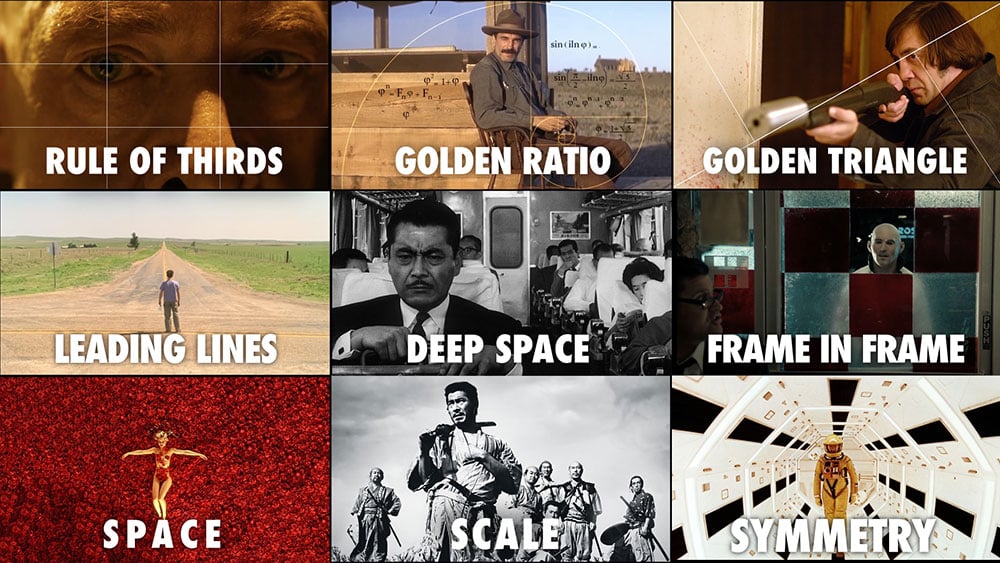
- Can you identify any classical principles like the Rule of Thirds, Golden Ratio/Spiral, or Golden Triangles?
- Is symmetry or asymmetry used deliberately?
- Are there strong geometric shapes (triangles, circles) or frames-within-a-frame that organize the elements?
Here's a quick visual reminder of some of these principles in action.
3. The Power of Diagramming: A Walkthrough
Writing about composition is one thing, but diagramming it is a powerful way to solidify your understanding. It forces you to actively identify and trace the structures within the frame. This is precisely the kind of hands-on analysis that will accelerate your learning.
The article "How to analyze an artwork" from the Student Art Guide explicitly recommends this.
How to analyze an artwork: a step-by-step guide for students
This article is a very thorough guide to art analysis. We're not going to read it all, but I want to highlight its endorsement of using diagrams, as this will be a core part of your exercise.
Skim these sections to support your task: In the 'Art analysis tips' section, find the bullet point that begins with 'Support writing with visual analysis.' Read this paragraph to understand why sketching and diagramming is such a valuable analytical tool. Under 'Composition analysis: a list of questions,' browse the questions under 'System of arrangement' and 'Line.' These are excellent prompts for your own analysis. You don't need to answer them all; use them as a guide.
Let's look at a concrete example of a diagrammed analysis.

If we were to analyze this image using our framework:
- Impression: The composition is dynamic and full of movement, thanks to the strong diagonal lines and the asymmetrical balance.
- Guiding the Eye: Our eye might land on the foreground ballerina first, drawn by her scale and the intersection of diagonals on her head. The lines created by the other ballerinas' arms and legs then lead our eye around the frame in a circular motion.
- Structure: The artist uses a powerful system of intersecting diagonals rather than a simple grid. The figures are placed deliberately along these lines to create a sense of rhythm and connection.
Test your understanding!
You're analyzing a film still of a lone character standing in the middle of a long, empty hallway, shot straight-on. If you were to diagram this, what kind of lines would you most likely draw, and what compositional principle would you identify?
Show answer
You would most likely draw lines following the edges of the hallway walls, floor, and ceiling, which would all appear to converge towards a single point behind the character. You would identify this as one-point perspective and leading lines, which work together to create a strong sense of depth and draw immense focus to the character. You might also identify it as having symmetrical balance.
4. Your Turn: Deconstruct the Masters (Approx. 25-30 minutes)
Now it's time for you to become the analyst. Your task is to apply this process to three images of your choice.
Instructions:
-
Select Your Images: Choose 3 high-quality film stills or master paintings.
- For film, consider directors known for strong composition: Stanley Kubrick, Wes Anderson, Akira Kurosawa, Denis Villeneuve, or Roger Deakins (as a cinematographer). A great resource is the website film-grab.com.
- For paintings, look at artists like Rembrandt, Caravaggio, Johannes Vermeer, or Edgar Degas.
-
Analyze and Diagram Each Image:
For each of the three images, perform the following two steps.-
A. Create a Diagram:
- Open the image in any simple image editor (Photoshop, GIMP, Krita, even PowerPoint).
- On a new layer, draw lines, grids, and shapes over the image to identify the compositional structure.
- Highlight things like: Rule of Thirds grid, leading lines, key diagonals, triangles, frames-within-frames, and circles around focal points.
- Save this diagrammed image (e.g.,
analysis_1_diagram.jpg).
-
B. Write a Brief Analysis:
- In a simple text document, write a short paragraph or a few bullet points for each image, using our framework.
- Refer to your diagram and explain how the composition works.
- Focus on the how and why: Don't just say "it uses rule of thirds." Say "The character's eye is placed on the top-right rule of thirds intersection, making it a powerful focal point."
-
The goal is not a lengthy essay, but a sharp, focused breakdown of the visual mechanics. This exercise is pure practice for your artistic eye.
Conclusion
Great work today. You've transitioned from being a user of compositional rules to an analyst who can spot them in the wild. This ability to deconstruct is not just academic; it's a practical skill that directly feeds your creative intuition. The more you can see and understand the underlying structure in others' work, the more naturally you will build it into your own.
Key Takeaways:
- Analyzing masterworks is a form of active learning that trains your "artistic eye."
- A structured approach—assessing mood, eye-flow, and underlying structure—makes analysis manageable and effective.
- Diagramming is a powerful, hands-on tool that moves analysis from passive observation to active deconstruction.
- Key principles like the Rule of Thirds, leading lines, and geometric shapes are the invisible architecture of compelling images.
In our next lesson, we will complete our first module by bringing everything together. You will rework an existing personal piece by applying the improved compositional principles you've learned, from hierarchy and visual flow to the analytical insights you gained today.