Hello! Welcome back to our study of the Cuban Missile Crisis.
In our last lesson, we examined the immediate, practical policy consequences of the crisis: the establishment of the Moscow-Washington Hotline and the Limited Test Ban Treaty. These were tangible steps taken by leaders who, having stared into the nuclear abyss, recognized an urgent, shared need for better communication and the first constraints on the arms race.
Today, we move from practical mechanisms to the realm of high-level strategic thought. The crisis didn't just create new policies; it fundamentally solidified the core doctrine of nuclear deterrence that would define the rest of the Cold War. Our learning outcome for this lesson is to explain how the crisis solidified 'Mutually Assured Destruction' (MAD) as the central doctrine of nuclear deterrence. We'll trace the evolution of this grim but powerful idea and see how the events of October 1962 made it the unquestioned strategic reality for a generation.
The Theory of Deterrence Before the Crisis
The concept of Mutually Assured Destruction did not emerge out of nowhere in 1962. It was the culmination of nearly two decades of strategic thinking that began as soon as the first atomic bomb was detonated. Early theorists like Bernard Brodie grasped that the sheer power of these weapons changed everything. Their primary value wasn't in their use, but in the threat of their use to prevent war.
To understand how MAD became doctrine, we first need to grasp the key ideas that were being developed in the 1950s.
How Nuclear Deterrence Theory developed - The Cold War DOCUMENTARY
This video from The Cold War channel provides an excellent overview of how early nuclear deterrence theory developed. It covers the foundational concepts that were in place long before the Cuban Missile Crisis.
Please watch the following segments. As you watch, focus on three evolving concepts: Retaliation (06:14 - 06:49): Note the simple, core idea that the only way to prevent an attack is to promise a devastating counter-attack. Targeting (09:40 - 11:26): Pay attention to how the development of the H-bomb, with its immense power, shifted targeting philosophy away from specific military or industrial sites toward entire cities. Survivability (13:31 - 15:47): This is the most critical part. Focus on the concept of a 'second strike'. Understand why it became paramount not just to have nuclear weapons, but to be able to protect them and ensure you could launch them after being attacked.
To summarize the crucial points from the video:
- Deterrence by Retaliation: The basic idea was to prevent an attack by guaranteeing that the aggressor would suffer unacceptable damage in return.
- Second-Strike Capability: This became the cornerstone of deterrence. It wasn't enough to be able to strike first. To truly deter an enemy, you had to convince them that even if they launched a surprise attack and destroyed many of your forces, you would still have enough surviving nuclear weapons to launch a retaliatory "second strike" and destroy them.
- Vulnerability as a Goal: To make the second strike credible, strategists reasoned it should target what the enemy valued most and could not protect: its population and industrial centers. This is known as a countervalue strategy, as opposed to a counterforce strategy that targets military assets.
Before 1962, these were powerful but largely theoretical concepts debated by strategists at institutions like the RAND Corporation. The Cuban Missile Crisis was the event that burned these theories into the minds of the political leaders who actually commanded the weapons.
The Crisis: From Theory to Terrifying Reality
The 13 days in October 1962 served as a live-fire drill for nuclear brinkmanship. For Kennedy and Khrushchev, the abstract notion of "escalation" became a series of concrete, terrifying decisions.
In one of the early ExComm meetings, Secretary of Defense Robert McNamara and President Kennedy discussed whether the new missiles in Cuba fundamentally altered the strategic balance. Their conclusion was telling.
The Cuban Missile Crisis: At The Brink (PBS, 1992)
In this clip from the PBS documentary 'At The Brink,' you'll hear excerpts from the actual secret White House tapes. It reveals the thinking at the highest level.
Watch the segment from 16:06 to 18:09. Listen for Kennedy and McNamara's assessment. Do they believe the missiles create a new military threat, or do they see the problem differently? Note McNamara's explicit statement that he did not believe the missiles changed the military balance.
As you heard, McNamara's view was that the Soviets could already destroy the United States with their existing long-range missiles and submarines. The Cuban missiles didn't change the fundamental reality of mutual vulnerability; they just made it more immediate and politically explosive. Both leaders had the power to annihilate the other, and the crisis forced them to confront this fact in the most direct way imaginable.
This standoff is perfectly captured in a famous political cartoon from the era.
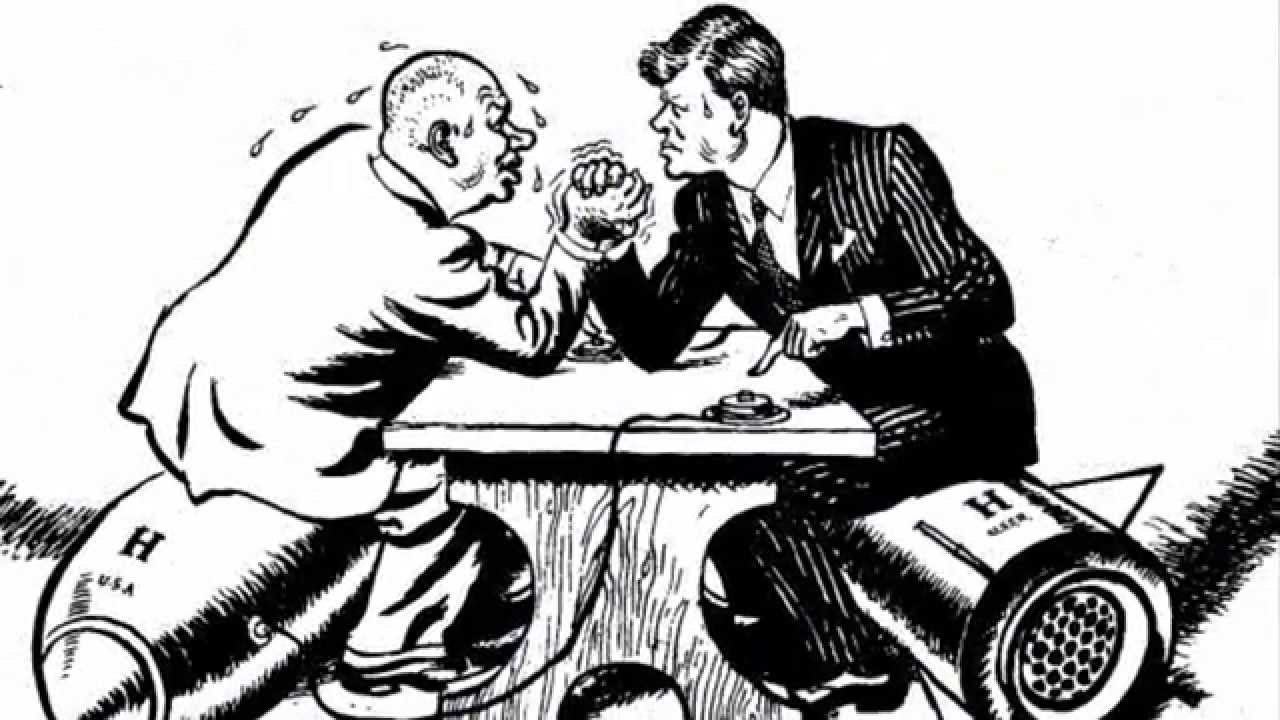
The lesson learned was clear, as participants later reflected. Brinkmanship with nuclear weapons was not a viable strategy.
Solidifying the Doctrine: McNamara's "Assured Destruction"
The shock of the crisis created the impetus to formalize this reality into official US policy. The chief architect of this was Robert McNamara. Having managed the crisis, he was determined to create a stable and predictable doctrine to prevent it from happening again.
He moved U.S. strategy away from any lingering, ambiguous ideas about "winning" a nuclear war toward an explicit doctrine he called "assured destruction."
The evolution of mutual assured destruction (MAD)
The Encyclopaedia Britannica article on MAD clearly explains this pivotal post-crisis shift in U.S. nuclear doctrine. It highlights McNamara's role in formalizing the concept.
Please read the section titled 'The evolution of mutual assured destruction (MAD)'. Focus on how the Cuban Missile Crisis prompted McNamara to shift from a 'counterforce' (military targets) to a 'countervalue' (cities) strategy, and his definition of 'assured destruction'.
As the article explains, McNamara quantified "assured destruction." He defined it as the ability to absorb a first strike and still be able to retaliate and destroy a significant percentage of the aggressor's population and industrial capacity (initially estimated at 20-33% of the population and 50% of industry).
The goal was no longer to "win," but to make the cost of starting a war so unthinkably high for both sides that no rational leader would ever contemplate it. When the Soviet Union also achieved a secure second-strike capability, this condition became mutual. Hence, "Mutually Assured Destruction," or MAD.
This thinking is laid bare in declassified government documents. For someone with your background in government policy, seeing the primary source can be particularly illuminating.
Program I Memorandum for the President, 23 September 1963
This document from the National Security Archive details a 1963 memorandum where Robert McNamara first lays out the concept of 'assured destruction' for President Kennedy as a way to determine required force levels. It's a fascinating look at how doctrine becomes policy.
Read the summary of 'Document 14' in the compilation. Focus on how McNamara defines the first 'block' of forces—the one essential for deterrence—and the specific level of destruction he believed would 'assure against a deliberate resort to general war'.
This memo is the policy DNA of MAD. It shows a shift from simply building more weapons to calculating how much is enough to guarantee the destruction of the enemy as a functioning society. The cold, analytical language masks a terrifyingly simple logic: if both sides can guarantee this outcome, a stable (though frightening) peace is achieved.
Conclusion
The Cuban Missile Crisis acted as a crucible for nuclear strategy. While the components of MAD—second-strike capability, countervalue targeting, and the concept of deterrence by punishment—existed before 1962, the crisis transformed them from academic theories into the central, organizing principle of superpower relations.
Key Takeaways:
- From Theory to Reality: The crisis moved the concept of a full-scale nuclear exchange from a theoretical possibility to a real and present danger in the minds of leaders.
- Solidification of Doctrine: In the aftermath, Secretary of Defense Robert McNamara formally articulated the doctrine of "Assured Destruction," defining a quantifiable level of devastation that the U.S. must be able to inflict in a retaliatory strike.
- The Logic of MAD: The doctrine rests on each superpower having a survivable second-strike capability, making any potential first strike an act of national suicide. This created a paradoxical form of stability based on shared vulnerability.
- A Shift in Goal: The objective of nuclear strategy was no longer to "win" a nuclear war, which the crisis proved impossible, but to prevent one from ever starting.
In our next lesson, we will delve into the great debate that has raged ever since. We will contrast the arguments that the crisis proves both the stabilizing effect of nuclear deterrence and the inherent dangers of proliferation and miscalculation. Is MAD a brilliant, peace-keeping paradox or a reckless gamble with the fate of humanity?