Hello! Welcome back.
In our last lesson, we identified the key individuals and factions—the 'hawks' and 'doves'—within the US, USSR, and Cuba, mapping them on a Power/Interest grid. We saw that upon discovering the Soviet missiles, President Kennedy convened ExComm, a group of powerful advisors with sharply conflicting views on how to respond.
This lesson drills down into the heart of ExComm's initial, frantic deliberations. We will move from who the players were to what they proposed to do. Your experience as a private secretary and in various government departments has no doubt exposed you to the high-pressure environment of a crisis, where a range of policy options must be generated and appraised rapidly. Today, we will conduct a similar appraisal.
By the end of this lesson, you will be able to appraise the initial US response options discussed by ExComm by listing the primary pros, cons, and potential risks of each.
The Men in the Room
On the morning of October 16, 1962, the members of ExComm gathered in the Cabinet Room of the White House. The atmosphere was one of shock, anger, and extreme tension. They were facing an unprecedented strategic challenge, and the fate of the world rested on their recommendations.

Their first task was to generate a set of possible responses. Let's start with a clear, high-level overview of the four main avenues they considered.
Teacher Talks - Cuban Missile Crisis - Watch, Revise, Repeat.
This clip from Horizon History provides an excellent summary of the four basic categories of options that President Kennedy had to consider, along with their most immediate pros and cons.
Please watch from 12:19 to 16:16. The video walks through the options of 'doing nothing', 'attacking Cuba', 'diplomacy', and 'blockading Cuba'.
The video gives us a solid framework. Now, let's use declassified records and historical analysis to add the detail and nuance that ExComm itself grappled with. We'll examine the arguments made for and against each option, as if we were preparing a briefing note for the President.
Appraising the Options
The choices before ExComm were not neat and tidy. They ranged from passive acceptance to global war, with a series of complex, risky alternatives in between. The initial discussions can be grouped into three broad categories: a passive/diplomatic path, an aggressive military path, and a middle course of coercive pressure.
Let's examine the detailed arguments for each, drawing on the actual discussions that took place in those first few days.
[PDF] The Cuban Missile Crisis: United States Deliberations and Actions
To understand the debate in detail, we'll turn to an academic paper, 'The Cuban Missile Crisis: United States Deliberations'. This provides a structured look at the options ExComm considered, distinguishing between diplomatic solutions, the 'fast track' (military strike), and the 'slow track' (blockade).
Please read the following sections of the paper. You don't need to memorise every detail, but focus on the core arguments for and against each course of action. Start under the heading 'U.S. POLICY RESPONSE' and read to the end of that section. Continue through the next five paragraphs, which discuss the rejection of purely diplomatic options, the 'fast track' (air strike), the 'slow track' (blockade), and the strong moral opposition to a surprise attack. This will take you from the bottom of page 6 to the middle of page 9.
Based on the video and the reading, we can now construct a detailed appraisal of the options, much like ExComm did.
| Option | Proponents (Initial Stance) | Pros (The Upside) | Cons (The Downside) | Risks (The Unintended Consequences) |
|---|---|---|---|---|
| 1. Do Nothing / Diplomatic Protest | No one seriously advocated doing nothing | - Avoids any immediate risk of military conflict. | - Politically catastrophic for Kennedy; seen as weak and indecisive. - Fails to remove the missile threat. - Cedes the strategic initiative to the USSR. - Undermines US credibility with allies. |
- Emboldens the Soviets to take further aggressive actions, for example in Berlin. |
| 2. Air Strike ("Fast Track") | Joint Chiefs of Staff, McCone, Bundy, Acheson | - Physically destroys the missiles, directly removing the threat. - A decisive show of American strength and resolve. - Could be limited to missile sites ("surgical") or expanded to remove Castro's air force. |
- A "surgical" strike could not guarantee destroying all missiles. - A surprise attack would be a "Pearl Harbor in reverse," morally compromising the US (R. Kennedy). - Kills Soviet personnel. |
- A surviving missile could be launched against the US. - A conventional Soviet response against US bases in Turkey or a move on West Berlin. - Rapid, uncontrollable escalation to nuclear war. |
| 3. Full-Scale Invasion | Some of the most ardent 'hawks' | - Removes the missiles and the Castro regime, permanently solving the "Cuba problem." | - Incurs massive casualties (US, Cuban, Soviet). - Guarantees international condemnation and alienates allies. - Gives the Soviets justification for a major response elsewhere. |
- Almost certain to trigger a full-scale war with the Soviet Union, likely leading to nuclear exchange. |
| 4. Naval Blockade ("Slow Track") | McNamara, R. Kennedy, Ball | - A firm military action, but short of an act of war. - Puts the burden of the next move on Khrushchev. - Prevents more missiles from arriving. - Allows time for diplomacy and negotiation. |
- Does not remove the missiles already in Cuba. - Could be legally challenged as an act of war. - Could drag on for weeks while missiles become fully operational. |
- A Soviet ship could challenge the blockade, forcing the US Navy to fire the first shot and trigger an escalation. |
This table summarises the immense pressures and trade-offs ExComm faced. The 'hawks', led by the military, saw the problem in purely strategic terms: a threat had appeared and must be eliminated. The 'doves', led by civilians like McNamara and Robert Kennedy, were more attuned to the political and moral dimensions, and the catastrophic risk of uncontrolled escalation.
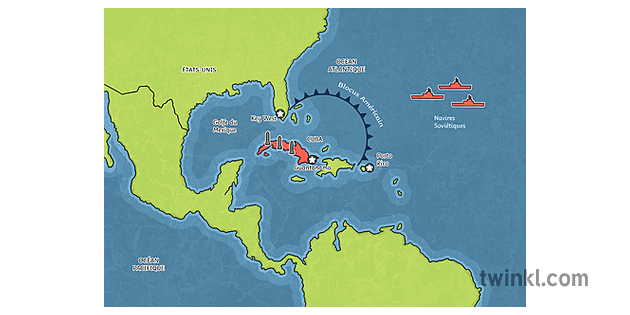
Visualising the "Slow Track"
The option that gained the most traction among the 'doves' was the naval blockade, which they strategically renamed a "quarantine" to sound less like an act of war. This option was a direct confrontation, but one that occurred on the open seas, giving both sides a crucial margin of time and space to think before acting.
The Evolution of the Debate
The debate was not static; it evolved as new intelligence came in and as advisors had more time to reflect. The initial gut reaction of many, including President Kennedy himself, was to favour a military strike. However, the profound risks and moral questions began to shift the consensus.
To see how the arguments sharpened over the first few days, let's watch one more detailed account of the initial ExComm meetings.
Shall we wipe Cuba off the Map? | The Cuban Missile Crisis I Day 01
The TimeGhost History channel provides a minute-by-minute feel for the first day's debates, showing how the different options were first articulated and challenged.
Please watch from 04:48 to 10:54. This covers the first two ExComm meetings on October 16th. Notice how the initial, broad ideas start to solidify into the more concrete 'air strike' versus 'blockade' alternatives.
As the video shows, the early discussions were a chaotic mix of strategic analysis, intelligence gaps (Did the Cubans have control? Where were the warheads?), and political calculation. Secretary McNamara's concern about not knowing "what kind of a world we live in after we've struck Cuba" perfectly captures the fear of the unknown that ultimately steered the administration away from the 'fast track' and towards the 'slow track'.
Conclusion
In this lesson, we have moved into the heart of the crisis room and appraised the choices facing President Kennedy and ExComm. This process of identifying options and rigorously assessing their pros, cons, and risks is the central function of executive crisis management.
Key Takeaways:
- ExComm initially considered a wide spectrum of options, from inaction to full-scale invasion.
- The debate quickly centered on two main paths: the "fast track" (an immediate air strike) and the "slow track" (a naval quarantine).
- The air strike offered decisiveness but carried an immense risk of failure and uncontrollable escalation, as well as significant moral objections.
- The naval quarantine was seen as a more controllable, reversible action that placed the onus for escalation on the Soviets, though it did not solve the immediate problem of the missiles already on the island.
- The final choice was shaped as much by the fear of unknown consequences and moral considerations as it was by pure military logic.
As we know, President Kennedy ultimately chose the "slow track" of a naval quarantine. In our next lesson, we will delve deeper into that specific decision, using a formal policy tool to apply Cost-Benefit Analysis (CBA) to the naval 'quarantine' option, incorporating non-market values like international prestige and risk of escalation.