Hello! Welcome to your first lesson in the "Mafia in glass industry baddies" course. I'm excited to get started with you on this fascinating topic.
Introduction
Given your background in history and your work in the civil service, you're uniquely equipped to appreciate the subject of our first lesson. We'll be examining a complex organization with its own deep-rooted history, strict hierarchy, and internal codes—themes that echo studies of statecraft and societal structures.
Today's lesson addresses the first learning outcome of our course: Define the term 'mafia' in the context of Italian-American and Sicilian organized crime, outlining its core characteristics, codes of conduct, and organizational structure.
We will build a clear, foundational understanding of who these "baddies" are before we explore how they infiltrated the glass industry. We will cover:
- The distinction between the generic term 'mafia' and the specific entities of the Sicilian Cosa Nostra and the American La Cosa Nostra (LCN).
- The rigid hierarchical structure common to Mafia families.
- The codes, rituals, and rules that govern members' behaviour.
This lesson should take you approximately 60 minutes to complete.
1. What is the 'Mafia'? From Sicily to America
The word 'mafia' is often used as a catch-all for organized crime, but for our purposes, we need to be much more precise. The term originates in Sicily and refers to a specific criminal society: the Cosa Nostra ("Our Thing"). This organization later established an offshoot in the United States, which became known as the American Mafia or La Cosa Nostra (LCN).
To get a feel for the origins and mystique of the Sicilian Mafia, let's start with a short video.
This introduction highlights the environment of historical instability in Sicily from which the Mafia emerged, initially as a provider of "protection" and a form of parallel governance.
Now, let's ground this in a more formal definition. Please read the following two sections from the Wikipedia article on the Sicilian Mafia. This should take about 7-8 minutes.
Reading 1: Defining the Sicilian Mafia
Sicilian Mafia (Definition and Overview; Etymology and Terminology)
As you read, focus on these key points:
- The Mafia's core business: protection racketeering and arbitrating disputes.
- The members' own term for their society: Cosa Nostra.
- The important distinction made by Judge Giovanni Falcone, who warned against using "Mafia" as an all-inclusive term for organized crime.
While born in Sicily, the organization put down deep roots in the United States. While it shares a name and heritage, the American LCN evolved in a different context.
Reading 2: La Cosa Nostra in the U.S.
Please read this brief overview from a U.S. Department of Justice report. It will take you only a minute or two.
La Cosa Nostra in the United States (Definition and Overview of La Cosa Nostra)
This report emphasizes the LCN's unique capacity in the U.S. for monopolizing criminal markets, using violence, and corrupting legitimate industries—a capacity that made its infiltration of sectors like glass and construction possible.
2. The Organizational Structure: A Hierarchy of Power
Both the Sicilian and American Mafia are defined by a clear, hierarchical structure. Understanding this chain of command is essential to understanding how they operate and maintain control. Your experience in the civil service will likely make these kinds of organograms feel quite familiar, though the objectives are, of course, vastly different.
Below is a typical organizational chart for a Mafia family.
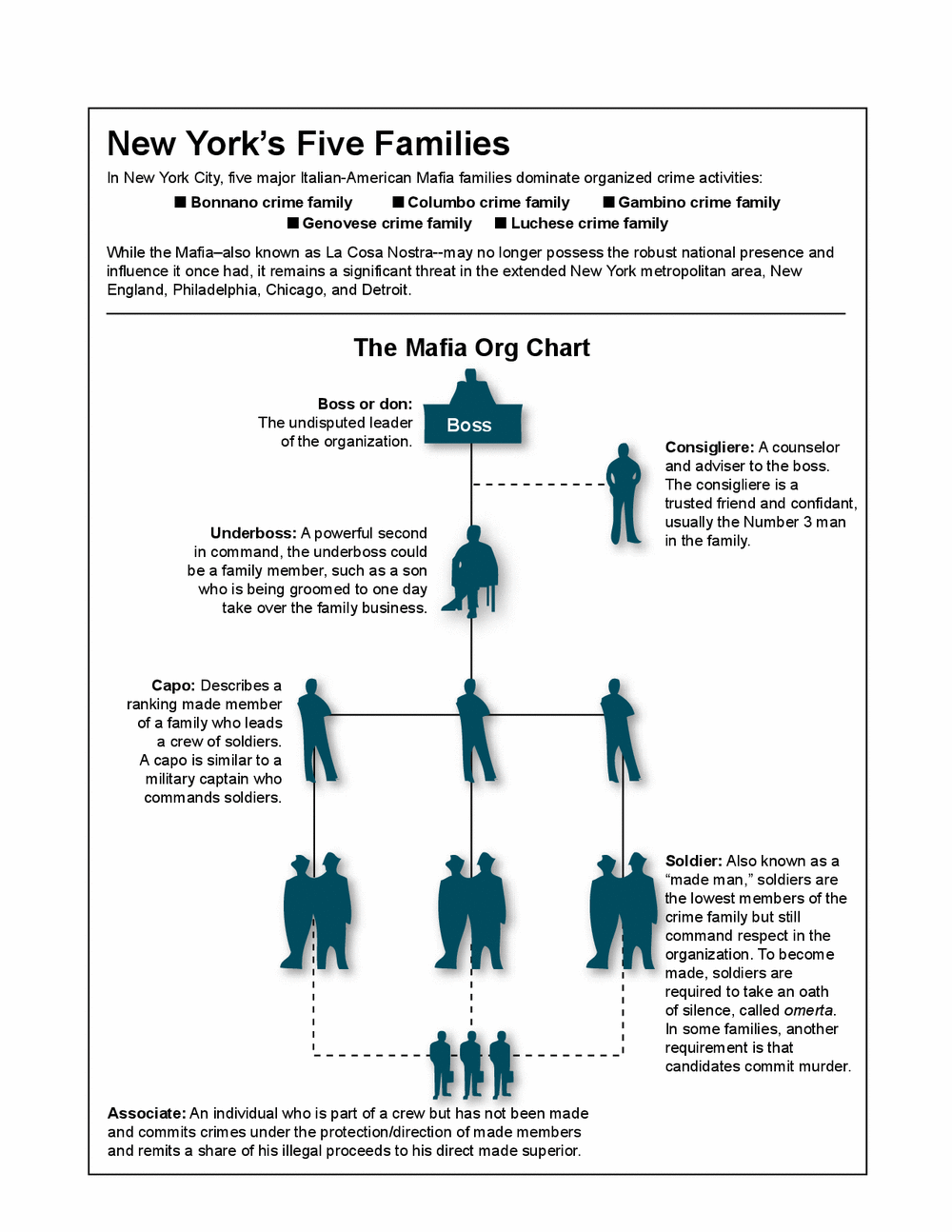
This FBI-produced chart illustrates the standard hierarchy of an American La Cosa Nostra family, from the Boss at the top down to the Soldiers and Associates. This structure ensures a clear chain of command and insulates the leadership from the criminal activities carried out by lower-ranking members.
Let's break down these roles, using insights from both documentary evidence and a first-hand account.
The Sicilian Structure
First, watch this segment that details the structure of the Sicilian Cosa Nostra, explaining concepts like the Commissione (Commission) and mandamenti (districts).
The American Structure: An Insider's View
Now, let's hear from John Pennisi, a former "made man" in the Lucchese crime family, as he explains the structure from his personal experience. His account provides a fantastic, unvarnished look at how the American LCN is organized.
To consolidate your understanding, please read the following section, which provides more detail on the clan hierarchy and the role of the Sicilian Mafia Commission. This should take about 5 minutes.
Sicilian Mafia (Structure and Composition)
The key takeaway is that a Mafia "family" is not a literal family but a disciplined crew. It is structured like a small army or a business division, with a clear line of authority designed for efficiency, discipline, and to protect the leadership. The consigliere, or counselor, is a particularly interesting role—not part of the direct chain of command, but an influential advisor, somewhat analogous to a senior policy advisor or a non-executive director.
3. Codes, Rituals, and Characteristics
The Mafia isn't just an organization; it's a society with its own culture, rules, and rituals designed to enforce loyalty and secrecy.
Membership and Initiation
Becoming a "made man" or a "man of honor" is a formal process. It's not a job you apply for; as John Pennisi says in the video, "that life picks you."
Let's hear Pennisi describe the induction ceremony. The symbolism of blood, saints, and fire is powerful and designed to be unforgettable.
The Sicilian ritual is nearly identical, steeped in a century of tradition. A key requirement for initiation, as mentioned in historical accounts and testimony, was often the commission of a murder. This served as the ultimate proof of a candidate's loyalty and ensured they could never cooperate with the authorities without implicating themselves.
The Rules of Conduct
Life in the Mafia is governed by a strict set of rules. The most famous is Omertà—the code of silence. Betraying the organization to the authorities is the ultimate sin, punishable by death.
But the rules go deeper. In 2007, police discovered a list of "Ten Commandments" in the hideout of Sicilian boss Salvatore Lo Piccolo. Please take a moment to read these rules and the accompanying section on Omertà.
Sicilian Mafia (Rituals and Codes of Conduct)
These rules regulate everything from personal conduct (don't look at the wives of friends) to professional duties (always be available for Cosa Nostra).
However, as with any institution, there can be a gap between the ideals and the reality. Listen to John Pennisi's final thoughts on the core principles of "honor, loyalty, and respect" and how, in his view, they have been eroded by greed.
This perspective is crucial. It shows that the Mafia is not a static, monolithic entity but one that has evolved, with its traditional codes coming under pressure over time—a theme your history background will surely connect with.
Conclusion
In this lesson, we have established a precise and detailed definition of the Mafia, moving beyond popular myth to its reality as a structured and disciplined criminal society.
Key Takeaways:
- The term 'Mafia' refers specifically to the Sicilian Cosa Nostra and its American offshoot, La Cosa Nostra (LCN). They are distinct from other organized crime groups.
- The organization is built on a rigid hierarchical structure: Boss, Underboss, Consigliere, Capos, and Soldiers. This creates a clear chain of command and insulates leadership.
- Membership is exclusive and sealed by a formal initiation ritual.
- A strict code of conduct, most famously Omertà (the code of silence), governs members' lives and is designed to ensure absolute loyalty and secrecy.
- The Mafia's core characteristic is its function as a parallel power structure, providing extra-legal services like "protection" and dispute resolution, enforced through the systematic threat and use of violence.
Preview of the Next Lesson:
Now that we have a clear understanding of the organization itself, our next lesson will turn to the other half of our course title: the glass industry. We will analyze the principal sectors of the industry and its supply chain to identify the economic and structural vulnerabilities that made it such an attractive target for infiltration by the "baddies" we've defined today.