Hello! Welcome back to your second lesson in our course on the Mafia's involvement in the glass industry.
Introduction
In our last lesson, we established a clear definition of the Mafia, exploring its hierarchical structure and the strict codes that bind its members. We now have a solid understanding of who the "baddies" are. Today, we turn our attention to the world they sought to control: the glass industry.
This lesson addresses the learning outcome: Describe the principal sectors of the global glass industry, including flat glass, container glass, and specialty glass, and identify key stages of the production and supply chain.
Understanding the structure and mechanics of this industry is essential. Just as your work in the civil service requires understanding the machinery of government, we must understand the machinery of the glass industry to see where it was vulnerable to infiltration. We will cover:
- The major sectors of the glass market and their economic significance.
- The fundamental process of making glass, from raw materials to finished product.
- The specific manufacturing techniques for the two largest sectors: flat glass and container glass.
- A map of the industry's supply chain, from quarry to customer.
This lesson should take you approximately 60 minutes to complete.
1. An Overview of the Global Glass Industry
The glass industry is a vast, capital-intensive global business. Before we dive into the details, let's get a sense of its scale and the primary markets it serves.
The image below shows the breakdown of the global glass market by application. As you can see, "Packaging" (container glass) and "Construction" (which heavily uses flat glass) are by far the largest segments.

This pie chart illustrates the global market share for glass manufacturing by its end-use application in 2022. It highlights that packaging and construction are the dominant sectors, which will be a key focus of our lesson.
While the chart shows the end-use applications, the industry itself is typically divided into several production sectors. For a more formal breakdown, please take a moment to read this introductory section.
Reading: Sectors of the Glass Industry
(Estimated reading time: 2 minutes)
Sectors of the Glass Industry (Sectors of the Glass Industry)
This reading introduces the eight main sectors. For our course, we will concentrate on the three most relevant to our story, as outlined in the learning outcome:
- Container (or Hollow) Glass: Bottles, jars, and other packaging.
- Flat Glass: Sheets of glass for windows, buildings, and cars.
- Specialty Glass: A broad category for glass with unique properties, like heat-resistant cookware or the screen on your phone.
2. The Glass Production Process: From Sand to Solid
At its heart, all glassmaking follows the same fundamental steps: melting raw materials and then shaping the resulting molten liquid before it cools.
Let's watch a short video that provides an excellent overview of this entire journey.
Video: How Glass is Made
(Estimated viewing time: 6 minutes)
As you watch, pay attention to the four key stages:
- Raw Materials (00:19 - 01:25): The basic recipe is simple: sand (silica), soda ash, and limestone. Note the role of recycled glass, known as cullet.
- Melting (01:25 - 02:49): The materials are melted in a furnace at incredibly high temperatures (around 1700°C) to form a molten, syrup-like liquid.
- Shaping (02:49 - 04:05): This is where the process diverges for different products. The video introduces the float process for flat glass and blowing/pressing for containers.
- Finishing (04:05 - 05:30): The shaped glass is slowly cooled in a process called annealing to remove internal stresses and prevent it from becoming brittle.
This general process forms the backbone of the industry's supply chain. Now, let's look more closely at how the shaping stage differs for the major sectors.
3. A Closer Look at the Principal Sectors
The different shaping methods define the major sectors of the industry. The scale, cost, and logistics of these methods are what create the economic landscape the Mafia would later navigate.
A. Flat Glass
Flat glass is the material that forms the skin of our modern cities—the windows in our homes and the glass facades of skyscrapers. It's also critical for the automotive industry.
The production of this perfectly uniform, distortion-free glass is a modern marvel of industrial engineering called the float process. To understand this, we'll watch a detailed video from one of the world's leading manufacturers, Saint-Gobain.
Video: The Float Process
(Estimated viewing time: 6 minutes)
- Highlight 1: 0:00 - 0:00
- Highlight 2: 0:00 - 0:00
- Highlight 3: 0:00 - 0:00
- Highlight 4: 0:00 - 0:00
- Highlight 5: 0:00 - 0:00
This video walks you through the entire production line. Focus on these key steps:
- Batching (01:39 - 03:26): The precise mixing of raw materials and cullet.
- Melting (03:26 - 04:40): The continuous furnace operation.
- The Float Bath (04:40 - 05:48): This is the heart of the process. Molten glass is floated on a bed of molten tin, allowing gravity to pull it into a perfectly flat ribbon.
- Annealing (05:48 - 06:53): The long cooling tunnel (the "lehr") that makes the glass strong.
- Cutting & Stacking (07:26 - 09:47): The automated finishing end of the line.
The following infographic provides a great static summary of the process you just watched.
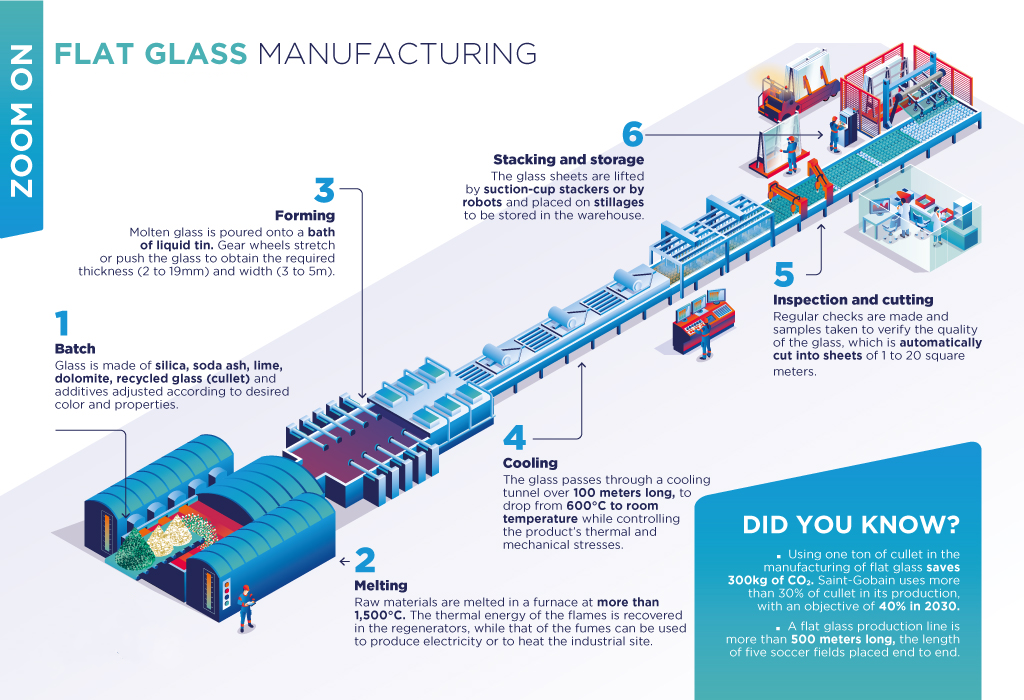
This infographic clearly visualizes the six key stages of the float glass manufacturing process, from raw materials to the final stacked product.
Now, let's consider the economics. Please read the following section on the flat glass sector. Your background in economics and history will find the details on investment and market structure particularly relevant.
Reading: The Flat Glass Sector
(Estimated reading time: 3 minutes)
Sectors of the Glass Industry (The Flat Glass Sector)
Note the key characteristics:
- Capital-Intensive: A float line costs over €100 million to build.
- Long Investment Cycle: Furnaces run continuously for 15-20 years.
- High Volume: A single plant produces 400-700 tons of glass per day.
These factors create an industry with high barriers to entry, dominated by a few large players—a structure that can be a tempting target for monopolistic control.
B. Container Glass
This is the largest sector of the industry, responsible for the vast number of bottles and jars we use every day. Unlike the continuous ribbon of the float process, container glass involves making billions of individual items.
The production method uses blowing and pressing techniques in what are known as "Individual Section" (IS) machines. The following text provides a detailed, step-by-step description of this process and the market it serves.
Reading: The Container Glass Sector
(Estimated reading time: 6 minutes)
Sectors of the Glass Industry (The Container Glass Sector)
As you read, focus on these stages and market features:
- The Process: Follow the journey from the molten "gob" of glass to the finished, inspected, and packaged bottle. Notice the stages of forming, annealing, and surface treatments.
- Market Characteristics: This is crucial. The container glass industry is described as having a short-range market, with most products sold within 500km of the factory due to high transport costs. This localization makes regional markets susceptible to control and manipulation—a key vulnerability we will explore later.
C. Specialty Glass
This is a catch-all term for a huge variety of glass types engineered for specific functions. While we won't go into as much detail here, it's important to recognize the diversity of the industry.
Please spend a few minutes exploring the "Types of Glass" section of the Wikipedia article on glass. You don't need to memorize the chemical formulas, but get a sense of the different categories and their uses.
Reading: Types of Glass
(Estimated reading time: 5 minutes)
Notice types like:
- Borosilicate glass: Used for lab equipment and cookware (like Pyrex) because of its resistance to thermal shock.
- Aluminosilicate glass: Used for fiberglass and modern touchscreens (like Gorilla Glass) due to its strength.
- Lead glass: Used for decorative "crystal" glassware due to its brilliance and workability.
This diversity means the "glass industry" is not one single entity but a web of interconnected markets, each with its own supply chains and pressure points.
4. The Glass Industry Supply Chain
Having examined the production processes, we can now map out the full supply chain. Understanding this chain is critical, as each link represents a potential point for criminal interference—from controlling raw materials to dominating transportation.
-
Upstream (Raw Materials):
- Extraction of primary materials like sand and limestone from quarries.
- Production of industrial chemicals like soda ash.
- Collection and processing of recycled glass (cullet).
-
Midstream (Manufacturing):
- The large, capital-intensive manufacturing plants we've just discussed, where the glass is melted and formed.
-
Downstream (Processing, Distribution, and End Use):
- Flat Glass: The large sheets ("float liners") are sold to secondary processors who cut, temper, laminate, or coat them for use by construction firms and automotive manufacturers.
- Container Glass: Bottles and jars are shipped directly to bottling plants for food, beverage, and pharmaceutical companies.
- Transportation & Logistics: A critical link connecting all stages, from moving raw materials to the plant to delivering finished goods to customers.
- Waste Disposal: A final, and often overlooked, part of the chain involving the disposal of manufacturing by-products.
Each of these stages—quarrying, transport, manufacturing, distribution, waste—involves contracts, labor, and logistics that can be exploited.
Conclusion
Today, we've dissected the glass industry, moving from a high-level market overview to the specific mechanics of its most important sectors.
Key Takeaways:
- The glass industry is dominated by two main sectors: container glass for packaging and flat glass for construction and automotive uses.
- The basic production process involves melting raw materials (sand, soda ash, limestone) and shaping the molten glass.
- Flat glass is produced via the highly-automated float process, creating a continuous ribbon of glass on a bed of molten tin.
- Container glass is made using blowing and pressing methods in high-speed machines to create individual items like bottles and jars.
- The industry's supply chain is a multi-stage process involving raw material sourcing, manufacturing, distribution, and transportation, all of which present different economic characteristics and potential vulnerabilities.
Preview of the Next Lesson:
Now that we have a solid grasp of both the Mafia (Lesson 1) and the glass industry (Lesson 2), we are ready to start connecting them. In the next lesson, we will step back in time to trace the historical origins of Mafia involvement in legitimate industries, focusing on the post-war economic boom. This will provide the crucial context for understanding why and how they began to target complex, capital-intensive sectors like construction and, by extension, the glass industry.