Hello! Let's continue our exploration of logistic regression.
In the last lesson, you learned how to construct the binary logistic regression model and why it's the right tool for binary outcomes. We ended with the core equation that transforms a non-linear probability problem into a linear one:
Today, we'll focus on the first, and arguably simplest, piece of this model: the intercept, . Your goal for this lesson is to interpret the intercept of a logistic regression model in terms of baseline odds. Mastering this is a key step for acing application questions on your exam.
1. The Intercept: Your Model's Starting Point
Just like in simple linear regression, the intercept () represents the value of the model's outcome when all predictor variables are equal to zero.
- In linear regression, , the intercept is the predicted value of when .
- In logistic regression, , the intercept is the predicted value of the log-odds when .
When you have multiple predictors, is the log-odds when all predictors are zero.
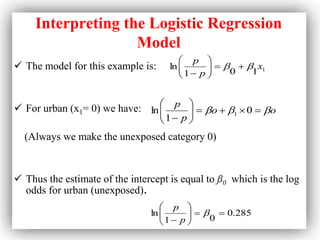
So, is the log-odds of the outcome occurring for a baseline case. However, "log-odds" aren't very intuitive. To make the interpretation meaningful, we need to convert it back into the more understandable scale of odds.
2. From Log-Odds to Baseline Odds
To get a practical interpretation of the intercept, we perform a simple mathematical step: we exponentiate it.
This value, , is called the baseline odds. It represents the odds of the outcome being 1 for the group where all predictor variables are equal to zero. This is the interpretation you need for your exam.
The following video provides a clear, concise explanation using an example of vaping and lung cancer.
Explaining logistic regression | VNT #14
This video from the 'Very Normal' channel explains how to interpret the intercept term, beta_0, by focusing on the reference group (when covariates are zero).
Please watch from 05:42 to 06:46. Pay close attention to how the model simplifies for the 'non-vaping' group (where X=0) and how the intercept is interpreted in terms of odds.
To solidify this concept, let's look at a text-based explanation that formally defines "baseline odds" and provides another worked example.
Slope and Intercept Interpretations
This reading from the Data Science Exploration website at the University of Illinois formally introduces the term 'baseline odds' and shows how to calculate and interpret it from a model equation.
Read the sections 'Intercept Interpretation' and the 'Example' that follows. Focus on how the equation is simplified to isolate the intercept and how the final interpretation of the baseline odds is phrased.
3. What Does "All Predictors = 0" Actually Mean?
The interpretation of the intercept depends entirely on what "zero" means for your predictor variables. This is a common place for mistakes, so let's be very clear.
You need to consider two main scenarios:
Scenario 1: The Predictor is Categorical
If you have a categorical predictor, like gender (coded as 0=Male, 1=Female), a value of 0 corresponds to the reference category.
- Model:
- Interpretation of : It's the log-odds of being in the honors class for a student where
female=0, which means the student is male. - Interpretation of : It's the odds of a male student being in the honors class.
Scenario 2: The Predictor is Continuous
If you have a continuous predictor, like math_score, a value of 0 is just that: a score of zero.
- Model:
- Interpretation of : It's the log-odds of being in the honors class for a student with a
math_scoreof 0. - Interpretation of : It's the odds of a student with a
math_scoreof 0 being in the honors class.
Important Nuance: Sometimes a value of 0 for a continuous predictor is not practically possible or meaningful (e.g., a weight of 0, an age of 0). In these cases, the intercept is a hypothetical baseline that helps anchor the regression line, but it may not have a direct real-world interpretation. For your exam, unless told otherwise, you should interpret it as the baseline when the predictor is zero.
The following resource provides excellent, clear examples for both categorical and continuous predictors, and also for a model with multiple predictors.
FAQ: How do I interpret odds ratios in logistic regression?
This FAQ from UCLA's statistics group is a classic resource that walks through intercept interpretation in several common modeling situations.
Please read the following three sections: 'Logistic regression with a single dichotomous predictor variables': Focus on how the intercept relates to the reference group ('male'). 'Logistic regression with a single continuous predictor variable': Note the interpretation for a 'math' score of zero and the discussion of it being a hypothetical value. 'Logistic regression with multiple predictor variables': Read the first paragraph to see how the rule extends—the intercept is when all predictors are held at zero.
Exam Strategy: A Decision Rule for Interpreting the Intercept
For an exam question that asks you to interpret the intercept of a logistic regression model, follow these steps:
- Identify the Baseline Condition: Look at all the predictor variables in the model. The baseline is when every continuous predictor is 0 and every categorical predictor is at its reference level (also coded as 0).
- Find the Intercept Coefficient: Locate in the model output.
- Calculate the Baseline Odds: Compute .
- Formulate the Interpretation: Write a clear sentence.
"For a case where [describe the baseline condition from Step 1], the odds of [describe the outcome being 1] are [value of ]."
Example:
- Model: Predicting heart disease (
disease=1) fromageandsmoking_status(0=non-smoker, 1=smoker). - Output:
- Step 1 (Baseline): A person who is 0 years old and is a non-smoker.
- Step 2 (Coefficient):
- Step 3 (Odds):
- Step 4 (Interpretation): "For a newborn non-smoker, the odds of having heart disease are approximately 0.03." (In this case, you might also note that age=0 is a hypothetical baseline).
Conclusion
You have now learned the specific rule for interpreting one of the two main types of coefficients in a logistic regression model. This is a fundamental skill for applying GLMs.
Key Takeaways:
- The intercept () is the log-odds of the outcome when all predictors are zero.
- For interpretation, we exponentiate the intercept () to get the baseline odds.
- The meaning of the baseline depends on the predictors: it corresponds to the reference level for categorical variables and a value of 0 for continuous variables.
In the next lesson, we will tackle the other coefficients (). As you might guess, their interpretation also involves exponentiation, but they tell us about how the odds change as a predictor changes. This will lead us to the crucial concept of the odds ratio.