Hello! Welcome to your fifth lesson.
In our last lesson, we conducted a comparative analysis to understand why gold and silver satisfied the principles of sound money more effectively than any other commodities. We concluded that their unique combination of durability, portability, divisibility, fungibility, and especially scarcity, allowed them to emerge as the market's choice for money.
Today, we will quantify that crucial principle of scarcity. This lesson concludes our first module on the foundations of commodity money. Your learning outcome is to calculate and interpret the stock-to-flow ratio, explaining its significance for gold and silver as monetary assets.
The stock-to-flow ratio is one of the most powerful concepts in monetary economics for understanding why certain assets hold value over time. For someone with your background in economics, this provides a rigorous, data-driven lens to view the abstract concept of "scarcity."
Defining and Calculating the Stock-to-Flow Ratio
At its core, the stock-to-flow (S2F) ratio is a simple yet profound metric that measures abundance. It answers the question: "How many years would it take to produce the current total supply (stock) at the current production rate (flow)?"
The formula is:
- Stock: The total, cumulative amount of a commodity that has been produced and is currently available. For gold, this is all the gold ever mined that hasn't been lost.
- Flow: The amount of new production added to the stock in a given year, primarily through mining.
To get a clear walkthrough of this concept and see it calculated for gold, please watch the first few minutes of the following video.
Stock to Flow Ratio - Meaning - Bitcoin - BTC - Gold - Scarcity - Mathematics - Maths - 💰/⛏️ - ₿
This video from Mind Math Money provides a clear and concise introduction to the stock-to-flow ratio, its formula, and a worked example for gold.
Watch from the beginning to 03:47. The first part (until 01:57) defines the ratio. The second part (starting at 02:22) calculates it for gold using 2019 data.
As the video demonstrates, with a stock of 185,000 tonnes and a flow of 3,000 tonnes, gold's S2F ratio is:
This means it would take approximately 62 years of current mining production to double the existing supply of gold. This extraordinarily high number is the key to its "hardness" as money.
A related and equally useful metric is the annual supply growth rate, which is simply the inverse of the S2F ratio (Flow / Stock). For gold, this is about 1.6% per year—a very low and predictable rate of inflation.
Interpreting the Ratio: Hard Money vs. Easy Money
The S2F ratio allows us to place commodities on a spectrum from "easy" money (low S2F) to "hard" money (high S2F).
- High S2F (Hard Money): A large, pre-existing stock relative to new production. This makes the total supply resistant to being significantly inflated by increases in production.
- Low S2F (Easy Money): New annual production is significant relative to the existing stock. The total supply is very sensitive to changes in production.
This distinction is the fundamental reason why industrial commodities fail as monetary assets. Let's delve into the economic theory behind this.
Dr. Saifedean Ammous's text on money provides a rigorous explanation of why the stock-to-flow ratio is the decisive factor for an asset's ability to hold value across time ('salability across time'). Pay close attention to his concept of the 'easy-money trap.'
Please read the sections titled 'Salability across Time' and the following untitled section that begins 'To understand why, we must first distinguish between market demand...'. These sections explain the concept of hardness, define the S2F ratio, and articulate the economic consequences of low vs. high ratios.
As Ammous explains, if people start using a low S2F commodity (like copper or platinum) as money, the increased monetary demand drives up the price. This incentivizes producers to massively ramp up production. Because the annual flow is so large relative to the stock, this new supply floods the market, crashing the price and wiping out the wealth of those who were saving in it. This is the "easy-money trap."
Gold, with its high S2F, is immune to this trap. Even a doubling of mining output would only increase the total stock by about 3% instead of 1.6%, a minor impact on the total supply. This makes gold a reliable store of value.
The Significance for Gold and Silver
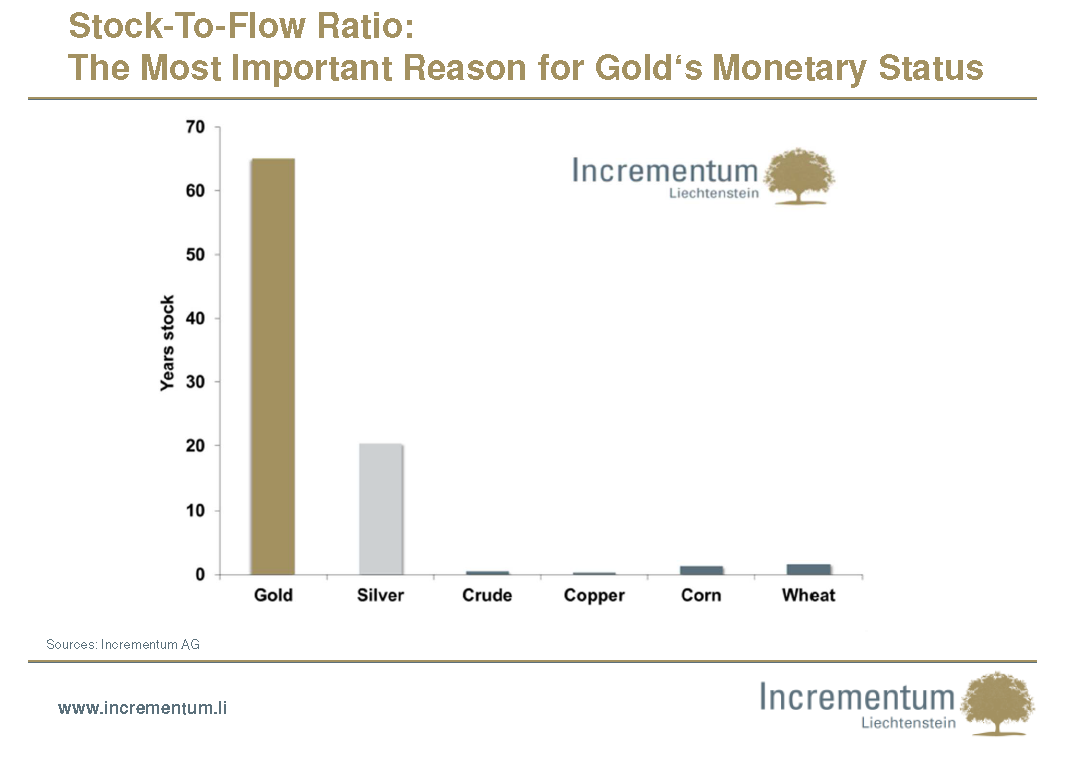
The high stock-to-flow ratio is arguably the single most important quantitative property that destined gold for a monetary role.
Let's refine our understanding by comparing the S2F ratios of gold, silver, and other metals and see how it impacts their monetary utility.
Now, let's read the next section of the Ammous text, which provides concrete S2F numbers for various metals and explains the historical divergence of gold and silver.
Please read the two sections following the ones you just read. They begin with 'The stock-to-flow metric has a value close to 1...' and 'The high stock-to-flow ratio of gold destined it to play a monetary role...'. Focus on why silver's monetary role has diminished relative to gold's, linking it to their respective S2F ratios.
This reading highlights two critical points:
- Industrial vs. Monetary Metals: For industrial metals like copper and zinc, S2F is less than 1. They are consumed. For gold, almost all of it is hoarded, making it a monetary asset.
- Gold vs. Silver: Silver's S2F ratio has declined over time. As it found more industrial uses (photography, electronics, etc.), a larger portion of its stock was "consumed" and removed from the monetary stockpile available for trade. This reduced its S2F as a monetary asset, making it less "hard" than gold. This explains its gradual demonetization and the ever-widening gold-to-silver price ratio we'll study later.
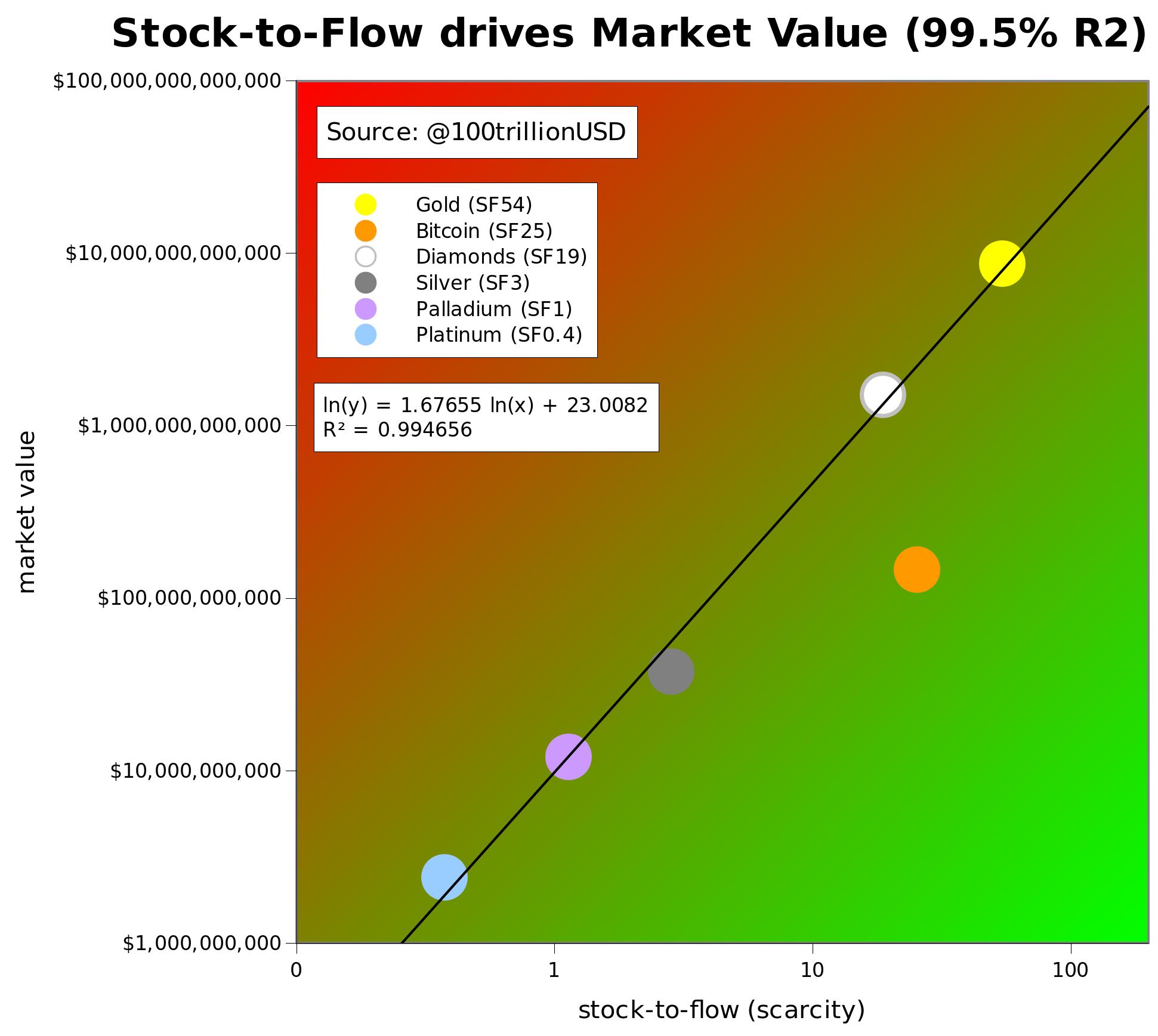
The ultimate significance of S2F is its strong correlation with market value. Scarcity, as measured by S2F, is not just an abstract principle; it is a primary driver of value.
Practice Calculation
Let's put this into practice. In 2019, global platinum stockpiles were estimated at around 270 metric tons. The annual mining production (flow) was approximately 180 metric tons.
- Calculate the approximate stock-to-flow ratio for platinum.
- Based on your calculation and the concepts from this lesson, briefly explain why platinum, despite being a "precious metal," has never sustained a major monetary role compared to gold.
Solution
- Calculation:
- Interpretation: Platinum's S2F ratio of 1.5 is dramatically lower than gold's (~62) and silver's (~22). This means its supply can be inflated very easily. The annual production is a huge proportion (66.7%) of the existing stock. If platinum were used as money, any price increase would trigger a surge in production that would quickly devalue the savings of holders, trapping them in the "easy-money trap." Its low S2F makes it an unreliable store of value, and therefore unsuitable as a primary monetary asset.
Conclusion
In this lesson, you have learned to calculate and interpret the stock-to-flow ratio, a critical tool for quantifying scarcity. This concludes our first module on the foundational properties that make for sound money.
Key Takeaways:
- The stock-to-flow ratio (Stock / Flow) measures how many years of production are needed to replicate the existing supply of a commodity.
- A high S2F ratio signifies "hard money" because new supply has a minimal impact on the total stock, protecting its value over time (e.g., gold).
- A low S2F ratio signifies "easy money" because new production can easily flood the market and crash its value, making it a poor store of value (e.g., industrial commodities).
- Gold's consistently high S2F ratio is the primary quantitative reason for its historical preeminence as money. Silver's lower and declining S2F ratio explains its secondary and diminishing monetary role.
Having established the theoretical and physical foundations of why gold and silver became money, we will now turn to history. Our next module, "Ancient Money and Empires," begins our chronological journey. In the next lesson, we will explore the earliest uses of gold and silver as ornamentation and ritual objects in prehistoric societies, tracing the very first steps on their long path to becoming money.