Hello! Welcome back to your personalized course on Data Structures and Algorithms.
In our last lesson, we delved into space complexity, analyzing how memory is used by inputs, auxiliary data structures, and the call stack. We even saw a sneak peek of today's topic with the Fibonacci example, where a dynamic programming solution (O(n) time, O(n) space) was much faster but used a comparable amount of memory to the naive recursive solution (O(2^n) time, O(n) space).
This lesson directly builds on that foundation to tackle one of the most fundamental concepts in algorithm design. You will learn to identify and articulate time-space tradeoffs in different algorithmic approaches. This is a critical skill for technical interviews. Interviewers aren't just looking for a correct answer; they want to see your ability to analyze different solutions and justify your choice based on performance characteristics and constraints.
The Core Idea: The Time-Space Seesaw
At its heart, the time-space tradeoff is the principle that you can often decrease an algorithm's runtime by using more memory, or decrease its memory usage by accepting a longer runtime. It's a balancing act, much like a seesaw.

Let's begin by grounding ourselves in the formal definitions and the core paradigm of this tradeoff.
Analyzing Time vs. Space Trade-offs in Code: Mastering Efficient ...
The article 'Analyzing Time vs. Space Trade-offs in Code' from Algocademy provides an excellent introduction to this topic. It formally defines the relationship between time and space complexity.
Please read the first two sections, 'Understanding Time Complexity and Space Complexity' and 'The Time-Space Trade-off Paradigm'. This will set the stage for the concrete examples we'll explore next. Estimated time: 5 minutes.
Trading Space for Time: The Need for Speed
The most common tradeoff you'll implement is using extra memory to make your algorithm faster. This is often achieved by storing pre-computed results or creating lookup tables to avoid redundant calculations.
1. Memoization and Dynamic Programming
We've touched on this, but it's the quintessential example. By storing the results of expensive function calls (memoization), we avoid re-computing them.
Let's watch a video that perfectly illustrates this with two common problems: the Fibonacci sequence and pathfinding on a grid.
Algorithms: Memoization and Dynamic Programming
The HackerRank video 'Algorithms: Memoization and Dynamic Programming' clearly demonstrates how adding a 'memo' table (space) drastically reduces computation (time).
Watch from 00:33 to 10:27. Pay close attention to: The analysis of the recursive Fibonacci's O(2^n) time and O(n) space (due to call stack depth). How memoization reduces the time to O(n) while space remains O(n) (call stack + memo table). The application of this same tradeoff to a grid pathfinding problem, comparing recursive, memoized, and iterative DP solutions.
As the video shows, the memoized and iterative DP solutions make a tradeoff:
- Time: Drastically reduced from exponential
O(2^n)orO(2^(rows+cols))to linearO(n)or polynomialO(rows*cols). - Space: Increased from just the
O(n)call stack to an additionalO(n)for the memoization table. The overall space complexity remainsO(n), but the source of memory usage shifts and enables a massive speedup.
2. Hash Tables for Fast Lookups
This is one of the highest-ROI patterns for interviews. Problems that seem to require a slow, nested-loop search (O(n^2)) can often be solved in linear time (O(n)) by using a hash map or hash set.
Classic Example: The Two Sum Problem
Given an array of integers nums and a target integer, find the indices of two numbers that add up to the target.
- Brute-Force Solution: Use two nested loops to check every pair of numbers.
- Time:
O(n^2) - Space:
O(1)
- Time:
- Hash Map Solution: Iterate through the array once. For each element
x, check iftarget - xexists in a hash map. If it does, you've found a pair. If not, addxand its index to the map.- Time:
O(n)(one pass, withO(1)average time for hash map lookups). - Space:
O(n)(in the worst case, you store allnelements in the hash map).
- Time:
Here, we've accepted O(n) auxiliary space to cut the runtime from quadratic to linear—a huge win for large inputs. This exact tradeoff is discussed in the resource below.
Coding Interview Prep Chapter 1: Introduction
The 'Coding Interview Prep' PDF is a fantastic resource that explicitly analyzes tradeoffs for common patterns. Let's see how it frames the Two Pointers pattern and its hash map alternative.
Read the section on 'Two Sum II (Sorted)'. Pay attention to the 'Trade-offs' box, which notes that if the array were unsorted, you'd have to choose between sorting (O(n log n) time) or using a hash map (O(n) time but O(n) space).
Trading Time for Space: When Memory is Tight
Sometimes, the priority is to minimize memory usage, even if it means more computation. This is common in memory-constrained environments like embedded systems, or with massive datasets that won't fit into memory.
1. In-place vs. Out-of-place Algorithms
Sorting algorithms provide a classic illustration of this tradeoff.
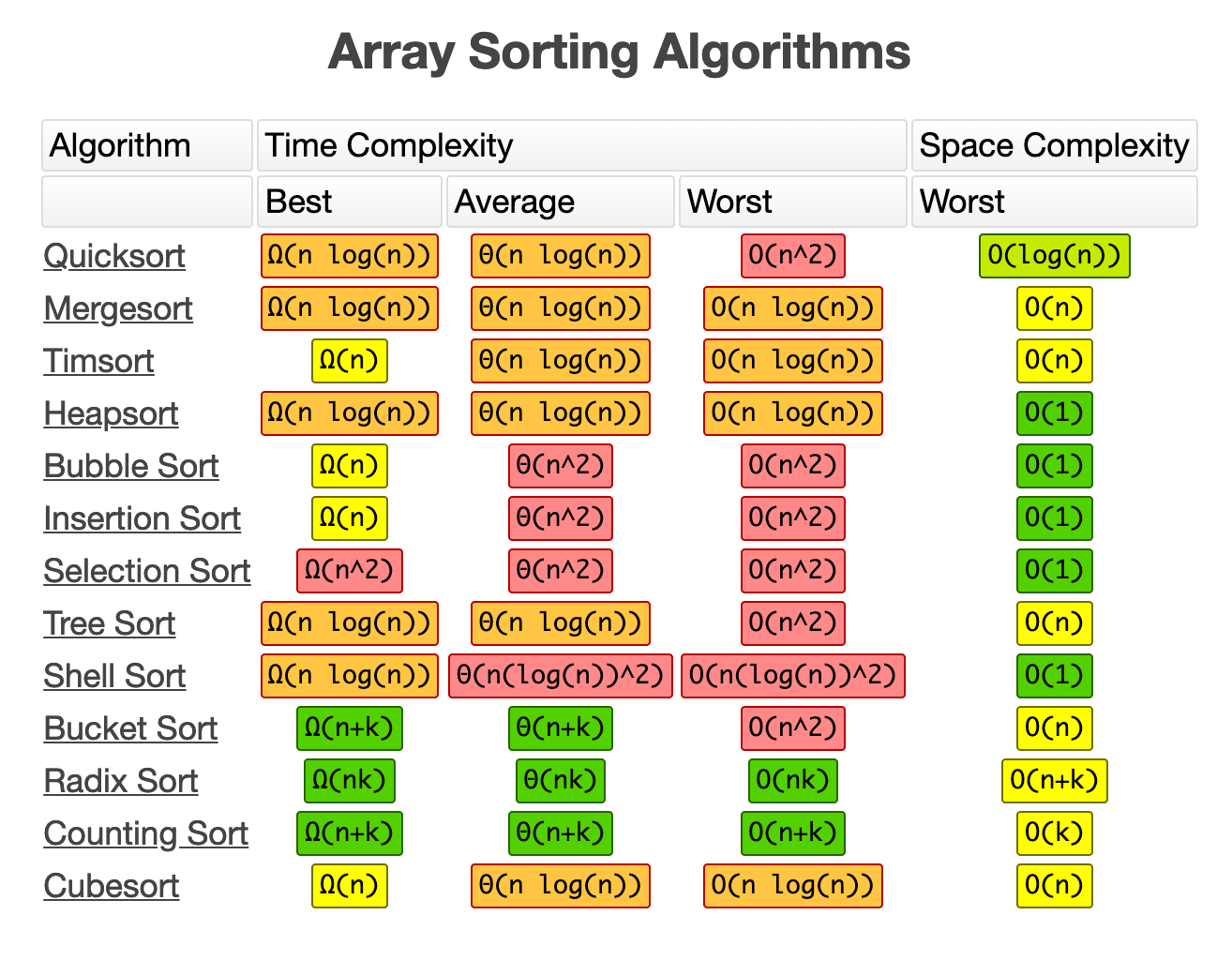
- Merge Sort: Guarantees
O(n log n)time complexity but requiresO(n)auxiliary space to merge the sorted halves. - Quicksort: Can be implemented to use only
O(log n)auxiliary space (for the recursion call stack). On average, it's very fast, but its worst-case time complexity isO(n^2).
The choice between them is a tradeoff: do you want the guaranteed O(n log n) performance of Merge Sort at the cost of O(n) space, or are you willing to risk Quicksort's O(n^2) worst case to gain its excellent average performance and O(log n) space efficiency?
2. Algorithmic Tricks: Floyd's Cycle Detection
Consider the problem of detecting a cycle in a linked list.
- Hash Set Approach: Traverse the list, adding each node to a hash set. If you encounter a node that's already in the set, you've found a cycle.
- Time:
O(n) - Space:
O(n)(to store the visited nodes).
- Time:
- Floyd's Tortoise & Hare Algorithm: Use two pointers, one moving one step at a time (
slow) and one moving two steps (fast). If they ever meet, there is a cycle.- Time:
O(n) - Space:
O(1)
- Time:
This is a brilliant example of a more complex algorithm (Floyd's) that eliminates the need for auxiliary storage, making it vastly more space-efficient without sacrificing time complexity.
Test your understanding!
You are given a read-only array of n+1 integers where each integer is between 1 and n. There is exactly one duplicate number. How would you find it? Describe two solutions and their time-space tradeoffs.
Show answer
This is a classic interview problem that maps directly to the linked list cycle detection logic.
-
Solution 1: Hash Set
- Iterate through the array and use a hash set to keep track of the numbers you've seen. If you encounter a number that's already in the set, that's the duplicate.
- Time:
O(n) - Space:
O(n)
-
Solution 2: Floyd's Algorithm (Array as a Linked List)
- Treat the array values as "pointers". For example, if
nums[0]is 3, the next "node" is at index 3. Since there's a duplicate number, there must be a cycle. You can apply Floyd's algorithm to find the start of the cycle, which is the duplicate number. - Time:
O(n) - Space:
O(1)
- Treat the array values as "pointers". For example, if
The Tradeoff: The hash set method is arguably more intuitive but requires linear auxiliary space. The Floyd's algorithm approach is non-obvious but is optimally efficient in terms of space, a crucial advantage if the array is very large. The Coding Interview Prep PDF (LINK, section on "Find Duplicate Number") walks through this exact problem and tradeoff.
Articulating Tradeoffs: The Interview-Ready Answer
Identifying tradeoffs is only half the battle. In an interview, you must clearly articulate them. A great answer demonstrates that you're not just a coder, but a problem-solver who considers constraints.
Let's look at the factors that guide the decision.
Analyzing Time vs. Space Trade-offs in Code: Mastering Efficient ...
Let's return to the Algocademy article to learn how to decide which side of the tradeoff to favor.
Please read the sections 'Analyzing Trade-offs: When to Optimize for Time or Space' and 'Real-world Examples of Time-Space Trade-offs'. This will give you a framework for justifying your algorithmic choices. Estimated time: 5 minutes.
A structured way to discuss tradeoffs in an interview:
- Start with a baseline: "A straightforward brute-force approach would be to..., which gives us
O(n^2)time andO(1)space." - Propose the optimized solution: "We can optimize this by trading space for time. If we use a hash map to store previously seen values, we can reduce the time complexity to
O(n)." - State the tradeoff clearly: "This improvement in time comes at the cost of
O(n)auxiliary space for the hash map." - Discuss the context: "If we're dealing with a very large input where memory is a concern, the
O(1)space solution might be necessary despite its slowness. However, for most typical scenarios where performance is key, theO(n)time solution is preferable and the linear space cost is acceptable."
Conclusion
Mastering time-space tradeoffs is a sign of a mature engineer. It shows you think beyond just "getting it to work" and consider how your solution will perform under real-world constraints.
Key Takeaways:
- Time and space are often inversely related: Faster algorithms frequently use more memory, and more memory-efficient algorithms can be slower.
- Common ways to trade space for time: Use hash tables for quick lookups, or use memoization/dynamic programming to store results of subproblems.
- Common ways to trade time for space: Use in-place algorithms (like some sorting methods) or clever algorithmic tricks (like Floyd's cycle detection) to avoid auxiliary data structures.
- Articulation is key: In an interview, clearly state the complexities of different approaches and justify your final choice based on the problem's likely constraints.
This lesson concludes our initial module on complexity analysis. You now have the foundational tools to analyze any algorithm's performance. In the next lesson, we will briefly review the common complexity classes (O(1), O(log n), O(n), etc.) to solidify your understanding before we dive into our first major data structure: arrays.