Hello! Welcome back.
In our last lesson, we distinguished between standard LLMs and Chat Models, establishing that the message-based interface of Chat Models is the modern standard for building applications. You now understand the types of models available in LangChain. Today, we'll tackle the next logical question: which specific model or provider should you use?
The LLM landscape is crowded and fast-moving, with major players like OpenAI, Anthropic, and Google, alongside a vibrant ecosystem of open-source models. Choosing the right one is a critical architectural decision that impacts your application's performance, cost, and capabilities.
This lesson will equip you with a durable framework for comparing LLM providers and their models. We won't focus on finding a single "best" model, but rather the "best-fit" model for a given task. We'll evaluate them across four key dimensions:
- Capability: How "intelligent" is the model? How well does it perform on tasks like coding, reasoning, and instruction following?
- Cost: What is the price per million tokens for inputs and outputs?
- Latency & Speed: How quickly does the model respond?
- Context Window: How much information can the model process in a single request?
By the end of this lesson, you'll be able to analyze these trade-offs to make informed decisions for your projects.
1. Navigating the LLM Maze
The sheer number of available models can be overwhelming. Before diving into specifics, it's helpful to establish a mental framework for evaluation. The problem isn't just about picking a name from a leaderboard; it's about matching a model's characteristics to your application's requirements.
To start, let's watch a short video that introduces the core challenge and the key factors to consider from a developer's point of view.
How to Choose Large Language Models: A Developer’s Guide to LLMs
This clip from IBM Technology's 'How to Choose Large Language Models' provides a concise overview of why model selection is a crucial step and introduces some of the tools and concepts we'll be using today.
Watch from the beginning to 01:35. Pay attention to the initial discussion of balancing accuracy, cost, and performance, and the introduction of a model comparison tool.
This video sets the stage perfectly. Now, let's adopt a structured methodology for this comparison, breaking it down into distinct characteristics.
2. The Four Pillars of LLM Comparison
We will now systematically explore the four dimensions we outlined earlier. For each one, we'll define what it is, why it matters, and how to evaluate it using industry-standard tools and benchmarks.
A. Capability & Intelligence
"Capability" refers to a model's effectiveness at various tasks, such as complex reasoning, coding, writing, and following instructions.
How to Measure Capability:
- Quantitative Benchmarks: These are standardized tests that score models on specific tasks. Common examples include MMLU (general knowledge), HumanEval (code generation), and SWE-bench (real-world software engineering tasks). While useful, these benchmarks can sometimes be "gamed" by models trained on the test data and may not always reflect real-world utility.
- Qualitative (Human) Evaluation: Platforms like the Chatbot Arena Leaderboard use crowdsourcing to rank models based on blind, side-by-side human preferences. This provides a valuable "vibe check" on a model's general helpfulness and conversational quality.
The following video provides a detailed breakdown of how to think about both quantitative and qualitative evaluations, and their respective pitfalls.
How to Choose the BEST LLM for YOUR Project: A Methodical Guide
In this segment from 'How to Choose the BEST LLM for YOUR Project', the presenter offers a methodical guide to judging model intelligence, covering both benchmarks and human evaluation platforms.
First, watch from 04:00 to 12:19 to understand quantitative benchmarks and their limitations. Then, watch from 19:23 to 22:50 to learn about qualitative evaluation using platforms like the LLM Arena.
To see this data in action, let's look at a resource that aggregates and presents these comparisons in a clear format.
LLM Comparison Guide: December 2025 Rankings
This 'LLM Comparison Guide' from Digital Applied provides a fantastic, though hypothetical, snapshot of how top-tier models stack up. Note that the models and dates are futuristic (e.g., 'GPT-5.2', 'December 2025'), but the framework and trade-offs are timeless. Think of 'GPT-5.2' as a stand-in for today's fastest models (like GPT-4o), 'Claude Opus 4.5' for the highest-quality reasoning models (like Claude 3 Opus), and 'DeepSeek' for cost-effective alternatives.
Read the 'Key Takeaways' for a high-level summary and then review the 'Comprehensive Benchmark Comparison' table. Notice how different models excel in different benchmarks—Claude on SWE-bench, GPT on math and abstract reasoning.
B. Cost
For any real-world application, cost is a primary constraint. LLM providers typically charge per token, with different rates for input (the prompt you send) and output (the text the model generates).
Given your background in managing cloud infrastructure on AWS, you'll appreciate that the choice is not just between different API price points, but also between using a managed API versus self-hosting an open-source model.
Let's explore this trade-off.
How to Choose the BEST LLM for YOUR Project: A Methodical Guide
The same video guide we watched earlier has an excellent section on pricing, comparing API costs directly with the financial and technical realities of self-hosting.
Watch from 12:19 to 15:56. The analysis of GPU VRAM requirements and hourly costs for hosting a large model versus paying for API calls is particularly insightful.
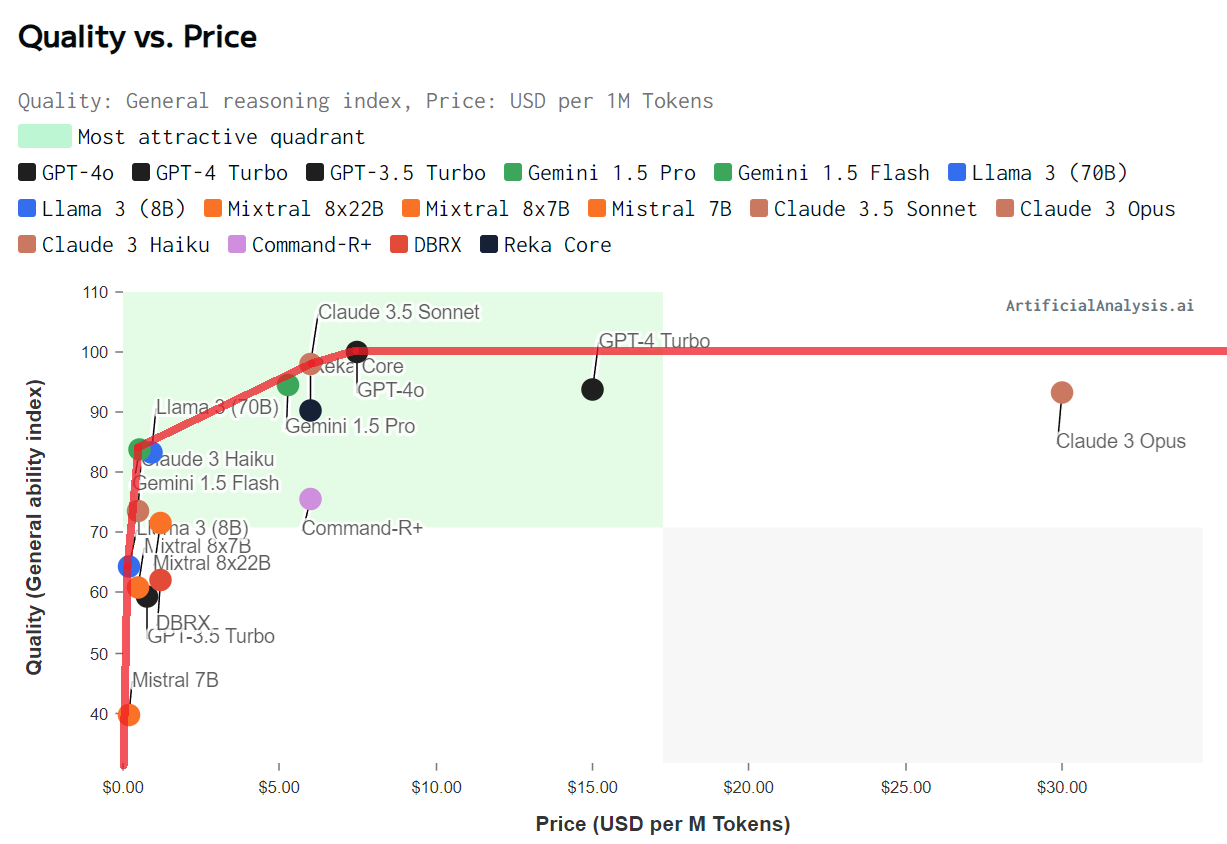
The key takeaway is that for many use cases, especially when you need a frontier model, using a provider's API is often more cost-effective than self-hosting, as providers benefit from economies of scale.
The trade-off between quality and price is fundamental. The following image visualizes this relationship for several popular models.
C. Latency & Speed
Performance is critical for user experience. We can break it down into two metrics:
- Latency (Time to First Token - TTFT): The delay between sending a request and receiving the first piece of the response. This determines how "responsive" an application feels.
- Output Speed (Tokens per Second - TPS): The rate at which subsequent tokens are generated. This determines how long it takes to read the full response.
For a chatbot, low TTFT is crucial to show the user that the model is "thinking." For a batch job summarizing documents, high TPS is more important to get the job done quickly.
LLM Comparison Guide: December 2025 Rankings
The 'LLM Comparison Guide' has a section dedicated to this topic, with a clear table that illustrates the performance differences.
Read the 'Speed & Latency: Inference Performance Comparison' section. Note the dramatic difference in response time between the fastest and slowest models and consider the use cases where this would be a deciding factor.
D. Context Window
The context window is the total number of tokens a model can handle in a single request (both input and output). A larger context window allows you to process longer documents, maintain extended conversations, or analyze entire codebases.
However, a larger context window isn't a free lunch. It comes with its own set of challenges.

A key skill is providing the model with just enough context, rather than simply filling the window. We will explore techniques for this in later modules on Retrieval Augmented Generation (RAG).
3. Putting It All Together: A Practical Framework
Now that we've analyzed the four pillars, how do you make a decision? It starts by defining your priority. Is it raw power, user-facing speed, budget, or the ability to process huge amounts of text?
The digitalapplied.com article provides an excellent decision matrix and honest advice on when not to use certain models.
LLM Comparison Guide: December 2025 Rankings
Let's return to the 'LLM Comparison Guide' to see how these concepts translate into actionable advice.
Read the sections 'When NOT to Use Each Model: Honest Guidance' and 'Use Case-Specific Model Recommendations'. This is perhaps the most valuable part of the article, as it translates abstract metrics into concrete deployment choices.
For the most up-to-date, raw data, websites like Artificial Analysis are invaluable. Take a few minutes to explore their interactive charts. This is the kind of resource you'll want to bookmark.
Comparison of AI Models across Intelligence, Performance, Price
Artificial Analysis provides the underlying data for many of the comparisons we've discussed. Familiarizing yourself with its layout is a key skill for staying current.
Spend about 5-10 minutes exploring this page. Don't try to read everything. Instead, get a feel for the data available. Click on the navigation links for 'Pricing', 'Speed', and 'Context Window'. Scroll down to the large table at the bottom to see the variety of models from providers like OpenAI, Google, and Anthropic.
4. Thought Exercise: Applying the Framework
Instead of writing more code to call different APIs, let's apply this framework to your own experience. Consider these scenarios based on projects you've worked on:
-
Real-Time Geospatial Dashboard: For the
TechnoRiseinternship project, you built a dashboard with LLM-powered insights.- Question: Which model would you choose for this real-time, user-facing feature? What are your primary and secondary concerns (Speed, Cost, Capability)? Justify your choice.
-
Message Broker Documentation: Imagine you want to build an internal tool for your "Kaho-aur-Suno" Go project. Its job is to read through the entire Go source code of a microservice and generate technical documentation.
- Question: Which model characteristics are most important here? Which model(s) would be on your shortlist and why?
-
Prisma Query Helper: For your
prisma-consoleproject, you want to add a chatbot that helps users formulate complex Prisma queries. A user types a natural language request, and the bot should generate a valid query.- Question: This requires high accuracy in code generation and a good user experience. How would you balance capability and latency? Would you consider a multi-model approach?
Take a few minutes to think through these scenarios. This exercise will help solidify the decision-making process in a practical context.
Conclusion
You've now learned how to navigate the complex landscape of LLM providers. This isn't a one-time decision but a continuous process of evaluation as new models are released.
Key Takeaways:
- No Single Best Model: The optimal choice is always task-dependent. It's about finding the best fit for your specific requirements.
- The Four-Way Trade-off: Every model choice is a balance between capability, cost, latency, and context window.
- Multi-Model Strategy: In production systems, the most effective strategy is often to use multiple models. A cheap, fast model can handle simple tasks (e.g., classification), while a more powerful, expensive model is reserved for complex reasoning, a pattern known as "model routing."
- Stay Informed: Use resources like Artificial Analysis, the Chatbot Arena, and technical blogs to stay current on model performance and pricing.
Preview of the Next Lesson:
We've completed our foundational module on LLMs and LangChain setup. You know what models are, the different types, and how to compare them.
In our next lesson, we'll begin Module 2: Prompt Engineering and Output Control. We'll start by diving deep into the art of conversation design, learning how to effectively construct conversations using System, Human, and AI message types to steer the model's behavior precisely.