Hello! Welcome to your first lesson in our course on LangChain. I'm excited to get started with you.
Given your extensive background in software engineering and your goal to gain an in-depth understanding of LangChain, we'll begin by establishing the absolute bedrock of how Large Language Models (LLMs) work. This isn't just theory; understanding these mechanics is what separates a casual user from an engineer who can build efficient, scalable, and cost-effective AI systems.
Today's lesson focuses on the token-based input/output model of LLMs. We will explore what tokens are, how they are generated, and why this concept is critical for managing application costs and performance. By the end of this lesson, you'll be able to describe tokens, tokenization, and context windows, and explain their direct implications on building LLM-powered applications.
1. Tokens: The Currency of LLMs
First, let's establish the fundamental unit that LLMs process. They don't "read" text in the way humans do. Instead, they operate on a numerical representation of text called tokens.
To get a dynamic and developer-focused introduction to this concept, please watch the following video. It explains what tokens are, how they form the basis for API billing, and why different models might process the same text differently.
Most devs don't understand how LLM tokens work
This video from Matt Pocock provides an excellent breakdown of tokens, geared specifically towards developers. It clearly explains the relationship between text, tokens, and cost.
Please watch from the beginning until 04:43. Pay close attention to: The distinction between input and output token costs. The visual diagram of how text is encoded into tokens and decoded back into text. The demonstration using tiktoken, OpenAI's tokenizer library.
As you saw, the entire interaction with an LLM is a process of:
- Encoding: Your input text is converted into a sequence of tokens (integers) by a tokenizer.
- Processing: The LLM performs computations on these tokens to predict the most likely sequence of output tokens.
- Decoding: The generated output tokens are converted back into human-readable text.
This token-based model has profound implications for cost, which is almost always calculated on a per-token basis, often with different rates for input (the tokens you send) and output (the tokens the model generates).
2. A Deeper Look at Tokenization
Now that you have the basic concept, let's explore why tokenization works the way it does. Why aren't tokens just words? And why does "Hello World" have a different token count than "こんにちは世界"? Your engineering background will appreciate the trade-offs involved here.
The article below provides a fantastic technical dive into tokenization, explaining the algorithms used and their practical consequences.
Temperature, Tokens, and Context Windows: The Three Pillars of LLM Control
This article from dev.to, titled 'Temperature, Tokens, and Context Windows,' is written from an engineer's perspective. It demystifies tokenization and connects it directly to real-world costs and system design choices.
Please read 'Part 1: Tokenization Deep-Dive'. Focus on the sections explaining: Why subword tokenization (like BPE) is used instead of word-level tokenization. How tokenization handles common vs. rare words. The cost implications of processing multilingual text and structured data like JSON.
To solidify this, you can use an online tokenizer tool (like OpenAI's Tokenizer or Hugging Face's Tokenizers) to see this in action. Try pasting in:
- A simple English sentence.
- A snippet of Python or Go code.
- A JSON object.
- A sentence in a non-English language.
Notice how the ratio of characters to tokens changes. This hands-on feel will be invaluable as you start designing prompts and processing data.
3. The Context Window: An LLM's Working Memory
Every LLM has a strict limit on the number of tokens it can consider at once. This limit is called the context window. It's crucial to understand that this window includes both the input tokens (your prompt, any provided history, or documents) and the output tokens the model generates.
This next video provides a clear conceptual overview of the context window.
What is a Context Window? Unlocking LLM Secrets
This video from IBM Technology explains the context window as an LLM's 'working memory' and discusses what fills it up.
Watch the entire video. It covers: A simple analogy for how the context window works. What kinds of information (system prompts, user input, documents) occupy space in the window. The performance challenges of larger context windows, including the quadratic scaling of the self-attention mechanism.
The mention of compute requirements scaling quadratically (O(n²)) with the sequence length is key. With your background in algorithm design, you can see this isn't an arbitrary limit but a fundamental computational constraint of the underlying Transformer architecture. Doubling the number of tokens in the context doesn't double the work—it quadruples it.
To help you visualize the scale of these token limits, here are two useful images.
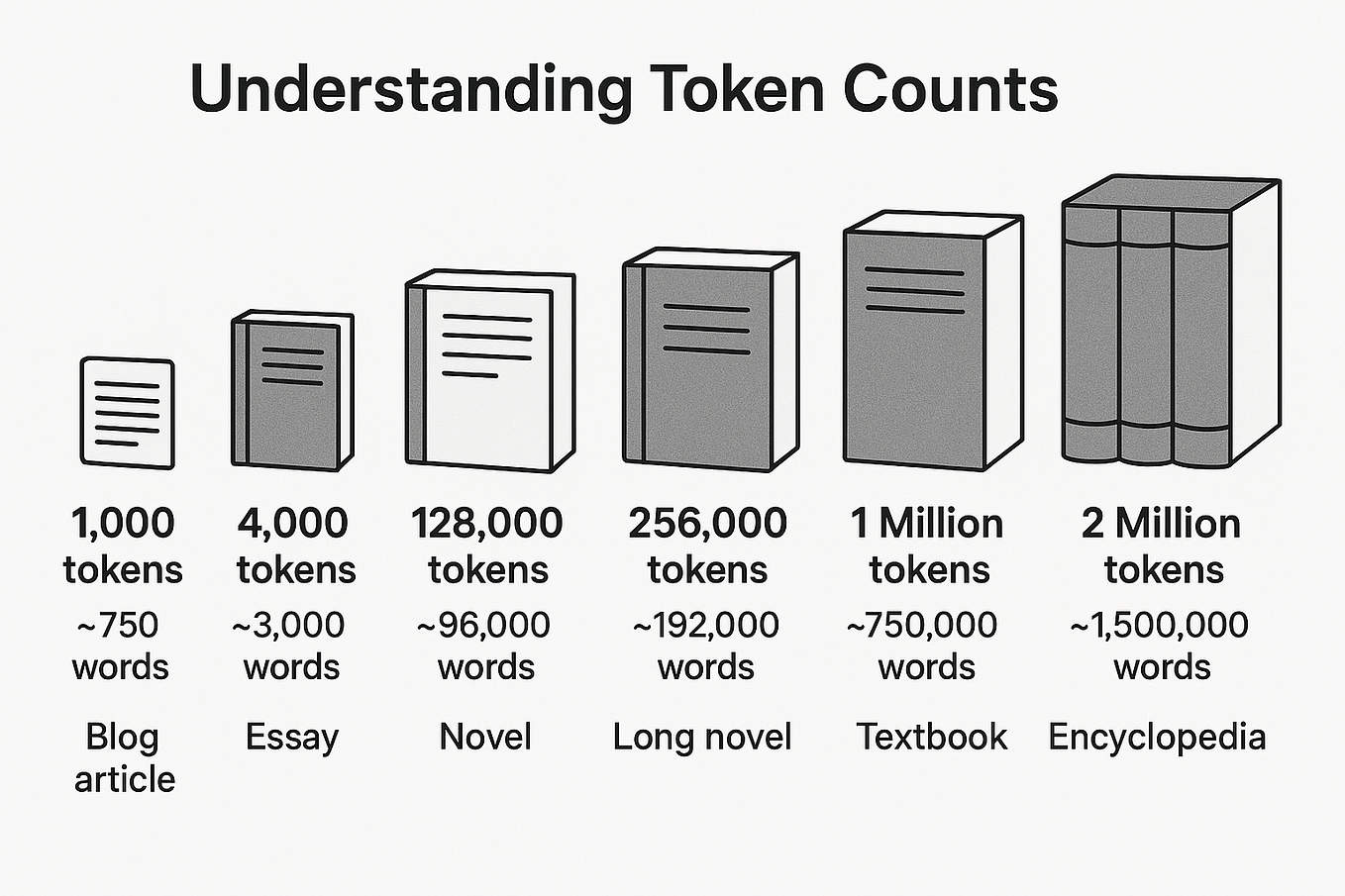
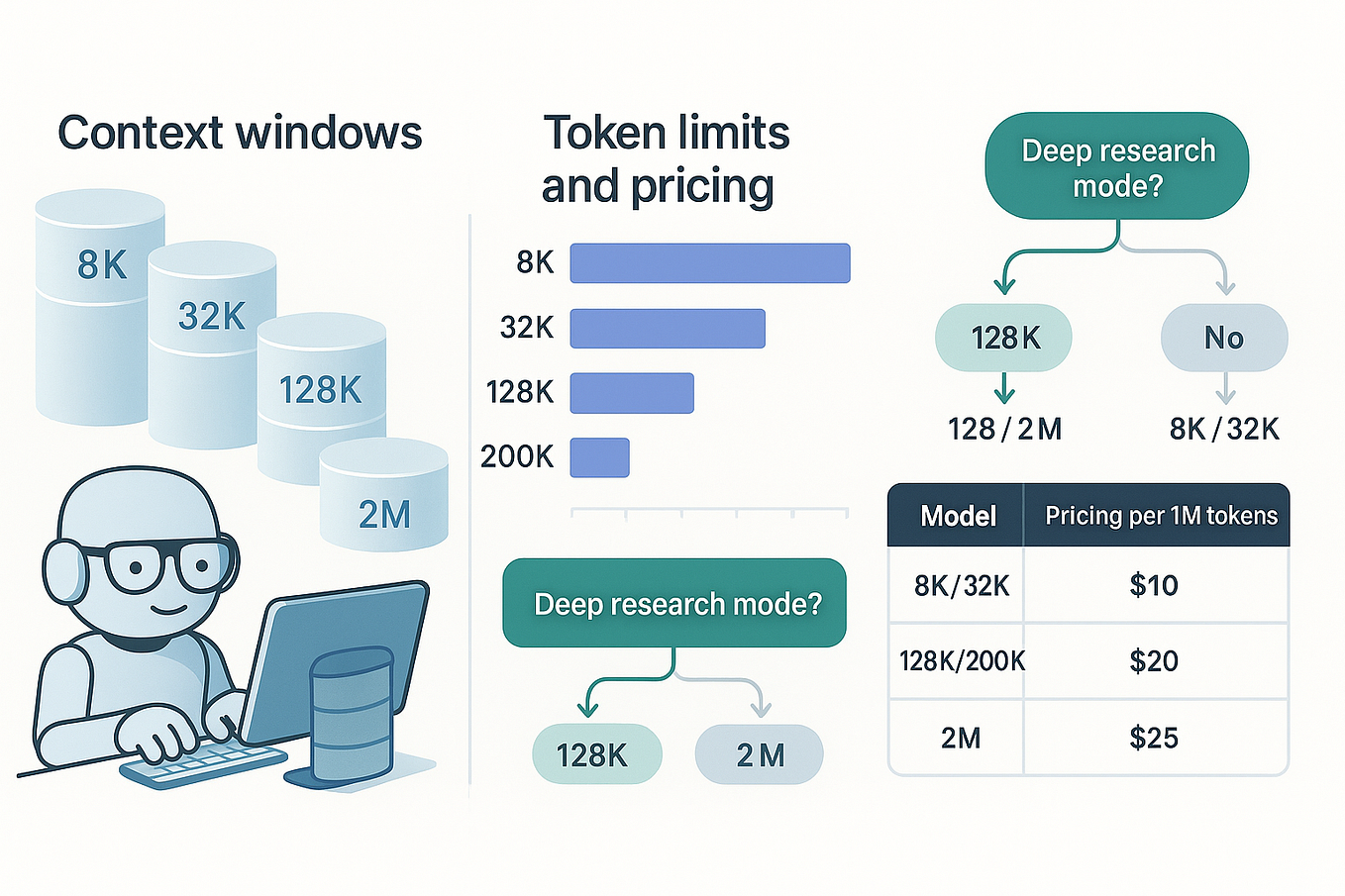
For a more in-depth engineering perspective on managing these constraints, you can refer back to the dev.to article and read Part 3: Context Windows and Memory Constraints. It discusses practical strategies like sliding windows and summarization, which we will implement in later lessons.
4. Tying It All Together: Estimating and Monitoring Costs
Understanding tokens and context windows is essential for one primary reason in a production environment: managing cost. A miscalculation here can lead to significant budget overruns.
This final resource provides a straightforward guide to estimating API costs.
LLM API Cost Estimation and Monitoring
This article from ApX Machine Learning offers a concise and practical guide to LLM API cost estimation.
Read the sections 'Understanding LLM Pricing Models' and 'Estimating Costs During Development'. Pay special attention to the formula for calculating the cost of a single request.
The core formula is simple yet powerful:
Where:
- = Number of input tokens
- = Cost per input token
- = Number of output tokens
- = Cost per output token
As a developer, you'll constantly balance the richness of the context you provide to the model against the cost of those input tokens.
Conclusion
In this lesson, we've established the foundational concepts that govern all interactions with LLMs.
Key Takeaways:
- Tokens are the fundamental unit that LLMs process, and their pricing model is the basis for operational cost.
- Tokenization is the process of converting text into these units. The efficiency of tokenization varies significantly with language, content structure (code, JSON), and the specific model's tokenizer.
- The Context Window is the total number of input and output tokens an LLM can handle in a single pass. This is a hard limit dictated by the computational complexity of the model's architecture.
- Effectively engineering an LLM application requires a constant balancing act between providing sufficient context for high-quality results and managing the token count to control latency and cost.
You now have the essential vocabulary and mental models to begin working with LLM APIs.
Preview of the Next Lesson:
We will move from this theoretical foundation to hands-on practice. In the next lesson, you will set up your development environment with LangChain, configure API keys for different LLM providers, and make your first API calls using the LangChain library. We'll start to see how LangChain provides abstractions to simplify the concepts we've discussed today.