Introduction
In our last lesson, we built an intuition for limits as a "prediction" of a function's value. We ended by seeing that this prediction can fail if the function makes a "jump" at the point we're interested in, approaching one value from the left and a different value from the right. This left us with a key question: how can we rigorously describe and handle this situation?
Today's lesson answers that question directly. We will introduce one-sided limits, a tool that allows us to be precise about the direction of our approach. You will learn the notation for left-hand and right-hand limits and, most importantly, discover the fundamental rule that connects them to the existence of a regular (or two-sided) limit. This concept is the definitive test for whether a limit exists at a tricky point, a skill that is foundational for calculus and frequently tested in competitive exams.
One-Sided Limits: Being Specific About Your Approach
The idea is simple: instead of approaching a point from both sides at once, we consider each side separately.
-
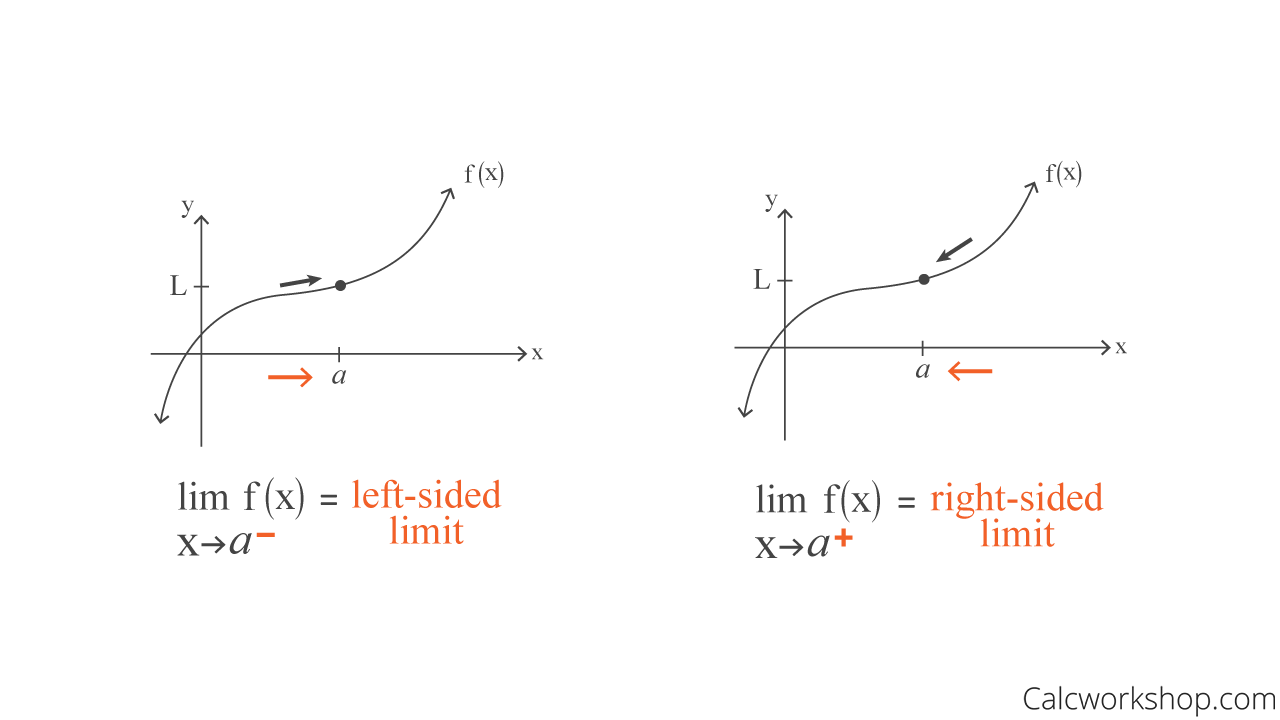
A left-hand limit is the value a function approaches as gets closer to a number from the left side, i.e., using values of that are less than . We denote this as:
Read this as "the limit of as approaches from the left." The little minus sign signifies "from the negative side" of the number line. -
A right-hand limit is the value a function approaches as gets closer to from the right side, i.e., using values of that are greater than . We denote this as:
Read this as "the limit of as approaches from the right." The plus sign signifies "from the positive side."
The following image provides a clear visual for these definitions.
For a more formal definition, please review the first part of the following resource from Paul's Online Math Notes.
Calculus I - One-Sided Limits - Pauls Online Math Notes
This reading recaps why we need one-sided limits and provides their formal definitions and notation.
Read from the beginning of the page down to the end of the "Left-handed limit" subsection. Focus on the notation difference and how the plus and minus signs relate to whether we consider x>a or x<a.
The Golden Rule for the Existence of a Limit
Now for the most important concept of this lesson. One-sided limits aren't just an interesting side note; they are the official gatekeepers for the existence of a two-sided limit (the "normal" limit we discussed previously).
A two-sided limit exists and equals if and only if both one-sided limits exist and are equal to .
In other words:
If the left-hand limit and the right-hand limit are different, or if either one fails to exist, then the two-sided limit does not exist. This is the rigorous explanation for the "jump" we saw in the last lesson.
This video from The Organic Chemistry Tutor provides a very clear graphical walkthrough of this rule in action.
How To Tell If The Limit Exists
This video directly demonstrates how to use the "golden rule" to determine if a limit exists by inspecting a graph.
Watch the first segment of the video, up to the first three minutes. Pay close attention to how he checks the left- and right-sided limits at x=-3 and x=-1 to decide if the overall limit exists at those points.
Applying the Rule: Graphical Analysis
Let's apply this rule to the examples from our previous lesson. The resource from Paul's Online Math Notes does exactly this.
Calculus I - One-Sided Limits - Pauls Online Math Notes
This reading will walk you through applying the concept of one-sided limits to different functions we've already seen.
First, read Example 1, which re-examines the Heaviside (step) function. Notice how \lim_{t \to 0^-} H(t) = 0 while \lim_{t \to 0^+} H(t) = 1. Since the one-sided limits are not equal, the overall limit \lim_{t \to 0} H(t) does not exist. Next, skip to Example 3. Here, you'll see a function with a "hole". Observe that both the left- and right-hand limits approach 4. Since they are equal, the two-sided limit is also 4. Finally, read the crucial summary under the heading "Fact". This section formalizes the golden rule we just discussed.
Now, let's put your understanding to the test with a comprehensive graphical problem.
Calculus I - One-Sided Limits - Pauls Online Math Notes
This is a great practice problem to consolidate everything we've learned about finding limits from a graph.
Look at the graph in Example 4. I'll walk you through the analysis for the point x=1. e) f(1): The value of the function at x=1 is given by the solid dot, so f(1) = 4. f) \lim_{x \to 1^-} f(x): As we approach x=1 from the left, the graph is heading towards a y-value of 4. So, the LHL is 4. g) \lim_{x \to 1^+} f(x): As we approach x=1 from the right, the graph jumps down and heads towards a y-value of -2. So, the RHL is -2. h) \lim_{x \to 1} f(x): Since the LHL (4) is not equal to the RHL (-2), the two-sided limit does not exist. Now, try to answer the questions for the points x=-4 and x=6 yourself before revealing the solution.
Algebraic Analysis: Piecewise and Special Functions
While graphical analysis is great for intuition, in an exam setting like the JEE, you'll often work with functions algebraically. This is especially true for piecewise functions. The strategy is simple: choose the correct piece of the function based on your direction of approach.
The same video from The Organic Chemistry Tutor demonstrates this perfectly.
How To Tell If The Limit Exists
This part of the video is crucial. It shows how to translate the graphical idea of left- and right-hand limits into an algebraic calculation for piecewise functions.
Watch the rest of the video, from piecewise functions. For the limit at x=-2, notice how he uses 5x+1 for the left-hand limit (because that's where x < -2) and x^2+1 for the right-hand limit (where x > -2). See if you can predict which functions he'll use for the limit at x=3 before he explains it.
JEE Focus: Special Functions
Exams like JEE Advanced love to test your understanding with non-standard functions. The greatest integer function, , and the fractional part function, , are classic examples where one-sided limits are essential.
Let's analyze the limit of the fractional part function, , as approaches 2.
-
Left-Hand Limit (LHL):
- We are approaching 2 from the left, so think of values like , then , then .
- Let's find the fractional part for these values:
- The trend is clear: the values are getting closer and closer to 1.
- Therefore, .
-
Right-Hand Limit (RHL):
- We are approaching 2 from the right, so think of values like , then , then .
- Let's find the fractional part:
- These values are clearly getting closer and closer to 0.
- Therefore, .
-
Conclusion
- Since the LHL (1) does not equal the RHL (0), the two-sided limit does not exist.
This is a perfect example of why just "plugging in the number" can be misleading and why a careful analysis of one-sided limits is so powerful.
Conclusion
In this lesson, we added a crucial layer of precision to our understanding of limits. We've moved from a general "prediction" to a rigorous test for a limit's existence.
Here are the key takeaways:
- One-sided limits allow us to analyze a function's behavior as we approach a point from either the left () or the right ().
- The golden rule of limit existence: A two-sided limit exists if and only if the left-hand limit and right-hand limit both exist and are equal.
- This rule is our primary tool for analyzing limits at points of discontinuity, especially for piecewise functions and special functions like that are common in competitive exams.
You now have a solid intuitive and graphical foundation for what limits are and when they exist. In our next lesson, we will build on this by learning powerful algebraic techniques, such as factoring and rationalization, which will allow us to calculate limits efficiently without always needing to draw a graph or create a table of values.