In our previous lesson on Gilbert's Law, we focused on the paralysis and frustration that arise from ambiguity—when you are held responsible for an objective that was never clearly defined. We saw how this manifests in a trainee struggling without a blueprint for a "perfect fit" and a partner feeling lost without a map for a changing relationship.
Today, we shift from the problem of unclear goals to the challenge of unconstrained resources, specifically time. This lesson introduces Parkinson's Law, which famously states: "Work expands so as to fill the time available for its completion." You will learn to apply this principle to explain why a lingerie production schedule can stretch to meet a distant deadline and why relationship discussions can inflate to consume an entire evening if left unbounded.
Where Gilbert's Law addresses a lack of direction, Parkinson's Law addresses a lack of constraints. It reveals how the container we create for a task—the time we allocate—profoundly shapes the task itself.
The Elastic Nature of Work
Cyril Northcote Parkinson, a British naval historian and author, made this observation after studying the bureaucracy of the British Civil Service. He noticed that the number of employees grew at a steady rate, regardless of the amount of actual work to be done. Tasks, he concluded, were not fixed entities; they were fluid, capable of swelling in perceived complexity and importance to justify the time and resources allocated to them.
To understand the mechanics of this, let's examine a formal analysis of the law.
Program evaluation and review technique and Parkinson's law - PMI
This article from the Project Management Institute provides a concise breakdown of Parkinson's Law and its implications.
Please read the following brief excerpts: Start with the famous opening sentence under the heading "Parkinson's Law": "Work expands...". Note the list of contributing factors that follow, including the "desire to appear busy," the drive to add subordinates, and simple procrastination. Next, read the definition of the propensity concept. This frames the law's effect as a quantifiable loss. Finally, focus on the first paragraph under "Parkinson vs. PERT," which introduces a crucial term: the Parkinson Gap. This gap is the difference between the actual working time required and the time allowed.
The key insight is the "Parkinson Gap"—the slack between the necessary effort and the deadline. The law predicts this gap will inevitably be filled. This isn't just about procrastination, though that is a factor. The work itself genuinely seems to become more complex. We find more details to polish, more research to conduct, and more potential problems to consider.
Application 1: The Three-Week Custom Bra Order
Imagine a client orders a custom-designed bikini top. Based on your experience, you estimate the core tasks—patterning, cutting, sewing, and finishing—will require about 10 solid hours of work. The client is not in a hurry, so you give yourself a generous deadline of three weeks.
According to Parkinson's Law, this 10-hour job will almost certainly take the full three weeks to complete. The vast Parkinson Gap (three weeks minus 10 hours) will be consumed. Here is how:
- Week 1: Procrastination & "Research." The deadline is far away, so the initial effort is low. You might spend hours browsing for "inspiration" that doesn't directly contribute to the design, or you might simply put off starting the project in favor of more urgent, shorter-term tasks.
- Week 2: Unnecessary Complexity. You begin the work but find ways to make it more elaborate. "Should I try that new, complex stitching I saw on an haute couture piece?" "Maybe I should experiment with three different types of fabric lining before choosing one." The task expands beyond its essential requirements.
- Week 3: Frantic Effort. As the deadline looms, the effort level spikes dramatically to complete the now-inflated task. You finish just in time, feeling busy and productive, but the reality is that a 10-hour task has occupied a three-week slot in your production schedule, preventing you from starting other projects.
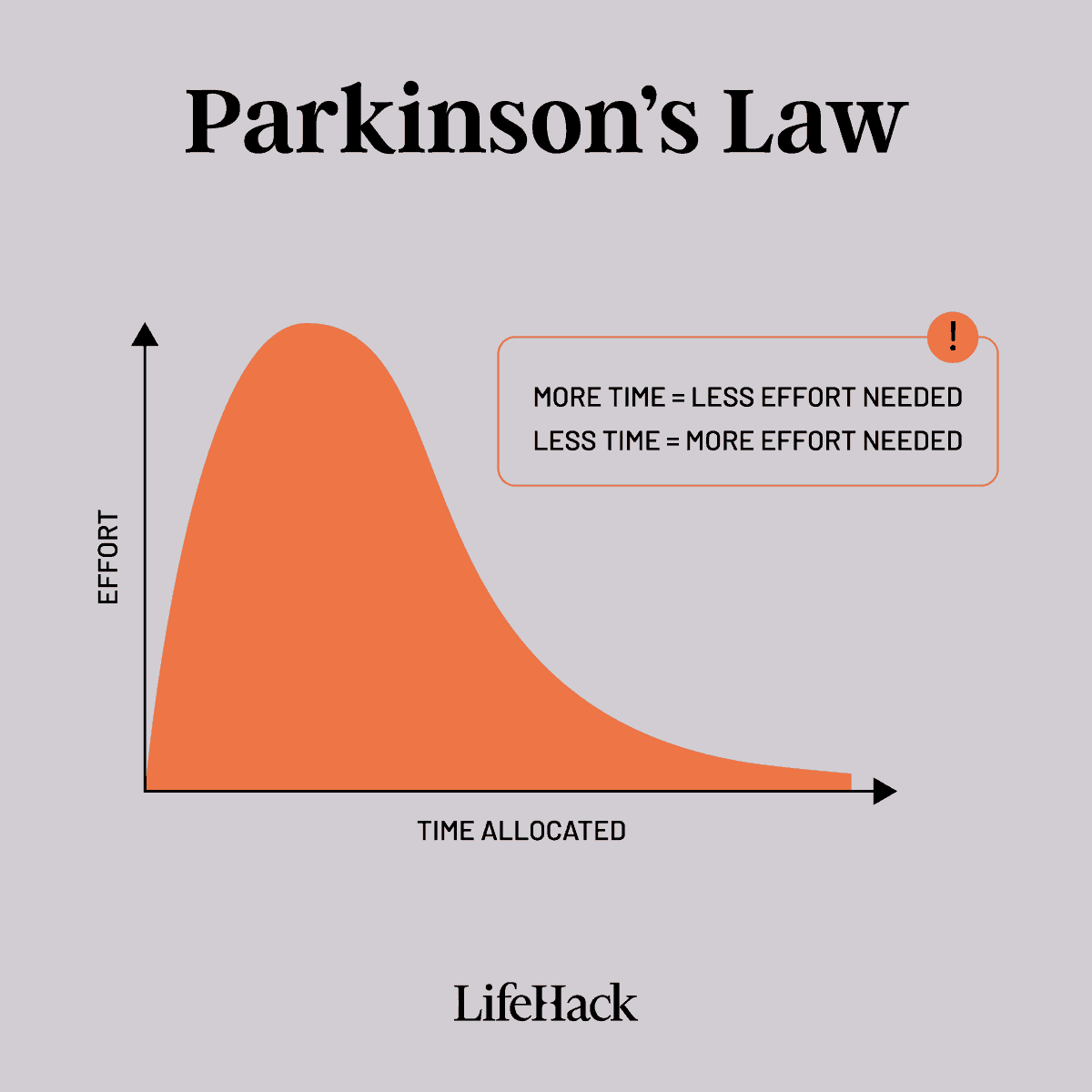
The consequence is a loss of efficiency. Your effective hourly rate plummets, and your business's overall capacity is reduced.
The Counter-Strategy: Imposing Constraints
The solution to Parkinson's Law is to intentionally shrink the container.
- Set Aggressive Deadlines: Give the 10-hour project a 2-day deadline, not a 3-week one. The pressure forces focus on essential tasks and eliminates time for unnecessary expansion.
- Deconstruct the Task: Break the project into smaller sub-tasks, each with its own short deadline.
- Patterning: End of Day 1.
- Cutting and initial assembly: End of Day 2.
- Finishing and quality check: Morning of Day 3.
This creates multiple, smaller "Parkinson Gaps," which are much easier to manage than one large one. By doing so, you move from being a victim of the law to actively managing it.
Application 2: The Unbounded Relationship Check-In
Now let's apply this to our vee relationship scenario. The wife and husband recognize the need to communicate about their evolving dynamic. They decide to set aside an evening "to talk." They have no specific agenda or time limit. "We'll just talk until we're done."
Parkinson's Law predicts this conversation will expand to fill the entire evening, likely becoming more emotionally draining and less productive than intended. The "work" of the relationship discussion—addressing insecurities, coordinating schedules, sharing feelings—will inflate to fill the unbounded container.
- A minor scheduling query can spiral into a philosophical debate about the nature of time and commitment.
- A single expression of vulnerability might be analyzed and re-analyzed for hours, far beyond its initial significance.
- The conversation may drift into old, unrelated grievances because there is "time" to air them.
The result is emotional exhaustion. The couple may feel they spent the whole evening "working on the relationship" but have little to show for it. This can create a conditioned response where the prospect of "a talk" is associated with a long, draining ordeal, leading to future avoidance.
The Counter-Strategy: Intentional Time
The antidote, much like in project management, is to create structure and impose constraints. The concept of "intentional time" is a powerful tool for this.
Polyamorous Time: Needs and Expectations
This article from Ready For Polyamory is essential reading for understanding how to manage time—a critical and finite resource in non-monogamous relationships.
Please read the following sections to see how to combat Parkinson's Law in relationships: Read the introductory section on "Polyamorous Time". It establishes why time allocation is fundamentally different and more deliberate in polyamory. Focus on the section that defines intentional time. The key is the shift from passive, undefined time to active, focused time. Read the advice for nesting partners. Pay close attention to the emphasis on scheduling and distinguishing relationship-nurturing time from passive household time. The line, "it's a running joke that polyamorists are actually folks with a scheduling kink," is a direct nod to the necessity of this structure. Finally, review the summary points under "So, for everyone...". These are direct, actionable strategies for implementing intentional time.
The article argues that the key to managing "polyamorous time" is to be explicit and deliberate. To counteract Parkinson's Law in relationship discussions, the couple could:
- Timebox the Conversation: "Let's set aside 45 minutes after dinner to talk about our schedules for the next two weeks." A defined end time forces focus.
- Set a Clear Agenda: "Tonight, I'd like to talk about just two things: 1) planning your overnight with your lover next week, and 2) how we can get more quality one-on-one time for ourselves." This prevents the conversation from expanding into unrelated areas.
- Use Focusing Tools: For broader conversations, tools can provide structure. A simple list of topics or even tools like conversation card decks can help keep the discussion on track and productive.

By replacing the unbounded "Let's talk" with a structured, time-boxed "check-in," the couple transforms a potentially draining marathon into a focused and efficient conversation, strengthening their relationship without succumbing to emotional exhaustion.
Conclusion
Parkinson's Law is a fundamental principle of resource management, whether the resource is a production schedule or an evening of emotional energy. It teaches us that work, in any form, abhors a vacuum. If you provide an expansive container, the task will swell to fill it.
Key Takeaways:
- Parkinson's Law: Work expands to fill the time available for its completion. This applies to professional tasks and personal activities alike.
- The Parkinson Gap: This is the slack time between the necessary work and the given deadline, which the law predicts will be consumed by procrastination, over-complication, or perfectionism.
- Application in Design: In lingerie production, generous deadlines lead to inefficiency and reduced throughput. The solution is to set tighter, more realistic deadlines and break projects into smaller, time-bound stages.
- Application in Relationships: In relationship dynamics, unbounded conversations lead to emotional exhaustion and unproductive conflict. The solution is to practice "intentional time" by timeboxing discussions and setting clear agendas.
In our next lesson, we will confront another universal challenge in planning: the inevitability of error. We will explore Murphy's Law, "Anything that can go wrong will go wrong," and apply it to anticipate complications in a lingerie fitting event and to prepare for the foreseeable difficulties of opening a relationship.