Welcome back. In our previous lesson, we treated Murphy's Law not as a cynical resignation to fate, but as a rigorous planning tool for anticipating and mitigating foreseeable failures. We learned to ask "What can go wrong?" to build more resilient systems, both in business and relationships.
Today, we shift from failures that can happen to overruns that will happen. This lesson examines two related principles: Hofstadter's Law and Cheops' Law. Together, they explain the deeply human and systemic reasons why complex projects—from creating a new product line to building a new relationship structure—consistently take more time and resources than we plan for. Your background in statistics will be particularly useful here, as we'll touch upon the cognitive biases and distributional properties that underpin these laws. Our goal is to apply them to explain why lingerie production and relationship development so often exceed our most careful estimates.
The Inevitability of Overruns: Hofstadter's and Cheops' Laws
At first glance, these two laws seem to state the obvious. But their true value lies in the nuances of why this happens and what it tells us about the limits of planning.
Hofstadter's Law is a recursive and self-referential statement about the psychology of estimation: "It always takes longer than you expect, even when you take into account Hofstadter's Law."
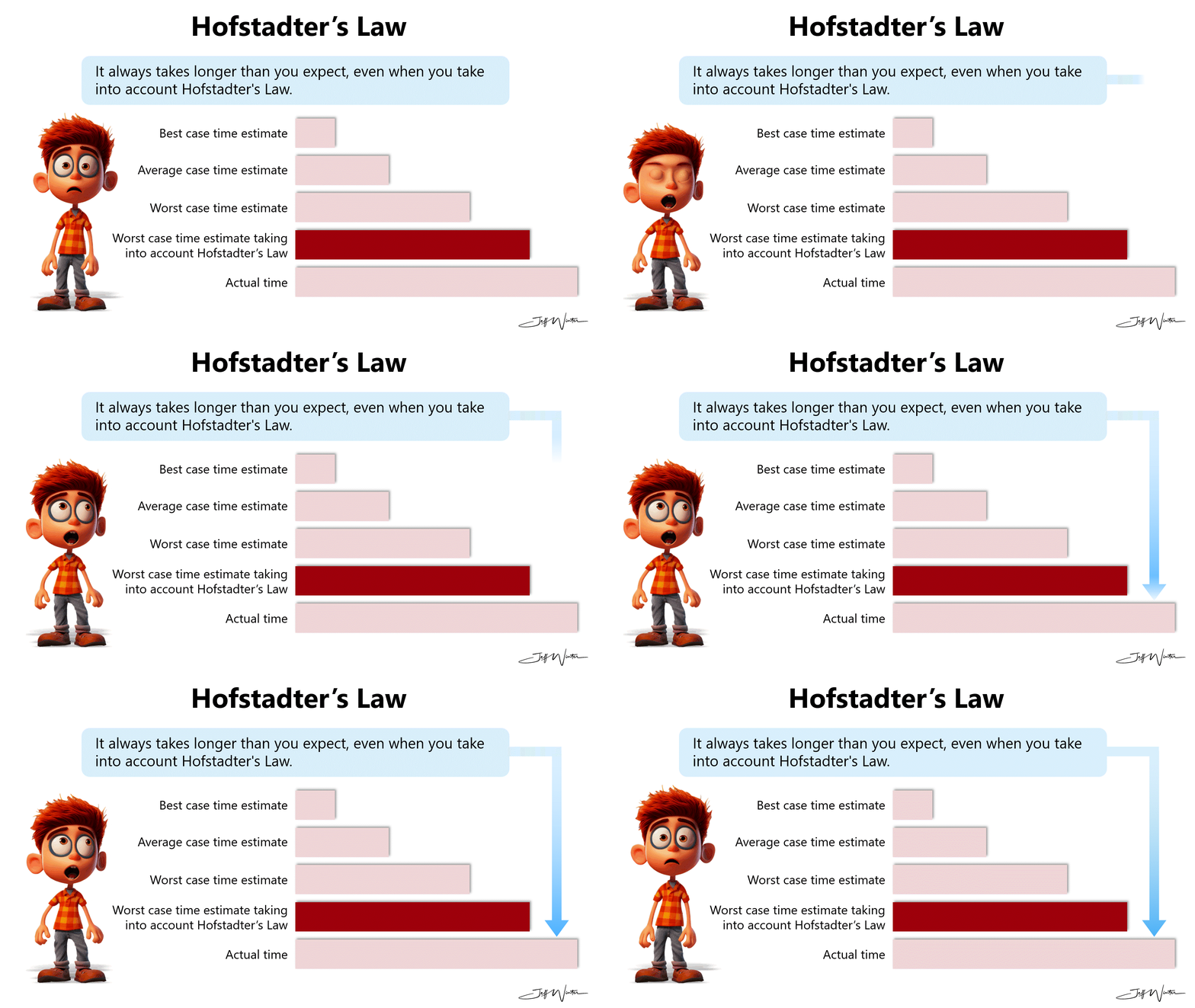
The law humorously captures our deep-seated optimism bias and what psychologists Daniel Kahneman and Amos Tversky termed the "planning fallacy"—our tendency to underestimate the time, costs, and risks of future actions while overestimating their benefits.
Cheops' Law is the macro-level, empirical observation of this phenomenon: "Nothing ever gets built on schedule or within budget." Named after the pharaoh who commissioned the Great Pyramid of Giza, it generalizes the problem from individual psychological bias to the systemic realities of any large project.
To grasp the mechanics behind these laws, let's turn to some background reading.
This article provides a comprehensive overview of Cheops' Law, linking it to its origins, project management theory, and cognitive biases.
Please read the following sections: Begin with the introductory section to understand the law's definition and origin. Notice the key systemic issues it highlights: scope creep, unforeseen hurdles, and external factors. Next, read the "Standard Statement" to fix the canonical phrasing in your mind. Finally, read the section on "Theoretical Relevance". Pay close attention to the connection made between Cheops' Law and the planning fallacy. The mention of agile methodologies as a counterpoint will be important later.
The Grokipedia article grounds Cheops' Law in project management, explicitly connecting it to the planning fallacy. Hofstadter's Law is the engine of that fallacy. The project management world has found that the distribution of project overruns isn't a normal bell curve; it has "fat tails," meaning extreme overruns are far more common than we'd intuitively expect.
How To Launch Big Complex Projects
This article from Smart Interface Design Patterns explains the practical consequences of these "fat-tailed" distributions in project management and introduces a statistical approach to better forecasting.
Please read the first two parts of the article: Start at the top, "99.5% Of Big Projects Overrun". This section formally defines Hofstadter's Law and visualizes the concept of a "fat-tail" distribution, which should be familiar territory. Continue to the next section, "Reference-Class Forecasting (RCF)". This introduces a powerful statistical method for mitigating the planning fallacy by shifting from an "inside view" to an "outside view."
Now, with this framework of psychological bias (Hofstadter) leading to systemic overruns (Cheops) that can be partially mitigated by better forecasting (RCF), let's apply these ideas.
Application 1: The Lingerie Collection Launch

Imagine you are launching a new, ambitious lingerie collection. It involves five new bra designs with intricate lace overlays and a novel underwire construction you've developed. You've created a detailed project plan with a 4-month timeline and a $10,000 budget. You've even learned from Murphy's Law and added a 25% buffer, allotting 5 months and $12,500.
Hofstadter's Law predicts you will still be late and over budget. Cheops' Law agrees, pointing to the systemic reasons.
-
Hofstadter's Law in Action: Your estimation for each task (pattern grading, sample sewing, fabric sourcing) is based on an idealized "inside view." You subconsciously underestimate the "unknown unknowns."
- You budget two days to perfect the stitching on a new lace edge. It takes a week of frustrating trial and error because the thread keeps snagging in an unexpected way.
- You account for a 25% buffer, but this buffer is itself a product of your optimism. The reality of the overrun isn't an additional 25%; as the "fat-tail" distribution shows, it could be 100% or more. The real buffer needed was unknowable from the inside.
-
Cheops' Law in Action: The project is beset by classic systemic problems.
- Scope Creep: Two months in, you have a brilliant idea for a matching suspender belt for the most popular design. It "won't take long" to add, but it requires new patterns, new hardware sourcing, and new rounds of sampling, quietly adding three weeks to the timeline.
- Unforeseen Technical Hurdles: Your novel underwire construction passes initial tests. But when you create the full size run, you discover it digs into the wearer's side in the larger cup sizes. You must now re-engineer the wire channel and re-make all the G+ size samples, costing time and materials.
- Supply Chain Disruptions: The specific shade of organic cotton you need for the bands is back-ordered for six weeks, halting production.
Mitigation: Reference-Class Forecasting (RCF)
To combat this, you must abandon the "inside view" and adopt the "outside view" suggested by the RCF method. Instead of estimating the new project's components, you look at historical data from a "reference class" of similar projects.
- Identify a Reference Class: Your past three collection launches.
- Gather the Data:
- Collection A: Planned 3 months, took 5 months (67% overrun).
- Collection B: Planned 4 months, took 6 months (50% overrun).
- Collection C: Planned 2 months, took 3.5 months (75% overrun).
- Establish a Baseline Prediction: Your average schedule overrun is about 64%.
- Adjust for the Current Project: Your new project is more complex than the previous ones. Therefore, a 64% overrun is likely a conservative baseline. A realistic timeline, based on data rather than optimism, is probably closer to 6.5 months (4 months + 64%), not the 5 you buffered.
This statistical, data-driven approach is the most effective antidote to the psychological optimism that fuels Hofstadter's Law.
Application 2: The Vee Relationship "Project Plan"
Now let's turn to the vee relationship. A husband (H) and wife (W) have decided the wife will pursue a relationship with a new partner (M, for metamour). They have done their homework, communicated extensively, and established a "project plan" for this new phase.
- The "Schedule": A series of steps. Month 1: Texting and virtual dates only. Month 2: First in-person dates, no overnights. Month 3: Introduce H and M.
- The "Budget": An emotional and temporal budget. They agree to two "processing nights" per week to discuss feelings and cap outside dates at one per week to preserve family time.
They've even accounted for Murphy's Law, anticipating jealousy. Yet, Hofstadter's and Cheops' Laws predict this carefully laid plan will go off the rails.
-
Hofstadter's Law in Action: The "task" is not "have a date"; it is "feel secure while your partner has a date." Emotional states cannot be scheduled.
- H thinks he'll be fine with an overnight in Month 2 because he's intellectually on board. But when the night comes, he's hit by a wave of loneliness he couldn't have predicted. The "task" of feeling secure takes longer than expected.
- Even if they account for this ("Okay, let's delay overnights until we both feel ready"), another unexpected emotional event will occur, revealing that their new estimate for "readiness" was also optimistic. The recursion is emotional.
-
Cheops' Law in Action: The "project" of establishing a stable vee encounters systemic issues.
- Scope Creep: The relationship between W and M deepens faster than anyone anticipated. What was planned as "casual dating" (the initial scope) now involves deep emotional intimacy and discussions of a future together. The entire project's scope has changed, and all initial agreements are now inadequate.
- Unforeseen "Technical" Hurdles: A communication style the couple (H & W) used successfully for years proves completely ineffective for discussing the complexities of a third person. They have to find or learn new "emotional technology" to proceed, causing major delays.
- External Factors: The new partner, M, has a family emergency and needs significant emotional support from W, which consumes her emotional "budget" and disrupts the planned allocation of time and energy for the primary relationship.
Mitigation: Agile Relationship Management
As the Grokipedia article noted, agile methodologies can counter the rigid failures of waterfall planning. A "waterfall" plan for opening a relationship is doomed to fail because it cannot account for the unknown unknowns of human emotion. An "agile" approach is more resilient.
- Work in Sprints: Instead of a 3-month plan, work in one-week sprints. The goal for the week might be, "W will go on one coffee date, and we will have a check-in the next day."
- Hold Retrospectives: The check-in is a "retrospective." What worked? What was harder than expected? What did we learn?
- Adapt the Backlog: Based on the retrospective, you plan the next sprint. Maybe the coffee date brought up unexpected anxiety, so the next week's goal isn't another date, but "Read a chapter of a book on managing jealousy and discuss it."
This iterative process abandons the fallacy of long-term prediction. It acknowledges that the project's timeline and budget are unknowable in advance and must be discovered through a process of experimentation, feedback, and continuous adaptation.
Conclusion
Hofstadter's and Cheops' Laws are not just cynical quips; they are fundamental observations about complex systems. They teach us that our intuition for estimating time and resources is fundamentally flawed by optimism, especially when dealing with projects that have many interdependent parts and "unknown unknowns."
Key Takeaways:
- Hofstadter's Law is the recursive, psychological principle that we consistently underestimate project duration, even when trying to compensate for this very tendency.
- Cheops' Law is the empirical observation that complex projects systematically overrun their schedules and budgets due to issues like scope creep, technical hurdles, and external factors.
- In Lingerie Production: These laws explain why a well-planned collection launch will almost certainly be late and over budget. The best mitigation is not simply adding a buffer, but using Reference-Class Forecasting to ground estimates in historical data.
- In Relationship Dynamics: The laws explain why a rigid "plan" for opening a relationship will fail. The process is inherently unpredictable. The best mitigation is to adopt an agile methodology of short sprints and frequent, adaptive check-ins.
We've now seen that projects are prone to failure (Murphy) and destined for overruns (Hofstadter/Cheops). A common, intuitive reaction when a project falls behind schedule is to throw more resources at it. In our next lesson, we will explore Brooks' Law, which reveals why this is often the worst thing you can do.