Welcome back. In our last lesson, we explored Fitts's Law, which provides a mathematical model for making user interface elements physically efficient to interact with—in short, how to make a button easy to click. We saw that larger, closer targets reduce the time and effort needed for a user to take action.
Today, we address the next logical question: Where should that button be placed so the user finds it without thinking? This brings us to Jakob's Law, a principle centered on user psychology and habituation. You will apply this law to design a lingerie website that aligns with established e-commerce conventions, thereby enhancing usability by meeting user expectations. As an efficiency expert, you'll see this as minimizing cognitive load, a crucial counterpart to minimizing physical effort.
The Power of Convention: Defining Jakob's Law
Jakob's Law is simple yet profound: Users spend most of their time on other websites, so they expect your site to work like all the other sites they already know. When a design deviates from these ingrained expectations, usability suffers because it forces the user to learn a new system. This creates cognitive friction, a "stumbling block" that distracts from the site's actual purpose—in our case, appreciating and purchasing lingerie.
Let's begin with a short video where the law's originator, Jakob Nielsen, explains this concept and its core rationale.
Jakobs Law of Internet User Experience
This brief video from the Nielsen Norman Group features Jakob Nielsen himself discussing the law. It succinctly captures why adhering to convention is not about a lack of creativity, but about effective communication.
Please watch the entire video. Pay attention to his argument that when a site's interaction design is what people expect, they don't have to worry about how to operate it; they can focus on what you're trying to deliver.
Now, let's go deeper into the mechanics of the law with Nielsen's foundational article.
Jakob's Law of the Internet User Experience - Jakob Nielsen on UX
This article provides the full definition of Jakob's Law and explains the three drivers behind it: the vast number of services users interact with, the cumulative nature of their experience, and the formation of expectations based on a synthesized mental model.
Read the first two major sections, from the beginning of the article through the explanation of how users form expectations and the consequences of violating them.
The core takeaway is that users don't approach your website as a blank slate. They arrive with a powerful mental model of "how e-commerce sites work," built from thousands of hours spent on Amazon, ASOS, and other retailers. Your design succeeds by aligning with this model and fails when it contradicts it.
Application 1: Designing a Lingerie E-commerce Website
Your goal is to create a seamless path from browsing to purchase. Jakob's Law dictates that the most effective way to do this is to follow the conventions established by market leaders.
Let's look at what these conventions are. The following video uses Amazon, the archetype of e-commerce, to break down the "perfect" product page layout.
The Perfect Ecommerce Website Layout Explained
In this video, "The Perfect Ecommerce Website Layout Explained," Payton Clark Smith deconstructs the standard, high-converting e-commerce layout, arguing that familiarity trumps creative novelty for driving sales.
First, watch the introduction where he makes the case for following Amazon's lead, from his opening argument. Then, focus on the detailed breakdown of a conventional desktop product page layout, from breadcrumbs to call-to-action. Finally, see his analysis of a "horrendous" example that violates these conventions, and note his key observation: an unfamiliar layout breeds distrust.
Now, let's analyze a real-world lingerie site through the lens of Jakob's Law. The images below are from Pepper, a brand specializing in bras for smaller cup sizes.
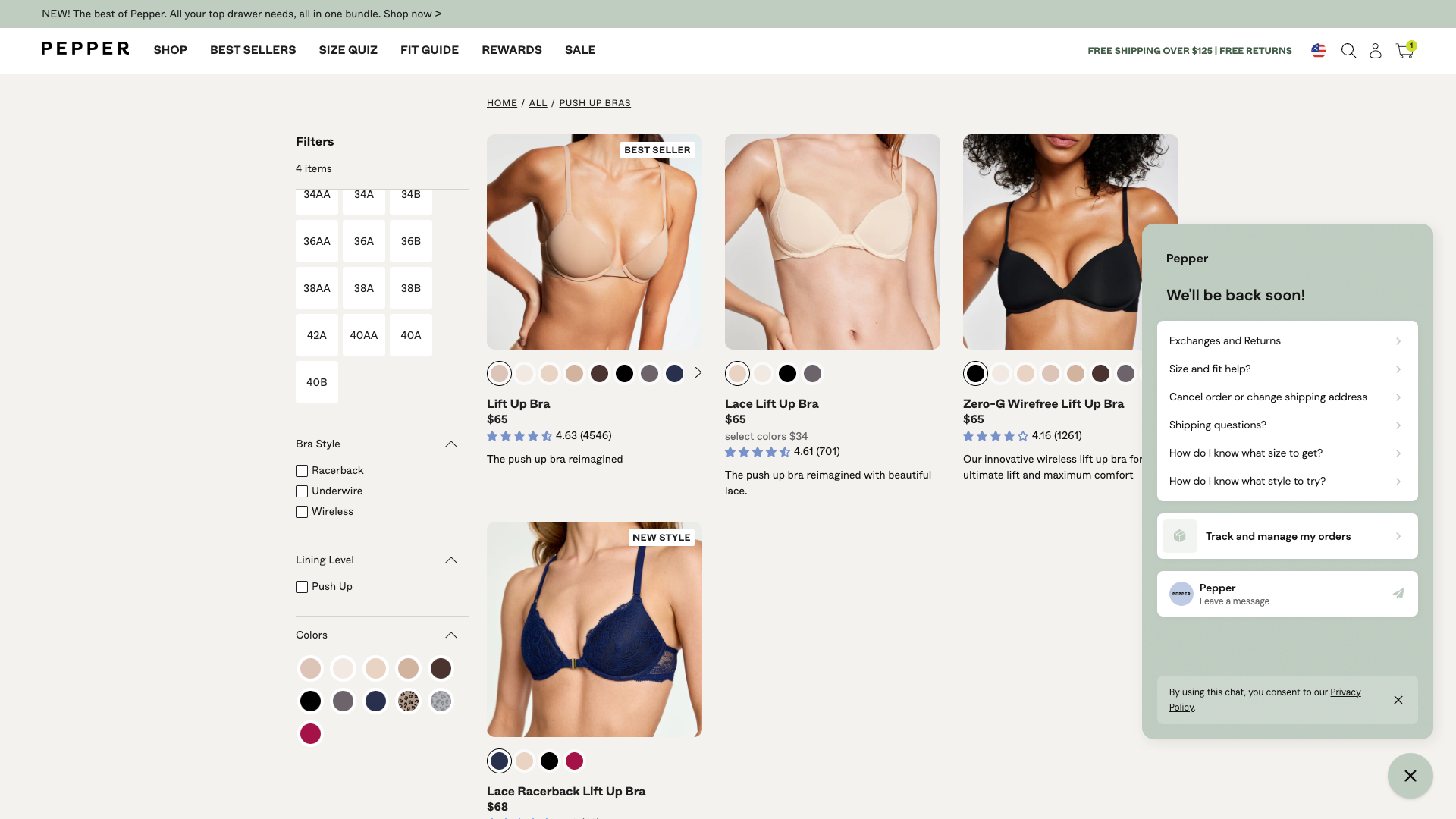
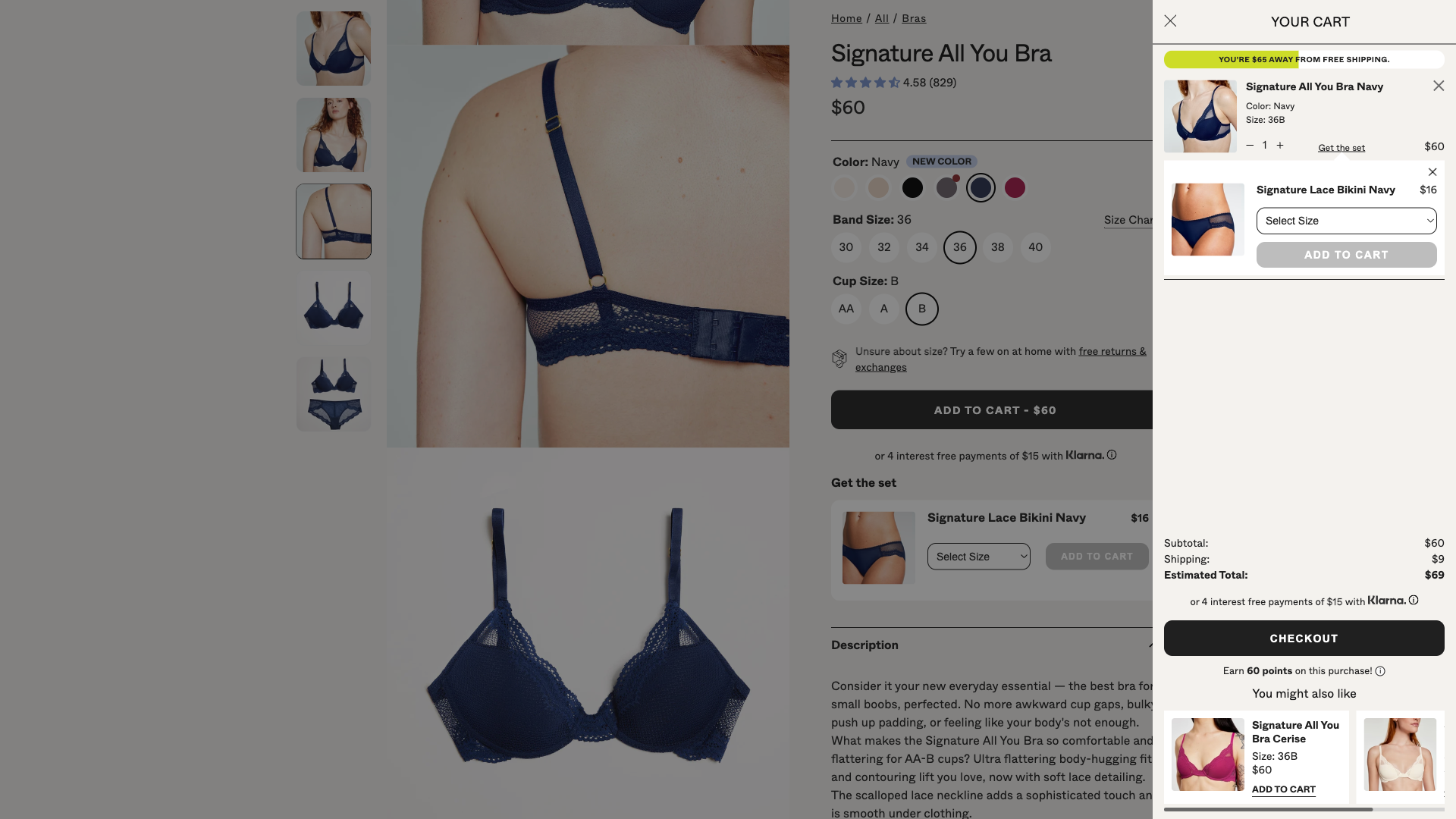
These pages are effective because they are instantly familiar.
- On the collection page (LINK): A user innately knows to use the filters on the left to narrow down options by size or style. This pattern is ubiquitous.
- On the product page (LINK): A user expects to find product images on the left, with details like price, color/size selection, and the "Add to Cart" button on the right. The shopping cart appearing on the right side after an item is added is also a deeply ingrained convention.
Deviating from this—for example, by placing filters at the bottom of the page or the "Add to Cart" button in the top-left corner—would not be "innovative." It would be confusing and inefficient, increasing the probability of user error or abandonment.
To confirm that these are not just general e-commerce trends but are specific to your field, let's review an analysis of top fashion websites.
Top 4 best-designed fashion websites: In-depth guide to inspire your ...
This article from Centra analyzes high-performing fashion e-commerce sites, and its findings underscore the importance of conventional design patterns.
First, review the "FAQ" section at the end of the article. Focus on the bulleted list under the question "What are the key elements of a well-designed fashion website?". Note how many of these elements—intuitive navigation, advanced search, sticky menus—are conventions you've seen. Then, go back to the section "Plan and design your fashion website." The key directive here is to design around your target audience's needs and expectations, which is the very essence of Jakob's Law.
From a statistics and operations research perspective, adhering to Jakob's Law is a form of Bayesian inference. Your "prior" is the massive dataset of user behavior across the web, which shows a strong preference for specific conventions. Designing a site that ignores this prior in favor of a novel-but-untested layout is a high-risk gamble that is statistically unlikely to pay off.
Application 2: Navigating Vee Relationship Dynamics
Applying a UX law to human relationships requires an analogy.
- The "Websites": A person’s past relationships (romantic, familial, platonic) and cultural narratives about relationships.
- The "Mental Model": The set of expectations and assumptions about how relationships are "supposed to" work, derived from these past experiences.
- Your "Website": The specific, and perhaps unconventional, structure of the vee relationship.
Consider our vee: Anna (the hinge) is married to Bob and dating Charlie. Bob's mental model for a romantic relationship is based entirely on monogamy. When he enters the vee with Anna and Charlie, he is, in effect, navigating a "website" with a completely unfamiliar interface.
Violating Jakob's Law (Friction and "Usability" Issues):
Bob might unconsciously apply monogamous conventions, leading to friction.
- Expectation: "My partner should be available to me by default, unless otherwise specified."
- Vee Reality: Anna's time is a resource that must be actively scheduled and divided.
- The "Error": Bob feels slighted or neglected when Anna has a date with Charlie, seeing it as a deviation from the "standard" he expects, rather than as a normal function of the new system.
This is a "usability problem." Bob is struggling to use the interface of the relationship because it violates the powerful mental model he brought with him.
Applying Jakob's Law (Reducing Friction):
An "efficiency expert" in relationships would not try to force the vee to look like a monogamous relationship. Instead, they would focus on managing user expectations and creating clear, learnable new patterns.
-
Leverage Existing Conventions: The foundations of any healthy relationship—respect, clear communication, honesty, scheduling—are universal conventions. Emphasize these. Use familiar language and processes (like a shared calendar) to handle logistics. This is like using standard icons and button styles even on a novel site.
-
Provide Explicit "Onboarding" for New Patterns: Where the vee structure must differ from the monogamous model (e.g., rules for overnights, managing jealousy, introducing new partners), you cannot rely on intuition. These new protocols must be explicitly discussed, agreed upon, and documented (even if just verbally). This is the equivalent of a website providing a brief tutorial for a genuinely new and powerful feature. It acknowledges the deviation from the user's default expectation and provides a clear path to learning the new interface.
The goal is to help all partners transition from their old mental model to a new, shared one that accurately reflects the structure and agreements of their specific relationship. This minimizes confusion and "user error," allowing them to focus on the purpose of the relationship itself: connection and fulfillment.
Conclusion
Jakob's Law teaches us that good design is often invisible because it aligns perfectly with what the user already knows. By leveraging established conventions, you reduce cognitive load, eliminate confusion, and build trust. This allows the user to focus not on how to use your interface, but on the value it provides.
Key Takeaways:
- Users Carry Their Habits: People build powerful mental models from their cumulative experience on other websites.
- Convention Creates Efficiency: Designing in line with user expectations minimizes cognitive friction, making your site feel intuitive and easy to use. In e-commerce, this translates directly to higher trust and conversion rates.
- Deviate with Purpose: Violating convention should be a deliberate choice, reserved for when a new pattern offers a substantial improvement over the old one, and you must be prepared to teach it to your users.
- The Principle is Abstractable: The concept of managing expectations based on prior experience applies to human systems, like relationships, just as it does to digital ones.
In our previous lesson on Fitts's Law, we optimized the physical action of clicking. Today, with Jakob's Law, we've optimized the mental process of finding what to click. However, even the most conventionally designed systems tend to grow in complexity over time. In our next lesson, we will explore Wirth's Law and Zawinski's Law, which describe the relentless expansion of software and features, often faster than hardware or user tolerance can keep up.