In our last session, we explored Miller's Law, which describes the fixed capacity of our working memory. You saw how presenting more than 7±2 "chunks" of information leads to cognitive overload and decision paralysis. Today, we advance from the capacity of memory to the speed of decision-making by examining Hick's Law.
This lesson will show you how to apply Hick's Law to explain why offering fewer bra choices speeds up a client's purchase decision and why limiting relationship structure options can reduce the paralysis that often stalls new polyamorous dynamics. For someone with your background in operations research and queuing theory, the core idea of quantifying time as a function of discrete choices will be quite intuitive. Hick's Law provides a formal model for the "analysis paralysis" we discussed previously.
From Overload to Time Cost: Defining Hick's Law
In the previous lesson, we saw that too many choices can be debilitating. Hick's Law, or the Hick-Hyman Law, quantifies this effect by modeling the time it takes to make a decision.
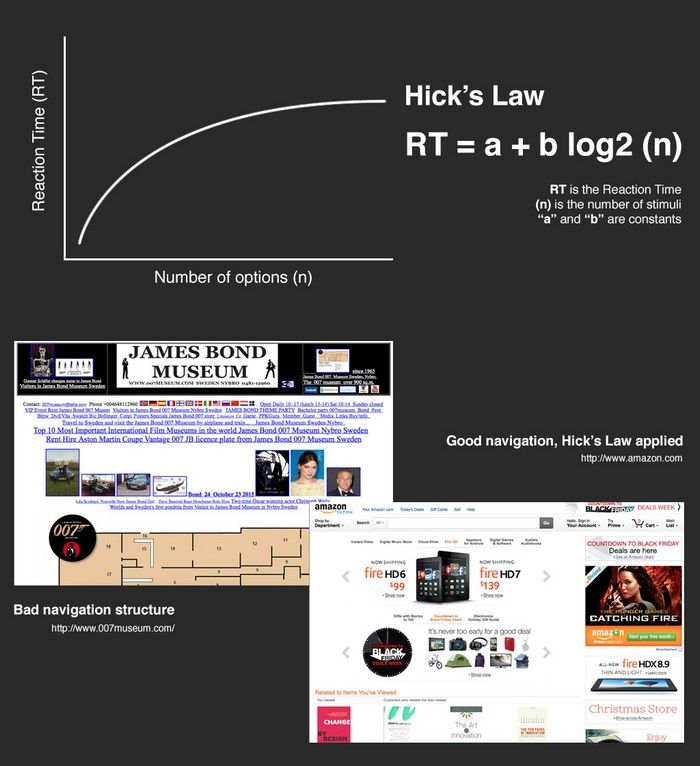
Your statistics background makes you perfectly equipped to understand the underlying formula. Let's look at a clear definition.
Using Hick's Law to help users make decisions - LogRocket Blog
This article from the LogRocket Blog provides a concise breakdown of Hick's Law and its formula.
Read the section "What is Hick's Law...". Focus on the formula: RT = a + b \log_2(n). Understand that a represents the time for non-decisional processes (like perception and motor response), while the b \log_2(n) term represents the cognitive time spent making the decision itself.
The key insight from the formula is the logarithmic relationship. This means that doubling the number of choices does not double the decision time; it adds a constant amount of time. While the time increase slows as n gets very large, the initial jump from 2 to 4 choices, or 4 to 8, is highly significant. This delay is the tangible cost of complexity.
The Psychology of Delay: Analysis Paralysis
Hick's Law describes the what—that time increases with options. The why is rooted in the concepts of choice overload and analysis paralysis, which we touched on last time. When faced with too many options, our brains become overwhelmed, leading to two common negative outcomes.
A brief video from the Nielsen Norman Group succinctly defines these outcomes.
Choice Overload Impedes User Decision-Making
This video, "Choice Overload Impedes User Decision-Making," explains the negative psychological states that arise from having too many options.
Watch the first minute, from the beginning. Pay attention to the definitions of buyer's remorse (regret after a hasty choice) and analysis paralysis (making no choice at all due to over-thinking).
Analysis paralysis is Hick's Law in action. The decision time (RT) becomes so long that it effectively stretches to infinity, and no action is taken. This happens because the cognitive load of evaluating each option exceeds our capacity, a concept deeply tied to Miller's Law.
For a deeper look into the neuroscience, let's connect this back to brain function.
Choice Overload: How to Overcome Decision Paralysis - ReachLink
This article from ReachLink explains the cognitive mechanisms behind decision fatigue.
Read the section "The neuroscience of decision fatigue." Note how it explicitly connects the problem to the limits of the prefrontal cortex and working memory (mentioning the 7±2 items from Miller's Law), explaining that cognitive strain triggers a stress response.
The implication is clear: to make decisions faster and less stressful, you must reduce n, the number of choices.
Application 1: Accelerating Bra Purchase Decisions
Imagine a client wants a "flattering but comfortable" bra for a special occasion. Your boutique has 20 different balcony-style bras that could fit this description.
Violating Hick's Law:
You pull out all 20 bras and present them to the client. The number of choices, n, is 20. According to the formula, her reaction time (RT) will be significant. She will try to evaluate each one, comparing lace patterns, strap thickness, and cup shapes. She quickly experiences choice overload and becomes paralyzed. She might say, "I'm overwhelmed, I can't decide," and leave without buying anything. The high n value led to an infinite RT.
Applying Hick's Law:
Your role as an expert is to strategically reduce n at each step of the process.
-
Prioritize and Categorize: You ask a critical question: "Will you be wearing it under something form-fitting, or something with more texture?" Her answer ("form-fitting") allows you to immediately eliminate all 12 bras with textured lace. Now
nis down to 8. -
Break Down the Task (Progressive Disclosure): You don't present all 8 remaining bras. You create a new, smaller choice. "Okay, of these smooth options, we have two main families: the molded cup that gives a very rounded shape, and the seamed cup that offers more forward projection. Do you have a preference?" Now
nis just 2. The decision is nearly instant. -
Final Selection: She chooses "molded cup." You now present the 4 bras in that category. This
n=4decision is far more manageable than the initialn=20.
By breaking one large, time-consuming decision into a series of small, fast ones, you have expertly managed the client's cognitive load and guided her to a satisfying purchase. This is the practical application of minimizing RT by manipulating n. The video below offers a simple illustration of this principle in web design.
This short video, "Hick's Law | UX Design Tips," uses the Facebook login page as an example of prioritizing essential choices.
Watch the segment from the Facebook example. Notice how the design de-emphasizes less common options to reduce the effective n for the primary task of logging in. Your fitting process should do the same: prioritize the most likely options and hide the rest until needed.
Application 2: Overcoming Decision Paralysis in a Vee Relationship
Hick's Law is equally potent when analyzing relationship dynamics. Consider a new vee relationship: Anna is the hinge, married to Bob, and starting a new relationship with Charlie. They all agree they need to establish agreements, but the sheer number of possibilities is daunting.
Violating Hick's Law:
During their first "state of the union" meeting, one of them says, "Let's figure out all the rules." They start listing variables: frequency of overnights, managing holidays, introducing friends, public displays of affection, sexual health protocols, communication expectations, etc. The list quickly grows to n=30 or more distinct decision points. They are immediately overwhelmed. This is analysis paralysis in a relationship context. The conversation stalls, and they avoid future talks because the process feels too difficult, leaving the relationship in a state of ambiguous, un-negotiated risk.
Applying Hick's Law:
As a relationship analyst, you would guide them to reduce n by using established models and progressive disclosure.
- Categorize Using Frameworks: Instead of generating an infinite list of rules from scratch, you can present a small number of established polyamorous structures. This immediately reduces
n.

You might say: "Let's not invent the wheel. Most successful vees start with one of three broad approaches. We can choose one as our starting point.
-
Hierarchical: Bob and Anna's relationship is primary, and Charlie is a secondary partner with specific agreements.
-
Egalitarian: All three individuals have equal opportunity to negotiate their needs and time.
-
Solo Poly: Anna acts as an independent individual who has two separate relationships, without an overarching structure governing them."
Now,n=3. The decision is about which philosophy to adopt, not about 30 individual rules. -
Progressive Disclosure: Once they choose a model (e.g., Hierarchical), they can move to the next level of decision-making within that context. "Okay, given we're starting with a hierarchical model, the next single decision is: what are the communication boundaries? Should all three of us be in a group chat for scheduling, or does Anna act as the sole communicator between Bob and Charlie?" Again, you've presented a simple choice with
n=2.
By structuring the meta-decision about the relationship's operating system, you prevent paralysis. You make progress by tackling a sequence of small, manageable choices, allowing the relationship architecture to evolve rather than requiring it to be perfectly designed from the start.
Conclusion
Hick's Law gives us a mathematical foundation for something we intuitively feel: too many choices are paralyzing. The time it takes to make a decision is a real cost that can derail a sale or stall a relationship.
Key Takeaways:
- Time is a function of choice: The time to make a decision increases logarithmically with the number of options ().
- Analysis paralysis is real: When the number of choices becomes too large, the decision time can become effectively infinite, leading to inaction.
- Your expertise is in reducing
n: As a designer or an analyst, your value lies in guiding clients and partners through complexity by categorizing options, prioritizing the essential, and breaking large decisions into smaller, sequential steps.
In our last two lessons, we've focused on the cognitive friction of making choices. In the next lesson, we will explore Fitts's Law, shifting our focus from the mind to the body. Fitts's Law provides a model for the time it takes to physically move to a target, a foundational concept in ergonomics and interface design that will connect directly with your work as an efficiency expert.