Welcome back. In our previous lesson, we investigated the Barnum Effect and the human tendency to see personal meaning in vague, general statements. Today, we'll shift our focus to a different kind of perceptual error, one that happens after we encounter something genuinely new.
This lesson addresses the Baader-Meinhof Effect, more formally known as the frequency illusion. This is the phenomenon where, after learning about a new concept, name, or idea, you suddenly seem to encounter it everywhere. It's not that the thing has become more common; it's that your brain has become better at noticing it. Your goal is to apply this effect to distinguish genuine fashion trends from mere frequency illusion in lingerie design, and to recognize how this same illusion can shape perceptions after first learning about polyamory.
The Mechanism of Frequency Illusion
Have you ever learned a new word and then heard it three times the next day? Or noticed a particular model of car for the first time, only to see it on every street corner? This is the Baader-Meinhof Effect in action.
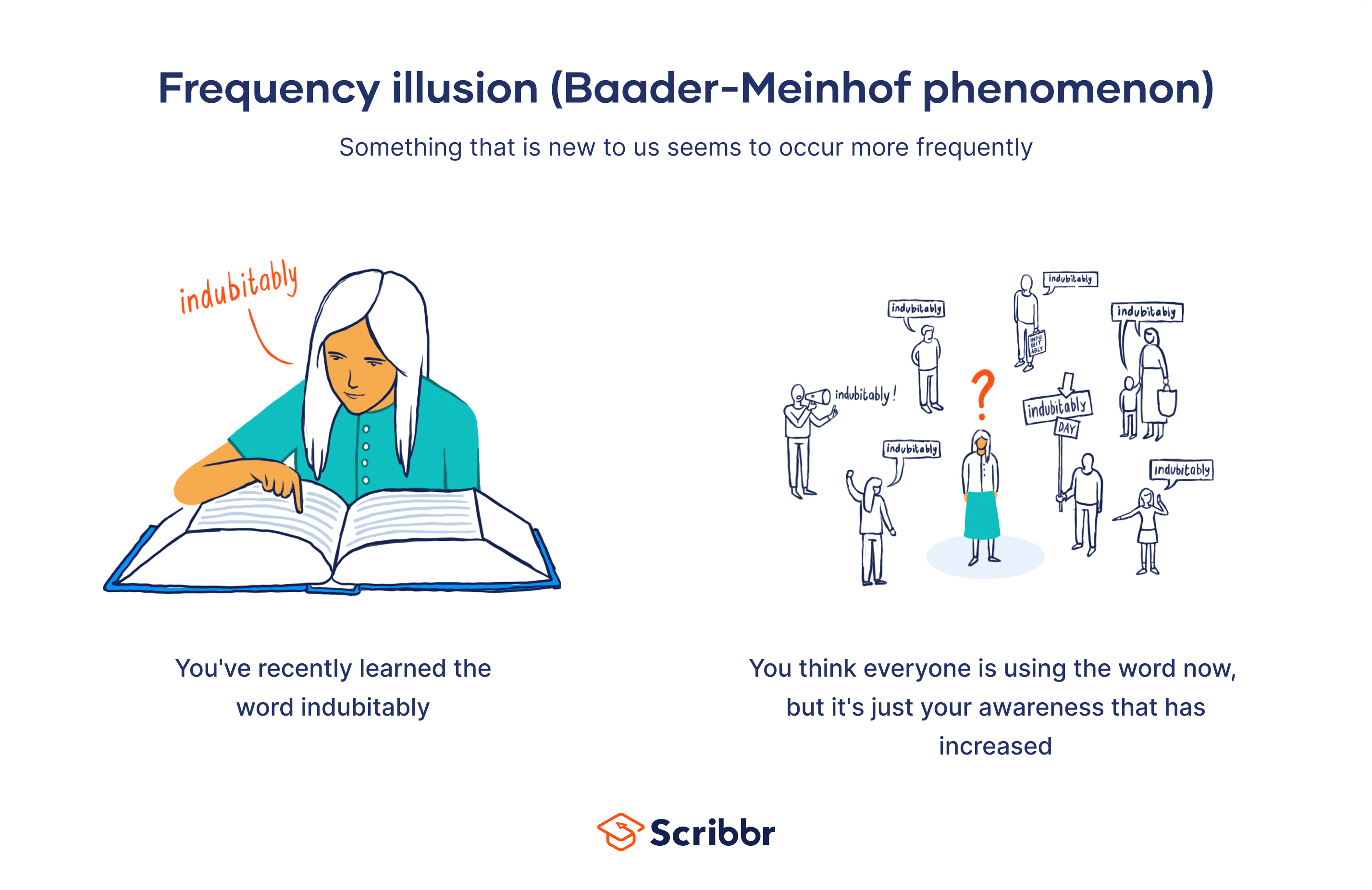
But what's happening in our brains to create this feeling? The effect is a combination of two cognitive processes: selective attention and confirmation bias. First, when you learn something new, your brain unconsciously flags it as novel and important. Then, your selective attention, which normally filters out a sea of irrelevant information, is primed to spot it. When you do see it again—which was always statistically likely—your confirmation bias kicks in, reinforcing your perception that "this thing is everywhere now!"
The short video below provides an excellent and concise explanation of this process.
Why The Frequency Illusion Is Everywhere Now
This video from MinuteEarth, "Why The Frequency Illusion Is Everywhere Now," explains the cognitive science behind the effect using the memorable example of "headless goat hockey."
Please watch the entire video, which is just over three minutes long. Pay close attention to these key ideas: The brain's filtering process: How your brain flags new information as potentially important. Pattern-seeking and coincidence: Why a second exposure, often just a coincidence, makes our pattern-seeking brains take notice. The role of priming: The powerful example of the narrator seeing the term "buzkashi" in a movie he had already seen multiple times, but only after being primed to notice it.
As the video explains, our brains evolved to notice patterns, but in our modern, information-rich world, this can lead us to see phantom trends. Let's apply this to your areas of interest.
Application 1: A New Lingerie Trend or Just an Illusion?
As a lingerie designer, you need to stay ahead of—or at least aware of—emerging trends. Imagine you come across a new design element, for instance, the use of architectural, non-stretch tulle panels in otherwise soft bralettes. You read an article about it, and suddenly, you start seeing it everywhere: on Instagram influencers, in avant-garde fashion shoots, and on a competitor's new collection.
The critical question is: Is this a genuine, rising trend that you need to incorporate into your next designs, or are you simply experiencing the Baader-Meinhof Effect?
This is a common challenge in the fashion world, as this article about a scarf trend points out directly.
This Chic Scarf Switch-Up Signals You're Bang On Trend For AW/26
This short article from MiNDFOOD magazine explicitly connects the Baader-Meinhof phenomenon to spotting new fashion trends.
Please read the first few paragraphs, from the beginning of the article down to the end of the introductory section. Notice how it perfectly describes the designer's dilemma.
The article highlights the core problem: your perception is no longer a reliable instrument. Your brain is now primed to find examples of "architectural tulle," and it will.
As a statistician, you know that anecdotal evidence is not data. To distinguish a real trend from a frequency illusion, you must move beyond your own perception and seek objective measures. This might involve:
- Search Trend Analysis: Using tools like Google Trends to see if public search interest for terms like "tulle bralette" or "sheer panel bra" is actually increasing over time.
- Sales Data: Analyzing sales figures from market data providers to see if this category of product is showing real growth.
- Keyword Monitoring: Tracking the frequency of mentions by major fashion publications and retailers, which is a more systematic approach than casual browsing.
By deliberately shifting from subjective perception to objective data, you can guard against chasing a phantom trend that exists only in your newly primed awareness.
Application 2: Skewed Perceptions of Polyamory
The frequency illusion can do more than just make you notice a new word or style; it can fundamentally shape your perception of an entire group of people. This is particularly relevant when someone is new to a subculture like polyamory.
Consider your Vee relationship scenario, with Alex, Bella, and Charles. Let's say this is their first exploration of non-monogamy. Having just learned the term "polyamory," their brains are now primed to notice any and all information related to it. They start reading, and what do they find? They find books, blogs, and memoirs.
Suddenly, it seems that the world of polyamory is filled with people who are constantly processing, using complex jargon, and living lives of intricate, often dramatic, emotional negotiation. It might seem that to be polyamorous is to be like the people who write books about being polyamorous. This is a more subtle and powerful form of the Baader-Meinhof Effect: it creates a frequency illusion not just for the topic, but for a specific type of person associated with it.
The article "You Don't Hate Polyamory, You Hate People Who Write Books" from Astral Codex Ten provides a brilliant analysis of this exact sampling bias.
You Don't Hate Polyamory, You Hate People Who Write Books
This article argues that the most visible representatives of a group are often not the most typical. It explains why our perception of communities like the polyamorous one can be skewed by the nature of who chooses to write about their experiences.
Please read the following sections to understand this argument: In section II, read the part explaining why advice often comes from those who struggle, not those for whom something is effortless. Next, read the brief but potent section III, which argues that memoirs are often written by narcissists. Finally, and most importantly, read section IV and consider the thought experiment about a "monogamy influencer." Focus on the paragraph that begins "You live in a world choked with ideas". This is the central mechanism: we learn about some things (like monogamy) informally, and others (like polyamory) through semi-formal channels like books and media, which creates a distorted view.
The article powerfully demonstrates how the information that becomes visible once you're primed to look for it is a non-random, biased sample. The quiet, "normal" polyamorous couple next door doesn't write a memoir. The person who struggled intensely, over-analyzed every interaction, and developed a complex theoretical framework for relationships does.
For Alex, Bella, and Charles, the takeaway is crucial. The seeming prevalence of drama, jargon, and navel-gazing they encounter in their initial research is likely a frequency illusion created by a biased information source. They are seeing the people who are predisposed to talk and write, not a representative sample of everyone in non-monogamous relationships. As a social researcher, you are intimately familiar with this problem of selection bias. Recognizing it here allows them to avoid generalizing from these loud, visible examples to their own potential experience.
Conclusion
The Baader-Meinhof Effect is a powerful reminder that our perception of reality is not a passive recording but an active construction. After learning something new, our brains automatically retune our attention, and we can easily mistake this internal shift for an external change in the world.
Key Takeaways:
- The Baader-Meinhof Effect is a two-step process: our attention is primed by new information, and our confirmation bias then over-interprets subsequent encounters as evidence of a trend.
- In lingerie design, this can create phantom trends. The antidote is to rely on objective data (search trends, sales figures) rather than subjective perception.
- In relationship dynamics, this can create a skewed perception of a community. The most visible examples (e.g., authors of polyamory books) are a biased sample, and we must be careful not to generalize from them.
In our next lesson, we will explore the Rashomon Effect. We'll move from biases in perceiving frequency to the fascinating ways in which different people can have radically different, yet equally valid, interpretations of the very same event.