Welcome to our new module. Having mastered tree-based ensembles and seeing how algorithms like XGBoost evolved to optimize performance, we are now shifting our focus to a completely different and powerful class of models: Support Vector Machines (SVMs). Where trees make decisions by recursively partitioning the feature space, SVMs approach classification from a geometric perspective.
Today's lesson introduces the foundational concept behind SVMs. You will learn the core intuition of how an SVM finds the optimal boundary between classes by maximizing a "margin," and you'll understand the critical role played by specific data points known as "support vectors." This provides the basis for all further discussions on SVMs.
The Quest for the Optimal Boundary
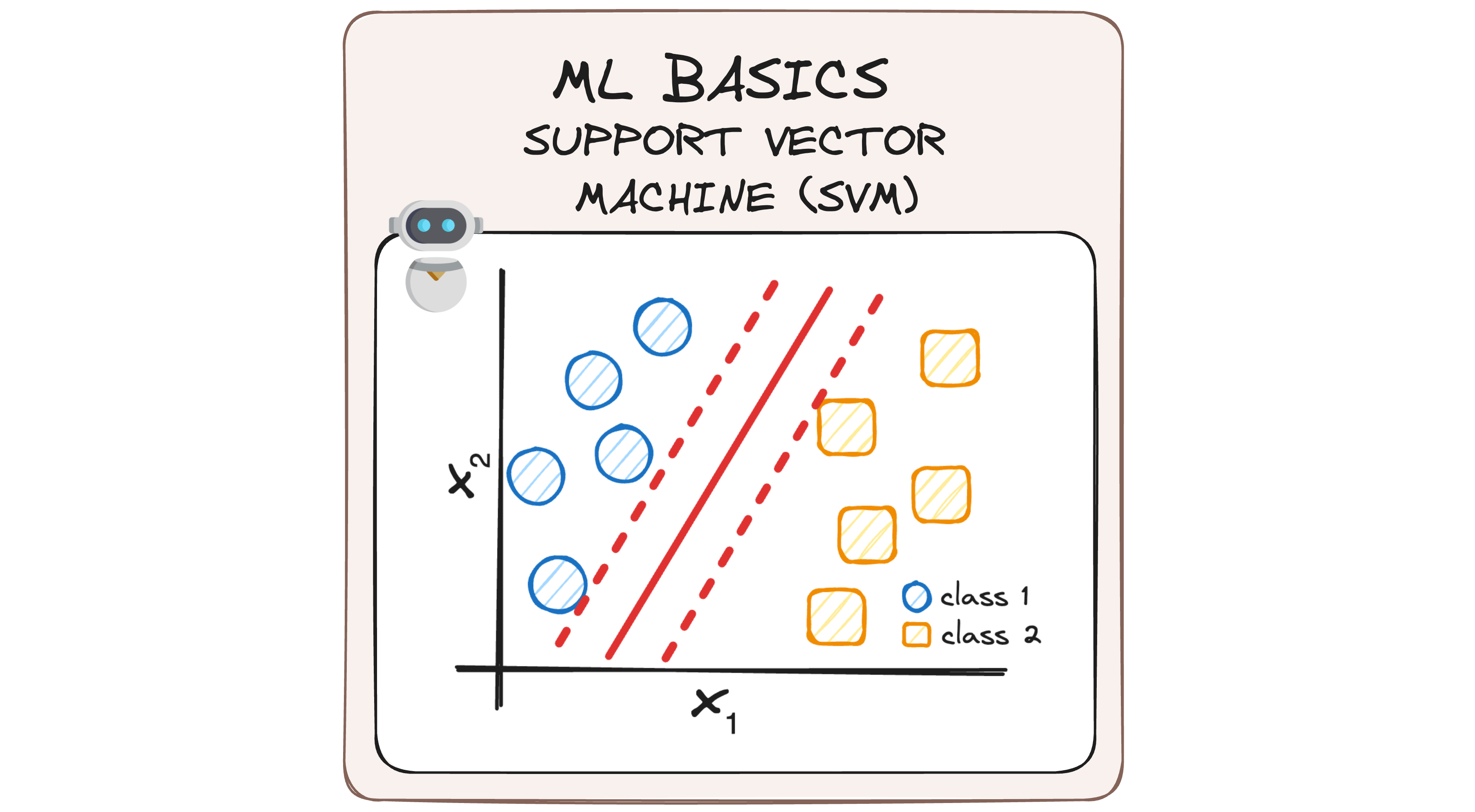
Imagine you have a dataset with two classes that are linearly separable, meaning you can draw a straight line to separate them. The challenge is that you can draw infinitely many such lines. Logistic regression, for instance, would find one such line, but it doesn't necessarily pick the "best" one in a geometric sense.
This raises the question: what makes a separating line "better" than another? Intuitively, a good boundary is one that is not just correct, but also confident. It should stay as far away from the data points of both classes as possible. This distance is the key idea behind SVMs.
The main separating line is called a hyperplane. In a 2D space like our example, it's a line. In 3D, it's a plane, and in higher dimensions, it's a hyperplane. SVMs aim to find the hyperplane that has the maximum possible distance to the nearest data point from any class. This distance is called the margin.
This fundamental idea is explained brilliantly in the following video. It will walk you through why simply finding a separating line isn't enough and how maximizing the margin leads to a more robust classifier.
Support Vector Machines Part 1 (of 3): Main Ideas!!!
This video from the StatQuest channel provides an excellent, step-by-step intuition for the main ideas behind SVMs.
Please watch the first part of the video, which covers the concept of a maximal margin classifier. Pay close attention to how the threshold is chosen to be as far as possible from the points on the edge of each cluster.
From Margin to Mathematics
The video introduced the core objective: find the hyperplane that maximizes the margin. Now, let's formalize this.
The hyperplane itself is defined by the equation , where is a weight vector perpendicular to the hyperplane and is a bias term. For any new point , we can classify it based on the sign of .
The margin is defined by two other hyperplanes, parallel to the main one, that pass through the closest points of each class. These boundary-defining points are called support vectors.

The width of this margin can be shown to be equal to , where is the norm (or magnitude) of the weight vector. This is a crucial connection. To maximize the margin, we need to minimize the magnitude of the weight vector, .
The following video provides a clear, step-by-step derivation of this relationship and formulates the SVM optimization problem. This will give you the "working understanding" of the math you're looking for without getting lost in complex proofs.
SVM (The Math) : Data Science Concepts
This video from the channel ritvikmath walks through the mathematics of the SVM formulation in a very accessible way.
First, watch the initial setup explaining the classification problem and the goal. Next, focus on how the hyperplane and margin are defined mathematically using the vector \mathbf{w} and intercept b. Finally, follow the derivation of the margin size, which shows why maximizing the margin is equivalent to minimizing the magnitude of \mathbf{w}.
The Optimization Problem and Support Vectors
As you just saw, the SVM's goal is to find the and that define the best hyperplane. This can be framed as a formal optimization problem:
Objective: Minimize
Subject to the constraint: for all data points .
Let's break this down:
- The Objective: Minimizing is the same as minimizing , which, as we saw, maximizes the margin . The square and the are included for mathematical convenience, turning this into a standard quadratic programming problem.
- The Constraint: This is the clever part. is the class label (+1 or -1). This constraint ensures that every data point is not only on the correct side of the hyperplane but is also outside the margin.
- For a positive class point (), it requires .
- For a negative class point (), it requires . Multiplying by flips the inequality, giving the same combined constraint.
The points for which the constraint is an equality (i.e., ) are precisely the support vectors. They lie exactly on the margin's edge. A key property of SVMs is that only these support vectors define the hyperplane. All other points could be moved or removed (as long as they don't cross the margin), and the solution would remain unchanged.
To see this entire formulation put together, let's turn to a more formal text.
Lecture 12: Support Vector Machines — Applied ML
These lecture notes from the Kuleshov Group at Cornell provide a concise yet thorough explanation of the max-margin classifier.
First, read the subsection titled "The Max-Margin Principle". This section visually contrasts a "Good Margin" (like an SVM would find) with "Bad Margin" boundaries. Next, read the subsection on the geometric margin. This explains why we use the normalized distance and how it relates geometrically to the hyperplane. Finally, read the section "The Max-Margin Classifier". This section puts everything together, showing how the goal of maximizing the margin is transformed into the quadratic optimization problem we just discussed.
Handling Imperfect Data: Soft Margins
The formulation we've discussed so far is for a Hard Margin Classifier. It assumes that the data is perfectly linearly separable. In the real world, this is rarely the case. Datasets often contain noise or overlapping classes where no single line can perfectly separate the data.
If we insist on a hard margin, the optimization problem has no solution. To overcome this, we relax the constraints and allow for some errors. This is called a Soft Margin Classifier. The idea is to find a balance between two goals:
- Making the margin as wide as possible.
- Limiting the number of margin violations (points inside the margin or on the wrong side).
This trade-off is controlled by a hyperparameter, often denoted as C, which penalizes violations. A small C allows for a wider margin at the cost of more violations, while a large C prioritizes correct classification of all points, leading to a narrower margin.
The StatQuest video you watched earlier also introduces this concept beautifully.
Support Vector Machines Part 1 (of 3): Main Ideas!!!
Let's revisit the StatQuest video to understand how SVMs handle outliers and non-separable data.
Watch the segment that explains why maximal margin classifiers are sensitive to outliers and introduces the idea of a soft margin. This part clearly defines support vectors as the points on the edge and within the soft margin.
For a quick-reference guide on these core terms, the following article provides simple, visual definitions.
Support Vector Classifier, Explained: A Visual Guide with ...
This article from Towards Data Science offers clear, bite-sized explanations of the key components of an SVM.
Quickly review the definitions and accompanying images for these four concepts to solidify your understanding: Decision Boundary Margin Hard Margin vs Soft Margin Support Vectors
Conclusion
In this lesson, you've grasped the fundamental principle of Support Vector Machines. Instead of just finding any separating boundary, SVMs seek the optimal one by maximizing the geometric margin between classes.
Key Takeaways:
- An SVM's goal is to find a hyperplane that separates classes with the widest possible margin.
- This is motivated by the idea that a larger margin leads to a more robust and confident classifier.
- The margin's width is inversely proportional to the magnitude of the weight vector . Therefore, maximizing the margin is equivalent to minimizing .
- The data points that lie on the edge of the margin are called support vectors. They are the critical points that define the position and orientation of the hyperplane.
- For data that is not perfectly separable, a soft margin is used, which allows for some classification errors in exchange for a wider, more generalizable margin.
We've focused entirely on the linear case today. But what makes SVMs truly powerful is their ability to handle complex, non-linear boundaries. In our next lesson, we will explore the "kernel trick," a clever mathematical technique that allows SVMs to create non-linear decision boundaries without a significant increase in computational cost.