In our previous lesson, we established the fundamental principles of the K-Nearest Neighbors algorithm. We learned that it's a "lazy" learner that classifies new data points based on a majority vote from their closest neighbors, a process heavily reliant on the choice of 'K' and the distance metric used. We also touched upon a crucial prerequisite: feature scaling.
This lesson builds directly on that foundation. Now that we understand how KNN works, we will critically analyze when it works. We'll explore the algorithm's distinct strengths and, more importantly, its significant weaknesses. Understanding this trade-off is essential for any data scientist to decide whether KNN is the right tool for a given problem. We will focus on three key challenges: sensitivity to feature scaling, computational cost, and the infamous "curse of dimensionality."
The Strengths of Simplicity
Before diving into its limitations, it's important to appreciate why KNN is a valuable part of the machine learning toolkit. Its primary advantages stem from its simplicity.
- Easy to Understand and Implement: The core logic—find the nearest neighbors and vote—is incredibly intuitive. This makes it easy to explain to non-technical stakeholders and serves as a great baseline model to benchmark more complex algorithms against.
- No "Training" Phase: KNN is a lazy learner, meaning it doesn't build a model in the traditional sense. The "training" simply involves storing the dataset. This is extremely fast, and it makes the algorithm highly adaptable, as new data can be added without needing to retrain a model from scratch.
- Non-parametric and Flexible: KNN makes no assumptions about the underlying structure of the data (e.g., that the decision boundary is linear). This allows it to capture complex, non-linear relationships if the data supports it.
The following short video from IBM Technology provides a quick recap of these benefits.
What is the K-Nearest Neighbor (KNN) Algorithm?
This video segment summarizes the key advantages that make KNN a popular choice for certain problems.
Please watch the section covering the strengths of KNN. Note the points about ease of implementation, limited hyperparameters, and adaptability.
The Weaknesses: A Deeper Look
Despite its elegance, KNN's simplicity hides several practical challenges that can severely limit its effectiveness.
1. Extreme Sensitivity to Feature Scaling
We concluded the last lesson by highlighting the necessity of feature scaling. Let's now solidify why this is not just a best practice, but a critical weakness if ignored. Because KNN relies entirely on distance, a feature with a large numerical range will dominate the distance calculation, effectively silencing the contribution of other features.
Imagine classifying customers based on age (18-70) and income (30,000-150,000). A difference of 20 years in age is numerically small compared to a difference of $20,000 in income. Without scaling, the algorithm would find neighbors based almost exclusively on income, regardless of age.
The image below, generated using scikit-learn, provides a stark visual of this problem. On the left, KNN is applied to unscaled data. The decision boundaries are vertical bands, indicating the model is almost exclusively using the proline feature (which has a large range) and ignoring the hue feature. On the right, after applying a standard scaler, both features contribute, and the model learns a much more sensible and nuanced decision boundary.
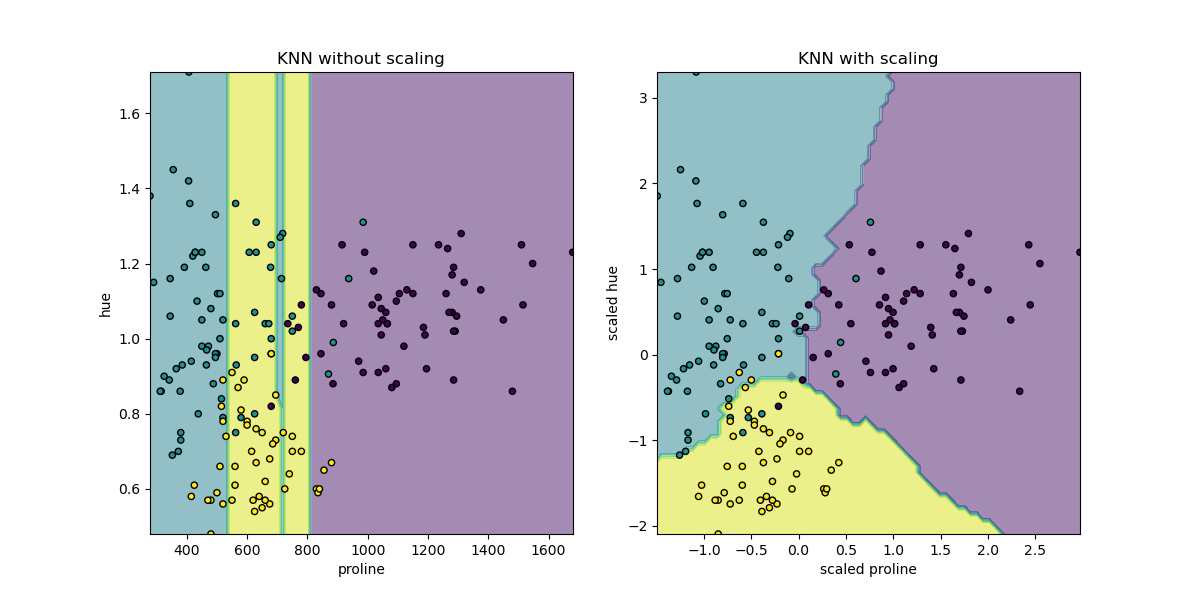
This extreme sensitivity means that you, the data scientist, are implicitly assigning feature importance through scaling. This is a significant drawback compared to models that can learn feature importances on their own.
KNN: The Importance of Being Scaled - DEV Community
This article provides an excellent practical demonstration of how unscaled features can lead to nonsensical decision boundaries and how scaling resolves the issue.
Start by reading the section What is Scaling? to recap the problem. Then, scroll down to "Visualizing Fit: An Unscaled Hot Mess" and read the text accompanying the plots to see the visual evidence of the problem. Finally, in the next section, "Visualizing Fit: Beautiful Scaling," see how applying a StandardScaler resolves the issue, creating more intuitive boundaries.
2. High Computational Cost at Prediction Time
Your background in algorithms and data structures makes the next weakness particularly relevant. While KNN has no real training cost, it pays a heavy price at prediction time. To classify a single new point, the algorithm must compute its distance to every single point in the training dataset.
If you have training examples and features, the complexity of a single prediction using a brute-force search is . This is computationally feasible for small datasets, but it becomes prohibitively slow as grows into the thousands or millions.
To mitigate this, specialized data structures like KD-trees and Ball-trees were developed. These structures partition the data during a pre-computation step, allowing the search algorithm to prune large portions of the feature space and avoid many distance calculations. This can significantly speed up the nearest neighbor search in low-to-moderate dimensions. However, as we're about to see, even these optimizations have their limits.
3. The Curse of Dimensionality
This is arguably the most profound weakness of KNN and other distance-based methods. The "curse of dimensionality" refers to a collection of counter-intuitive phenomena that occur when working in high-dimensional spaces.
As the number of features (dimensions) increases, the volume of the space grows exponentially. To maintain the same density of data points, you would need an exponentially larger dataset. In practice, with a fixed number of data points, the space becomes increasingly sparse.
The consequences for KNN are dire:
- Distance becomes less meaningful: In high dimensions, the distance between any two random points becomes very similar. The concept of a "close" neighbor breaks down because the distance to the nearest neighbor can be almost the same as the distance to the farthest neighbor.
- All points appear equidistant: The model loses its ability to discriminate between neighbors that are genuinely similar and those that are just "least dissimilar" in a vast, empty space.
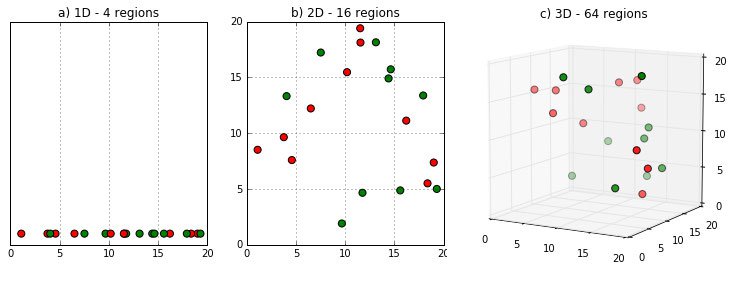
The image below illustrates the core problem. To cover a fraction of a 1D space, you need a few regions. To cover the same fraction in 2D and 3D, the number of regions needed grows exponentially. Now, imagine this in 100 or 1000 dimensions.
The following video from Caltech provides a brilliant and more formal explanation of this phenomenon. It uses the geometric argument of comparing the volume of a sphere to the volume of the cube that contains it.
8.2 David Thompson (Part 2): Nearest Neighbors and the Curse of Dimensionality
This video explains the geometric intuition behind the curse of dimensionality and why it causes distance-based methods like KNN to fail.
Watch the segment from this point. The speaker first presents the problem: in high dimensions, all points can appear equidistant from a query point. Then, pay close attention to the geometric explanation using the volume of an n-ball versus a hypercube. This demonstrates why most of the volume in high-dimensional space is far from the center, making it hard to find "near" neighbors.
Because of the curse of dimensionality, even optimized search structures like KD-trees fail. Their pruning logic relies on being able to definitively rule out large regions of space, but when all points are almost equidistant, the search is forced to explore nearly the entire tree, degrading to the performance of a brute-force search.
Summary: When to Use KNN
KNN's strengths and weaknesses paint a clear picture of where it fits in the machine learning landscape.
| Strengths | Weaknesses |
|---|---|
| Simple and intuitive | Computationally expensive at prediction time (high latency) |
| No training time required | Very sensitive to feature scaling and irrelevant features |
| Flexible (can learn non-linear boundaries) | Performance degrades significantly with high-dimensional data |
| Good baseline model | Requires large memory to store the entire dataset |
| Can be adapted (e.g., weighted KNN) | Does not handle imbalanced datasets well by default |
This detailed article provides an excellent summary of these points and compares KNN to other models. It's a great resource to consolidate your understanding.
Data Science Interview Guide - Part 7: kNN - BuildML | Substack
This article summarizes the practical conditions under which KNN excels or fails and provides a concise recap of the curse of dimensionality.
First, read the section When kNN Works Well for a concise summary of its ideal use cases and limitations. Then, review the section The Curse of Dimensionality for a clear, intuitive explanation of why distance loses meaning in high-dimensional space.
In essence, you should consider using KNN when:
- You are working with low-dimensional data (e.g., fewer than ~10-20 features).
- The dataset is not excessively large, so prediction time is manageable.
- You have reason to believe the features are on a similar scale or you have scaled them properly.
- You need a simple, interpretable baseline to compare against more complex models.
Conclusion
In this lesson, we moved beyond the mechanics of KNN to critically evaluate its practical utility. You've learned that while its simplicity is appealing, it comes with significant costs.
Key Takeaways:
- Strengths: KNN is simple, requires no training, and is flexible enough to capture non-linear patterns.
- Weaknesses: Its three main drawbacks are severe:
- Sensitivity to Feature Scaling: Unscaled features with large ranges will dominate distance calculations, leading to poor models.
- High Computational Cost: Prediction is slow for large datasets as it requires comparing a new point to every training point.
- The Curse of Dimensionality: In high-dimensional spaces, distance loses its meaning, rendering the core assumption of KNN invalid.
- Ideal Use Case: KNN is most effective as a baseline model for low-dimensional, small-to-medium-sized datasets where features are carefully scaled.
Now that we have a complete theoretical understanding of how KNN works, its parameters, and its practical trade-offs, our next lesson will put it all into practice. You will apply the KNN algorithm to a real-world classification dataset using Python and scikit-learn, where you will tune the hyperparameter 'K' and see the impact of these concepts firsthand.