In our previous lesson, we established a working vocabulary by defining mindfulness and distinguishing it from the related but distinct concepts of relaxation and concentration. We concluded that mindfulness is an intentional, non-judgmental awareness of the present moment. Now, we will deconstruct that definition to understand its functional parts.
This lesson delves into the three core components that form the engine of mindful awareness: Intention, Attention, and Attitude. By examining each one, you will gain a clear operational model of what it means to practice mindfulness. This framework is not just theoretical; it provides a practical map for how to orient yourself as we move toward the hands-on meditation practices later in the course.
The IAA Model: A Blueprint for Mindfulness
To understand how mindfulness works, many contemporary researchers and teachers use a simple yet powerful model comprised of three interwoven elements: Intention, Attention, and Attitude. Dr. Shauna Shapiro, a leading clinical psychologist and mindfulness researcher, has been instrumental in articulating this framework.
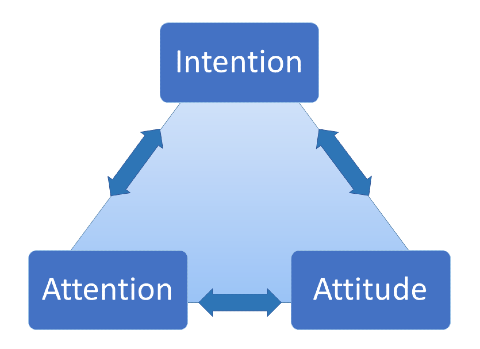
As the IAA Diagram shows, these three components are not a linear sequence but a dynamic, mutually reinforcing system. Your intention shapes how you direct your attention, and the attitude you bring to your attention determines the quality of your practice, which in turn can refine and strengthen your original intention.
Think of it as a feedback loop in a complex system. The Intention is the system's objective. Attention is the monitoring process that gathers data about the current state. Attitude is the protocol for how that data is processed—whether with harsh, reactive exceptions or with graceful, accepting logging. Each part is essential for the whole system to function effectively.
Let's begin by reading the section from the paper "Paradoxes of Mindfulness" that introduces this model.
This paper by Shauna Shapiro, Ronald Siegel, and Kristin Neff provides a clear and academically grounded overview of the Intention, Attention, and Attitude (IAA) model. It will serve as our primary guide for this lesson.
Please read the section that begins with the introduction to the IAA model. Then, continue reading the detailed descriptions of all three components: Intention, Attention, and Attitude.
Now that you have an overview, let's explore each component with the philosophical and practical depth you're seeking.
1. Intention: The 'Why'
As you've just read, intention is about knowing why you are practicing. It is the aspiration that sets the compass for your journey. It's not a rigid goal to be achieved, but a guiding direction. Your own stated goal for this course—to gain a deep, philosophical understanding of mindfulness—is a perfect example of a powerful intention. It orients your study and practice toward insight rather than just, say, stress relief.
While many people begin mindfulness with the intention to reduce stress or feel better, the traditions we'll be studying point toward deeper intentions, such as:
- Self-understanding
- Living more ethically
- Gaining insight into the nature of reality
- Cultivating compassion
The tradition of Stoicism, which we will explore more later, has a strong emphasis on intention. For the Stoics, the primary intention is to live a life of virtue and reason. Attention is the tool used to ensure one's actions are in alignment with that core purpose.
2. Attention: The 'What' and 'How'
Attention is the central faculty of mindfulness practice. It is the act of observing your experience—thoughts, feelings, bodily sensations, external sounds—as it unfolds moment by moment. In our last lesson, we distinguished the broad, open awareness of mindfulness from the narrow focus of concentration.
Let's look at this from the Stoic perspective. The Stoics called this practice prosochē (προσοχή), a continuous, vigilant attention to one's own mind.
Epictetus, Discourses | Attention or Mindfulness | Philosophy Core Concepts
In this video, philosopher Dr. Gregory Sadler explains the Stoic concept of prosochē. This provides a fascinating parallel to the Buddhist-derived models of mindfulness and aligns with your interest in comparative philosophy.
First, watch the introduction to the concept of attention (prosochē). Then, pay close attention to the section where Dr. Sadler explains the first and most important thing the Stoics believed we should pay attention to: our general principles or core beliefs.
As you can see, for the Stoics, attention is not a passive act. It is a purposeful skill directed toward ensuring one's inner state and outward actions align with one's chosen philosophy.
A Deeper Look: Attention as Retention
The popular view of mindfulness often describes it as "bare attention"—a simple, passive noticing. However, Buddhist scholar Georges Dreyfus argues that this is an incomplete picture. The classical term for mindfulness, sati (Pāli) or smṛti (Sanskrit), is derived from a root word meaning "to remember" or "to keep in mind." This implies a more active, cognitive function.
Is Mindfulness Present-Centered and Nonjudgmental?
This article by Georges Dreyfus offers a critical, scholarly perspective that challenges the simplified, modern definitions of mindfulness. It will add significant depth to your philosophical understanding.
Please read the section titled "Mindfulness, Sati and Retention." Focus on the etymology of smṛti and Buddhaghosa's classical definition, which characterizes sati as "not wobbling." Contrast this with the idea of bare attention.
This idea of sati as "retention" or "not forgetting" is crucial. It suggests that attention is not just a fleeting glance but a faculty that holds an object in the field of awareness long enough for it to be investigated. From your background in computer science, you can think of this as the difference between a fire-and-forget UDP packet and the persistent state held in RAM or a working memory register. Bare attention is like the packet; sati is like the active memory, holding the data so that it can be processed and understood.
3. Attitude: The 'Quality' of Awareness
Attitude is arguably what transforms simple attention into mindful attention. It is the quality of kindness, curiosity, and acceptance that you bring to your observation. As Dr. Shapiro explains, practicing attention with a judgmental, impatient, or frustrated attitude doesn't cultivate mindfulness; it reinforces judgment, impatience, and frustration.
Attention, Intention, Attitude - Shauna Shapiro
In this clip, Dr. Shauna Shapiro powerfully elaborates on the IAA model, especially the crucial role of attitude.
First, listen to her explain that mindfulness is attention with a certain intention. She then explicitly outlines the three components. Finally, listen carefully to her personal story from a meditation retreat, which perfectly illustrates why attitude is not an optional add-on, but an essential part of the practice.
Judgment vs. Non-Judgment
The "non-judgmental" aspect of mindfulness can be confusing. It does not mean abandoning discernment. It means stepping out of the brain's automatic, habitual pattern of labeling experiences as "good" or "bad," "wanted" or "unwanted." This pattern is a primitive survival mechanism.
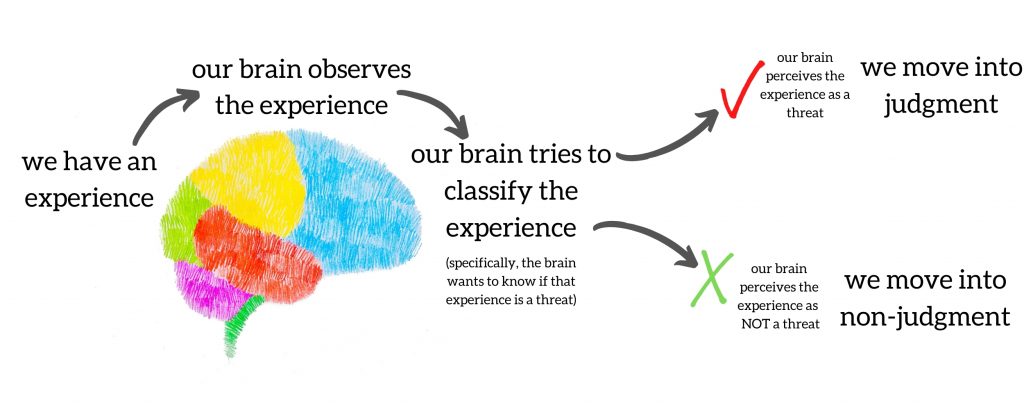
As the flowchart shows, our brains are wired to quickly classify experiences, especially for potential threats. A judgmental reaction is an automatic, often unconscious, response. A non-judgmental attitude is a conscious choice to observe the raw data of an experience before the layer of automatic judgment is applied.
A Deeper Look: Non-Judgment vs. Wise Discrimination
Again, the philosophical traditions offer a more nuanced view than simply "don't judge." Dreyfus points out that a key part of mindfulness practice is developing samprajñāna (Sanskrit), or "clear comprehension." This is a form of wise discrimination that allows the practitioner to distinguish between wholesome and unwholesome mental states.
Is Mindfulness Present-Centered and Nonjudgmental?
Let's return to Dreyfus's paper to understand this crucial distinction.
Please read the first paragraph of the section "A Phenomenology of Attention," starting from "Still, this understanding" and focusing on the introduction of "wise mindfulness."
This is a critical point. The "non-judgment" of mindfulness is not a state of moral apathy. It is a suspension of the reactive, automatic, self-centered judgments of liking and disliking. This creates the mental space needed to apply wise discrimination—a considered, ethical evaluation that is aligned with your core intention. It's the difference between a knee-jerk if (dislike) { reject } statement and a thoughtful analysis of a situation based on clear principles.
Conclusion
In this lesson, we have dissected the definition of mindfulness into its three operational components, creating a functional model for practice.
Key Takeaways:
- Mindful awareness is a dynamic process built on three pillars: Intention (the "why"), Attention (the "what" and "where"), and Attitude (the "how").
- Intention is the guiding purpose that gives your practice direction and meaning.
- Attention in a classical sense is not just passive noticing, but an active faculty of retention (sati), which holds experience in awareness for investigation.
- Attitude is the quality of kindness, curiosity, and acceptance you bring to your attention. It's what distinguishes mindfulness from mere concentration.
- "Non-judgment" means suspending automatic, reactive evaluations to create space for wise discrimination (samprajñāna), an essential part of the path.
With this robust model of the components of mindfulness, we are ready to examine how these components come together. In the next lesson, we will explore the difference between mindfulness as a temporary state, an enduring trait, and a deliberate practice. This will be our final step before you begin your first formal meditation exercise.