Hello! Welcome to the first lesson in your course on analyzing AI infrastructure companies.
As a financial analyst in the technology sector, you're already skilled at deconstructing company value and market dynamics. This course is designed to equip you with the specific technical and business frameworks needed to apply that expertise to the complex and rapidly evolving world of AI infrastructure.
Today, we'll start by building a foundational map of this new landscape. Our goal is to map the AI infrastructure value chain, all the way from the silicon chips to the end-user applications like ChatGPT. Think of this as creating a sector-level chart of accounts. Understanding this full "stack" is the essential first step—it allows you to see how the different pieces fit together, identify the critical players in each segment, and begin to understand where economic value is created, captured, and potentially at risk.
1. The Global Supply Chain Behind AI
Before we dive into a formal framework, it's helpful to get a high-level narrative of how interconnected and surprisingly fragile the AI supply chain is. Many people think of AI as pure software, but it's built on a massive, capital-intensive, and highly concentrated physical infrastructure.
To get a quick and insightful overview, please watch this short video from the London School of Economics (LSE). It works backward from the AI applications you know to the foundational hardware and materials they depend on.
AI's hidden supply chain explained: why it's more fragile than you think | LSE Research
This video, 'AI's hidden supply chain explained,' provides a concise overview of the key stages and players in the AI hardware ecosystem, highlighting its global nature and strategic chokepoints.
Please watch from 00:39 to 03:35. As you watch, note the key companies mentioned at each stage of the supply chain (e.g., Nvidia, TSMC, ASML) and the specific role each one plays.
The video introduces a crucial theme for any analyst in this space: the entire AI industry relies on a handful of key players. This concentration creates enormous value for the dominant companies but also introduces significant geopolitical and supply chain risks.
2. Visualizing the AI Value Chain
Now, let's put this into a more structured framework that you can use for your analysis. The AI value chain can be visualized as a series of tiers or layers, starting with the most fundamental components and building up to the services that reach the end-user.
This diagram provides an excellent map of the ecosystem. We'll spend the rest of this lesson breaking down these tiers.
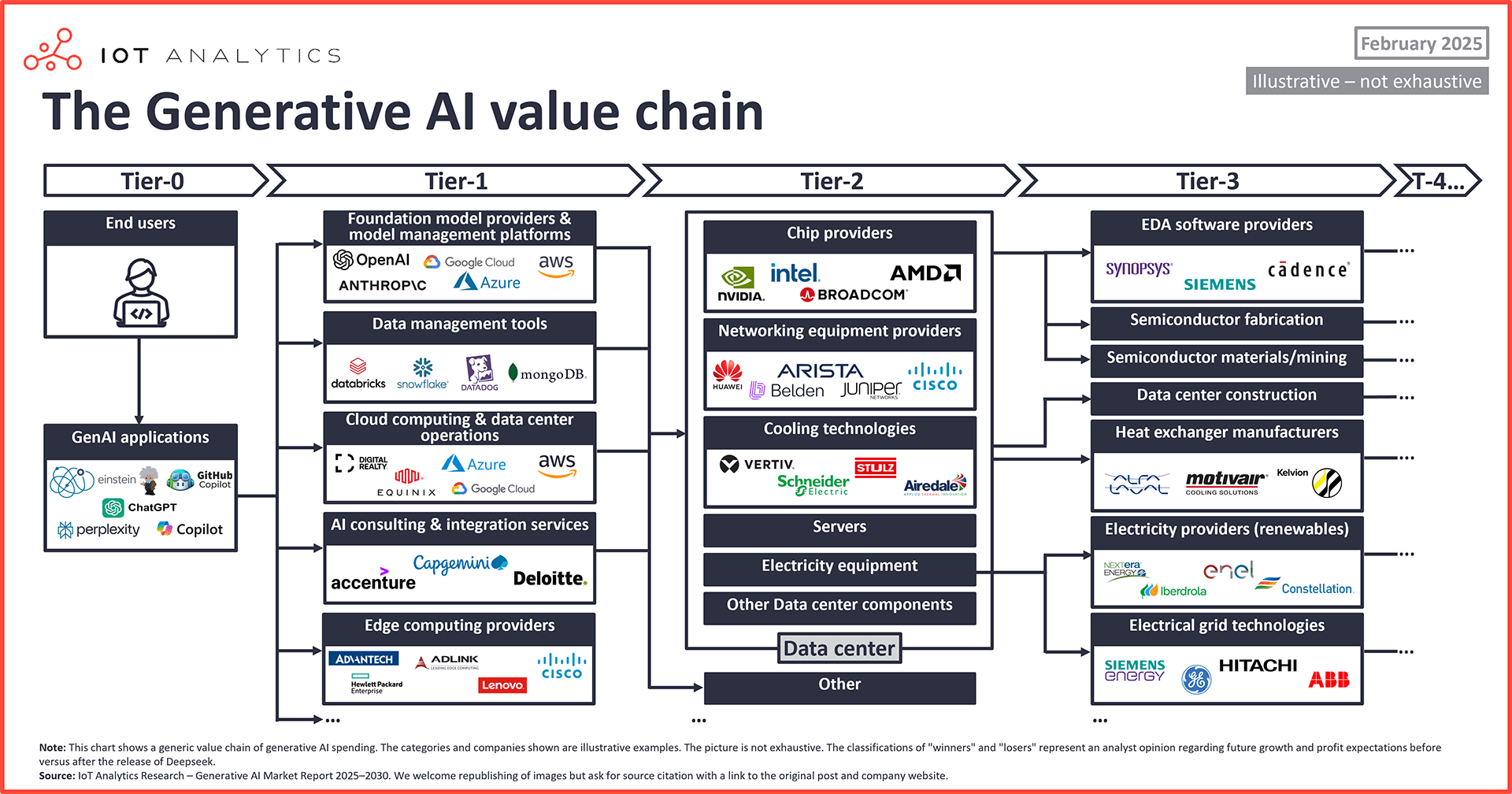
As you can see, the chain is composed of:
- Upstream Inputs (Tier 3): The foundational tools and materials needed to make hardware.
- Hardware (Tier 2): The core physical components, like chips and networking gear.
- Software & Services (Tier 1): The data centers, cloud platforms, and foundation models that run on the hardware.
- Applications (Tier 0): The end-user products that businesses and consumers interact with.
Let's begin our deep dive at the bottom of the stack: the semiconductor value chain.
3. The Foundation: The Semiconductor Value Chain
The performance and progress of AI are fundamentally tied to the capabilities of specialized microchips, or semiconductors. These are the "brains" of the operation. Producing these chips is an incredibly complex and specialized process.
The OECD report on "Competition in artificial intelligence infrastructure" provides a thorough breakdown of this segment. Please read the following sections to understand the key stages, business models, and players.
AI supply chain: Competition in artificial intelligence infrastructure
This report from the OECD offers a detailed analysis of the AI supply chain with a focus on market structure and competition—a perspective highly relevant to financial analysis. We will focus on the sections that describe the chip industry.
Please read Section 2.2 'Importance of Integrated circuits (chips)' and Section 2.3 'Overview of the chip supply chain,' including its subsections on 'Suppliers of key inputs.' This covers the different types of AI chips, the production process, different company business models, and the critical upstream suppliers. The reading should take about 15 minutes.
Let's distill the key takeaways from that reading from an analyst's perspective:
The Chip Production Process
The chip supply chain is disaggregated into distinct stages, each with different economics and competitive dynamics:
-
Design: This is where the chip's architecture is created. It's a high-value, R&D-intensive activity.
- Key Players: Fabless companies like NVIDIA and AMD dominate this space for AI GPUs. They own the intellectual property (IP) but outsource the manufacturing.
- Analyst Angle: The moat here is often not just the hardware design, but the software ecosystem built around it. NVIDIA's CUDA platform is a prime example of creating powerful developer lock-in, a topic we will explore in-depth in Module 7.
-
Fabrication (Manufacturing): This is the physical production of chips in factories called "fabs."
- Key Players: Pure-play foundries like TSMC (Taiwan Semiconductor Manufacturing Company) and Samsung are the leaders.
- Analyst Angle: This stage is defined by immense capital expenditures (a new fab can cost over $20 billion), long build times, and massive economies of scale. This creates extremely high barriers to entry. TSMC's dominance in leading-edge manufacturing makes it arguably one of the most critical companies in the world.
-
Assembly, Test, and Packaging (ATP): Once fabricated on a silicon wafer, the individual chips are cut, packaged, and tested.
- Key Players: Companies like Amkor specialize in this (known as OSATs - Outsourced Semiconductor Assembly and Test), but foundries like TSMC are also bringing advanced packaging in-house for high-performance chips.
- Analyst Angle: Historically a lower-margin business, advanced packaging is becoming a critical performance differentiator for AI chips, especially for integrating high-bandwidth memory (HBM).
Critical Upstream Suppliers
Even before a chip is designed or fabricated, there are two critical inputs that represent powerful chokepoints in the value chain:
-
Electronic Design Automation (EDA) Software: This is the specialized software used to design the chips.
- Key Players: A near-triopoly of Synopsys, Cadence, and Siemens EDA (formerly Mentor Graphics).
- Analyst Angle: These companies are indispensable. No advanced chip can be designed without their software, giving them significant pricing power and very sticky customer relationships.
-
Semiconductor Manufacturing Equipment: The machinery inside the fabs.
- Key Player: The most critical supplier here is ASML (Netherlands), which holds a monopoly on the Extreme Ultraviolet (EUV) lithography machines required to produce the most advanced chips.
- Analyst Angle: ASML represents the ultimate bottleneck. Without its machines, there is no leading-edge AI hardware. This gives it a unique and powerful position in the entire tech ecosystem.
4. From Components to Systems: Data Centers & Cloud
Individual chips are just the beginning. To be useful, they must be assembled into massive systems inside data centers, which have become the "AI factories" of the 21st century.
Let's return to the OECD report to understand this next layer of the stack.
AI supply chain: Competition in artificial intelligence infrastructure
We will now read the part of the OECD report that moves up the value chain from chips to the larger systems and services they enable.
Please read Section 2.4 'Data centres, cloud computing and other inputs' and its subsections. This will explain how chips are deployed in data centers, the role of cloud providers, and the critical importance of connectivity and energy. This should take about 10 minutes.
Here is a summary of the key points for your analysis:
-
Data Centers & Cloud Providers: While some companies build their own data centers, the vast majority of AI development and deployment happens on the public cloud.
- Key Players: The "hyperscalers"—Amazon Web Services (AWS), Microsoft Azure, and Google Cloud Platform (GCP)—are the dominant players. They are the biggest customers for AI chips from companies like NVIDIA.
- Analyst Angle: Hyperscalers play a dual role. They are the primary channel to market for AI compute, but they are also developing their own custom AI chips (e.g., Google's TPUs, AWS's Trainium/Inferentia). This vertical integration is a key strategic threat to incumbent chip designers that we will analyze in Module 7.
-
Networking Infrastructure: In an AI data center, thousands of GPUs must communicate with each other at extremely high speeds. The networking that connects them can be a major performance bottleneck or a source of competitive advantage.
- Key Players: Companies like Arista Networks and Broadcom are key suppliers of the high-speed switches and interconnects (like Ethernet and InfiniBand) used in AI clusters.
- Analyst Angle: As AI models grow, the performance of the network becomes just as important as the performance of the chips themselves. This is an increasingly critical and high-value part of the infrastructure stack.
-
Power and Cooling: These are no longer afterthoughts; they are primary constraints and major drivers of operational expenditure (OpEx). AI workloads are incredibly energy-intensive.
- Analyst Angle: Access to cheap, reliable power is becoming a key factor in data center site selection. An analyst evaluating a data center operator or cloud provider must scrutinize their power sourcing strategy and PUE (Power Usage Effectiveness). This is a critical, and often underappreciated, diligence item.
5. The Top of the Stack: Models and Applications
Finally, all of this hardware infrastructure exists for one purpose: to run software. This top layer is where the AI models are developed and where end-users interact with AI-powered applications.
While our course focuses on the infrastructure, it's crucial to see how it enables this top layer. The "AI Stack" includes:
- The Data Layer: AI models are trained on vast datasets. Companies like Snowflake and Databricks provide platforms for managing this data.
- The Model Layer: This is where foundation models like OpenAI's GPT series or Google's Gemini are developed. These models are the direct output of the massive training computations run on the hardware infrastructure.
- The Orchestration Layer: Frameworks and tools are needed to manage the complex process of training and running these models.
- The Application Layer: This is the user-facing product, such as Microsoft's Copilot (powered by OpenAI models running on Azure's infrastructure) or a company's internal fraud detection system.
The IBM Technology video "What Is an AI Stack?" provides a good overview of these software layers that sit on top of the physical infrastructure we've just discussed. Understanding this shows you the complete path from a transistor on a TSMC-fabricated chip to the generated text you see from a chatbot.
Conclusion
In this lesson, we have constructed a foundational map of the AI infrastructure value chain. You should now be able to trace the flow of value and technology from the most basic inputs to the most sophisticated applications.
Key Takeaways:
- The AI value chain is a multi-layered stack, starting with upstream inputs (EDA, equipment), moving to the semiconductor layer (design, fabrication), then the systems layer (data centers, cloud, networking), and finally to the software and application layer.
- The industry is characterized by extreme capital intensity (especially in fabrication) and high concentration in key segments (e.g., ASML in lithography, NVIDIA in AI training GPUs, TSMC in manufacturing, and hyperscalers in cloud compute).
- For a financial analyst, this map is your guide to the ecosystem. It helps you contextualize a company's position, understand its dependencies on suppliers, its power over customers, and its exposure to competitive and technological threats from adjacent layers.
Preview of the Next Lesson:
Now that we have our map, our next step is to use it to formally categorize the market. In the next lesson, we will identify the major segments within AI infrastructure (compute, networking, storage, cloud platforms). We'll build on today's value chain analysis to create a clear taxonomy of the investment landscape.