Hello! Welcome to the final lesson of our first module on the AI infrastructure landscape.
In our last two lessons, we established a conceptual map of the AI infrastructure world. We first segmented the market into its core pillars—compute, networking, storage, and cloud platforms. Then, we explored the two fundamental workloads, training and inference, that drive demand across these segments.
Today, we will bring this map to life by populating it with the actual companies that define this ecosystem. The learning outcome for this lesson is to categorize key players by segment and business model (e.g., NVIDIA, hyperscalers, data center operators).
This is a crucial exercise for your role as a financial analyst. Understanding who the key players are, what they do, and how they make money is the foundation for performing comparative analysis, building valuation models, and assessing the strategic positioning of any company in this space.
A Framework for Mapping the Players
To organize the complex AI infrastructure ecosystem, it's helpful to think of it in three broad categories, each with distinct financial characteristics. This approach separates the companies based on their role in the value chain and their risk/return profiles.
To introduce this framework, we'll watch a segment from a video that lays out this high-level structure.
99% of Investors Miss The AI Backbone (My Full Map)
The video '99% of Investors Miss The AI Backbone (My Full Map)' from the channel BWB - Business With Brian provides an excellent investment-focused breakdown of the AI infrastructure space. We'll watch the part where he introduces his three main categories.
Please watch from 03:28 to 08:08. The first part (03:28 - 04:53) outlines the two primary buckets: 'Compute' and 'Facilities', explaining their different growth and risk profiles. The second part (06:26 - 08:08) introduces the 'Hyperscalers' as a special, third category that spans the other two.
As the video explains, we can categorize the key players into three buckets:
- The Hyperscalers: Vertically integrated giants that play in every layer.
- The Compute Layer: The high-growth, technology-driven companies providing the "brains" of AI.
- The Facilities Layer: The steadier, foundational companies providing the physical "body" for AI infrastructure.
Let's now dive into each of these categories, identifying the key companies and their business models. We will heavily reference a comprehensive report that maps out these players and their competitive dynamics.
40 Equities That Control AI Infrastructure - TSCS
The article '40 Equities That Control AI Infrastructure' from The Special Situations and Cyclicals Report (TSCS) is an exceptionally detailed resource that's perfectly suited for financial analysis. It identifies key players and explains the 'physics' behind their market position. We will use it as our guide for this lesson.
Please start by reading the introduction (from the top to 'What Part 2 Covers:') and the high-level overview of the segments (the bulleted list under 'What Part 2 Covers:'). This will give you a sense of the report's structure and the sheer breadth of the ecosystem. Focus on how it frames the market as a series of 'chokepoints'.
Category 1: The Hyperscalers (The Integrated Giants)
As we saw in the video, this is a category of its own. Hyperscalers are the dominant force shaping the AI infrastructure landscape.
- Key Players: Amazon (AWS), Microsoft (Azure), Google (GCP). Meta and Oracle also operate at this scale.
- Business Model: These companies are unique because they are both the largest customers of AI infrastructure and major suppliers of AI services.
- As Customers: They are the biggest buyers of NVIDIA GPUs, networking equipment, and data center capacity. Their massive CapEx cycles drive the revenues of many other companies in the ecosystem.
- As Suppliers: They offer AI services (e.g., Azure OpenAI Service, Google Vertex AI) and cloud infrastructure (e.g., GPU instances on AWS).
- As Competitors: They are vertically integrating by designing their own custom chips (e.g., Google's TPU, AWS's Trainium & Inferentia, Microsoft's Maia) to reduce reliance on vendors like NVIDIA and optimize performance for their own workloads.
- Financial Characteristics:
- Their financial performance is driven by their core businesses (cloud, advertising, software), which fund massive AI-related CapEx.
- They engage in complex, multi-billion dollar deals with each other and with other key players, creating a web of interdependencies often called "circular financing" or "roundabouting."
For a deeper look into the financial dynamics of this group, the following report is essential reading.
[PDF] Bubble or Nothing: Data Center Project Finance
The report 'Bubble or Nothing: Data Center Project Finance' provides a critical financial perspective on the AI boom. It highlights the complex financial relationships between key players.
Please read the section 'H. Focusing on the hyperscalers' (pages 32-36). This section explains why hyperscalers are in a class of their own due to their scale and data access. Crucially, it details the 'roundabouting' phenomenon, providing specific examples of deals between OpenAI, Microsoft, NVIDIA, and Oracle. This is vital for understanding concentration risk and the true nature of revenue growth in the sector.
Category 2: The Compute Layer
This is where the core AI processing happens. It's a layered stack of hardware and software components, characterized by rapid innovation, high growth, and intense competition.
Semiconductors & Components
This is the most critical and highest-margin part of the compute stack.
| Sub-Segment | Key Players | Business Model & Notes |
|---|---|---|
| GPUs | NVIDIA, AMD, Intel | NVIDIA is dominant due to its hardware performance and, critically, its CUDA software ecosystem. AMD is the primary challenger. Their model is fabless design, relying on foundries like TSMC. |
| Memory (HBM) | SK Hynix, Samsung, Micron | These companies produce the High Bandwidth Memory essential for GPUs. SK Hynix has a lead due to its superior MR-MUF packaging technology, a key technical moat. |
| Custom ASICs | Broadcom, Marvell, Alchip | These firms design custom chips for hyperscalers who want alternatives to NVIDIA's GPUs (e.g., Broadcom's work on Google's TPU). This is a high-margin design and IP business. |
| Networking Silicon | Broadcom, NVIDIA (Mellanox), Marvell | They design the "brains" of the network switches and adapters (e.g., Broadcom's Tomahawk series). Broadcom has a near-monopoly in the merchant silicon market. |
| Semiconductor Equipment | ASML, Applied Materials, Lam Research, KLA | This is the oligopoly that sells the "picks and shovels" to chip manufacturers. ASML has a monopoly on the EUV lithography machines needed for advanced chips. Their business is a chokepoint upstream of the entire industry. |
The TSCS report (LINK) provides excellent detail on the competitive dynamics of the memory (Section 10), semi-equipment (Section 10.4), and custom silicon (Section 12) markets.
Systems & Services
These companies assemble the components into functional systems or sell access to them as a service.
| Sub-Segment | Key Players | Business Model & Notes |
|---|---|---|
| Server ODMs | Quanta Computer, Wiwynn | Original Design Manufacturers (ODMs) from Taiwan who build servers directly for hyperscalers. They have a low-margin, high-volume model and are taking market share. |
| Server OEMs | Dell, HPE, Super Micro | Original Equipment Manufacturers (OEMs) sell branded servers to enterprises. Dell and HPE are struggling to compete with ODMs in the hyperscale market but are targeting the enterprise AI segment. Super Micro has a strong niche due to its close ties with NVIDIA and speed to market. |
| GPU Cloud Providers ("Neoclouds") | CoreWeave, Lambda Labs, Applied Digital | These companies buy massive fleets of GPUs and lease compute capacity. Their model is highly capital-intensive and often financed with debt collateralized by the GPUs themselves. They are deeply enmeshed in the "roundabouting" with hyperscalers. |
The report 'Bubble or Nothing' (LINK) is the best source for understanding the precarious business model of the neocloud providers.
Category 3: The Facilities Layer
This layer provides the physical foundation—the power, cooling, buildings, and connections—that the compute layer depends on. This segment is generally characterized by steadier, more predictable growth tied to the physical buildout of data centers.
Data Center Infrastructure
| Sub-Segment | Key Players | Business Model & Notes |
|---|---|---|
| Data Center Operators | Equinix, Digital Realty (REITs); STACK Infrastructure (Private) | These are real estate companies that provide secure, powered, and connected space. Equinix focuses on high-margin retail colocation and interconnection, while Digital Realty focuses on large wholesale leases. |
| Power & Cooling | Vertiv, Eaton, Schneider Electric, Cummins | Industrial companies that sell critical equipment: Uninterruptible Power Supplies (UPS), power distribution units, and backup diesel generators. Vertiv is a key player in high-density liquid cooling solutions. |
| Grid & Transformers | Siemens, HD Hyundai, Hitachi; Cleveland-Cliffs | These firms supply the massive power transformers that are a major bottleneck, with lead times of over two years. Cleveland-Cliffs has a domestic monopoly on the specialized electrical steel required for these transformers. |
Networking Infrastructure
While the networking silicon is in the compute layer, the physical hardware that uses it sits in the facilities layer.
| Sub-Segment | Key Players | Business Model & Notes |
|---|---|---|
| Switches & Routers | Arista Networks, Cisco | These companies build and sell the network switches that route data. Arista is dominant in the hyperscale data center market with its open, software-driven approach, while Cisco's strength is in the traditional enterprise market. |
| Optical Components & Transceivers | Coherent, Lumentum, Fabrinet | They manufacture the lasers and optical modules that convert electrical signals to light for fiber optic communication. This is a critical sub-segment for high-speed networking. |
| Cabling | Corning, Amphenol | These companies provide the physical fiber optic and copper cabling that connect everything together. |
For more detail on the networking players, this video provides a helpful breakdown.
How to Invest In Chip Stocks 2026 -- AI Data Center Networking, Optical, and Silicon Photonics
Let's watch a few segments from 'How to Invest In Chip Stocks 2026' by Chip Stock Investor. It provides a clear, layered view of the networking hardware space, from cables to transceivers to switches.
Please watch the following clips to see how the networking stack is built: Cables (06:20 - 07:56): Identifies players like Amphenol and Corning. Light Sources & Transceivers (07:56 - 11:23 and 14:52 - 16:45): Covers the duopoly of Coherent and Lumentum and discusses the role of assemblers. Switches (16:45 - 17:58): Lists the system builders like Arista and Cisco who compete to sell the final 'box'.
Visualizing the Ecosystem
To bring all these players together, let's look at a market map that visualizes the AI data center value chain.
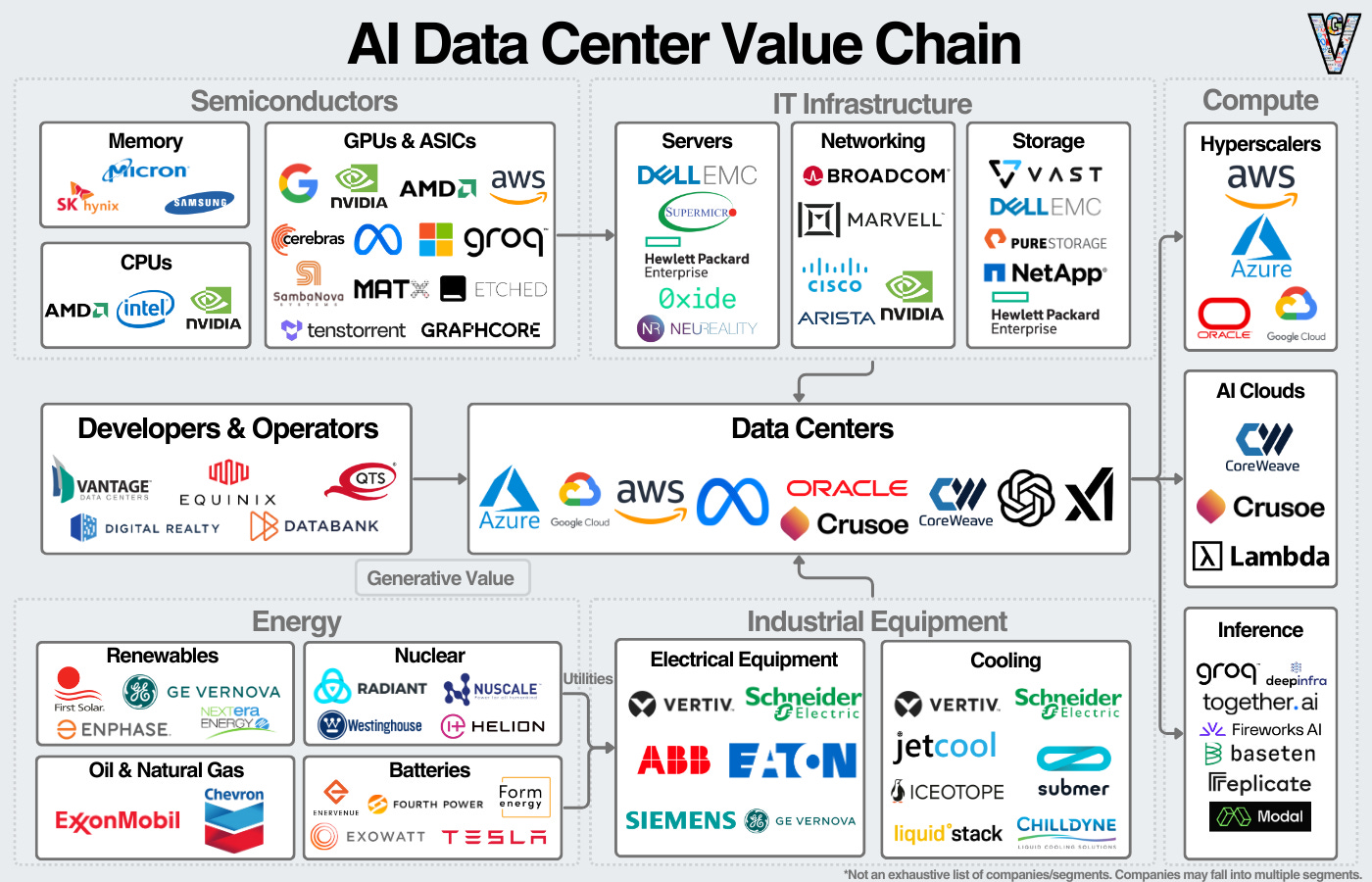
This map effectively summarizes the categories we've discussed. You can see the compute layer represented by Semiconductors and IT Infrastructure, and the facilities layer by the Data Centers, Energy, and Industrial Equipment segments. The Hyperscalers appear in the "Compute" box, highlighting their role as major compute providers, but as we've discussed, their influence spans the entire chart.
Conclusion
In this lesson, we moved from abstract categories to a concrete map of the companies that constitute the AI infrastructure ecosystem. By categorizing them, we can analyze their distinct business models and financial profiles.
Key Takeaways:
- The AI infrastructure landscape can be structured into three main groups: the Hyperscalers, the Compute Layer, and the Facilities Layer.
- Hyperscalers (Google, Microsoft, AWS) are vertically integrated giants that are simultaneously the largest customers, suppliers, and competitors in the market. Their business models are complex and marked by massive CapEx and "circular financing."
- The Compute Layer contains the highest-growth and highest-margin businesses, from the semi-equipment oligopoly (ASML) and chip designers (NVIDIA, Broadcom) to server manufacturers (Quanta, Dell) and GPU cloud providers (CoreWeave).
- The Facilities Layer provides the essential physical infrastructure. These are often more stable, industrial-style businesses involved in real estate (Digital Realty), power & cooling (Vertiv, Eaton), and networking hardware (Arista).
- Understanding a company's specific segment and business model is the first step to identifying its peer group, key financial metrics, competitive moats, and risks.
Preview of the Next Module:
We have now completed our foundational overview of the AI infrastructure landscape. In the next module, "GPU & AI Accelerator Fundamentals," we will zoom in on the single most important segment we identified today: the compute hardware. Our first lesson will explain the investment thesis behind the dominance of GPUs in AI workloads, with a deep focus on the market leader, NVIDIA.