Hello! Welcome back.
In our last lesson, we took a deep dive into enumerating a single, very common service: SMB. You learned how to use specialized tools like smbclient and enum4linux-ng to pull out valuable information like share lists and usernames.
Today, we're going to broaden that skill set dramatically. Instead of focusing on one service, we'll learn a technique that applies to almost any service you discover. We're going back to our trusted tool, Nmap, and unlocking one of its most powerful features: the Nmap Scripting Engine (NSE).
This lesson will show you how to use Nmap's built-in scripts to automatically probe for misconfigurations and enumerate information from common network services. Specifically, we'll target NFS (Network File System) and SMTP (Simple Mail Transfer Protocol), two services where misconfigurations can lead to significant security vulnerabilities.
1. Introduction to the Nmap Scripting Engine (NSE)
Think of the NSE as a way to supercharge your Nmap scans. After Nmap discovers open ports and services, the NSE can run small, targeted programs—called scripts—to perform more advanced tasks. These tasks range from deeper discovery and information gathering to vulnerability detection and even basic exploitation.
This allows you to automate a huge part of the enumeration process directly within Nmap.
To get a better sense of what NSE is and how it works, let's start with a couple of resources.
How to Use Nmap Scripts for Penetration Testing
First, watch this brief introduction from the video "How to Use Nmap Scripts for Penetration Testing" by Nielsen Networking. It gives a great high-level overview of why NSE is so valuable for ethical hackers.
Watch the clip from 00:23 to 00:57. Focus on understanding the purpose of using Nmap scripts in a penetration test.
Reconnaissance with Nmap Scripting Engine
Now, let's look at a textual resource that breaks down the technical details. This article, "Reconnaissance with Nmap Scripting Engine," explains the script categories and the basic commands you'll use to run them.
Read the first few sections of the article, starting from the beginning down to just before the heading 'Metasploitable 2: NFS misconfiguration'. Pay close attention to: The different script categories mentioned (like default, discovery, vuln). The command to update the script database: nmap --script-updatedb. The basic syntax for running scripts: -sC (for default scripts) and --script=<script-name> (for a specific script).
To summarize the key points:
- NSE automates tasks: It runs scripts written in the Lua language to perform actions on the target.
- Scripts are categorized: This helps you choose the right script for the job (e.g.,
discoveryfor information gathering,vulnfor checking known vulnerabilities). - Key Commands:
nmap --script-updatedb: It's good practice to run this occasionally to get the latest scripts. You'll likely needsudofor it.nmap -sC <target>: Runs all scripts in thedefaultcategory. This is a good starting point, but can be "noisy."nmap --script "<script-name>" <target>: Runs a single, specific script. This is great for targeted enumeration.nmap --script-help "<script-name>": Shows you what a script does, its author, and what arguments it accepts.
2. Practical Enumeration with NSE
Now for the hands-on part. We'll use your lab environment (Kali and Metasploitable2) to see NSE in action against two common services.
Case Study 1: Enumerating NFS Misconfigurations
NFS (Network File System) is the standard way for Linux/Unix systems to share directories and files over a network. A common and severe misconfiguration is when a server "exports" (shares) its entire root filesystem (/) to anyone on the network (*). This is equivalent to leaving the front door of the server wide open.
Let's see if we can find this on Metasploitable2 using an NSE script.
Reconnaissance with Nmap Scripting Engine
We'll continue with the article "Reconnaissance with Nmap Scripting Engine," which has a perfect, step-by-step guide for this exact scenario.
Read the rest of the article, starting from 'Metasploitable 2: NFS misconfiguration'. Follow along with the commands in your own terminal against your Metasploitable2 VM. The article will guide you through: Identifying the nfs-ls script and learning about it with --script-help. Running the nfs-ls script against the correct port (port 111, rpcbind). Interpreting the output, which shows the exported root directory. Confirming the finding with showmount and then actually mounting the remote filesystem. This final step proves the impact of the misconfiguration.
Your Turn: Lab Instructions
-
Get Help: First, learn about the
nfs-lsscript.nmap --script-help nfs-ls -
Run the Script: As the article explains, NFS relies on the
rpcbindservice on port 111 to manage connections. Let's run our script against that port on your Metasploitable2 VM.nmap -p 111 --script=nfs-ls <metasploitable_ip>You should see a very revealing output: a directory listing of the target's root (
/) folder! -
Confirm the Finding: The tool
showmountis designed to query NFS servers about their exports.showmount -e <metasploitable_ip>This should confirm that
/is exported to*(everyone). This is a critical finding in a real penetration test. It means you can mount the target's entire filesystem and have read/write access to its files.
Case Study 2: Enumerating SMTP
SMTP (Simple Mail Transfer Protocol) is the engine of email, running on port 25. Enumerating SMTP can reveal valid user accounts (useful for password attacks) or dangerous configurations like "open relay," where the server will happily send emails on behalf of anyone to anyone else (a spammer's dream).
Let's use NSE to probe the SMTP service on Metasploitable2.
This page from Hackviser, "SMTP Pentesting," serves as an excellent cheat sheet for SMTP enumeration. We'll focus on the section that lists Nmap scripts.
Read the 'SMTP Server Assessment' section. It provides a concise list of useful NSE scripts for SMTP, including smtp-commands and smtp-enum-users.
Now let's see this in action. The HackerSploit video below provides a good visual demonstration.
This video, "Nmap - SMTP Enumeration," demonstrates how to use the exact scripts we're interested in.
Watch the sections from 01:08 to 07:52. The video will show you how to use: smtp-commands: To see what commands the server supports. smtp-enum-users: To try and find valid usernames on the server.
Your Turn: Lab Instructions
-
Check Supported Commands: Run the
smtp-commandsscript against your Metasploitable2 VM.nmap -p 25 --script smtp-commands <metasploitable_ip>The output will show you the capabilities of the SMTP server. Look for commands like
VRFY(Verify) orEXPN(Expand), which are classic ways to enumerate users. -
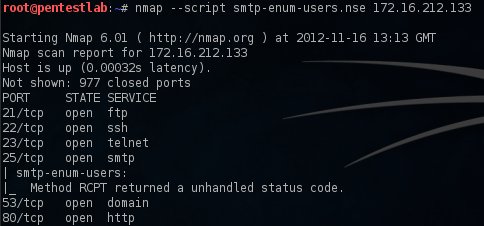
Enumerate Users: Now, let's try to get a list of valid users.
nmap -p 25 --script smtp-enum-users <metasploitable_ip>Metasploitable2 is configured to allow this. The script will run and should return a list of usernames found on the system, such as
root,admin,user, etc. This is another critical finding, providing you with a list of targets for brute-force or password-spraying attacks.
3. The Ultimate Enumeration Script: vulners
So far, we've used scripts to find service-specific information. But what if a script could take the service version you found and automatically check it against a massive database of known vulnerabilities?
That's exactly what the vulners script does. It is one of the most powerful scripts in the NSE library. It takes the results from a version scan (-sV), cross-references them with the Vulners.com vulnerability database, and reports back any known CVEs (Common Vulnerabilities and Exposures).
How to Use Nmap Scripts for Penetration Testing
The video "How to Use Nmap Scripts for Penetration Testing" provides a fantastic, in-depth demonstration of using the vulners script, including a very practical technique for handling its verbose output.
Watch the segment from 21:59 to 30:08. This is a mini-project. The video walks you through: Running a scan with the vulners script. Seeing how overwhelming the raw output can be. Re-running the scan to save the output as an XML file (-oX). Using a simple Python script to parse the XML and generate a clean, readable report with vulnerability scores and links.
This is an advanced technique that combines several command-line skills. Don't worry if it seems complex; the video breaks it down step-by-step. Replicating this workflow is an excellent exercise. The ability to script and process tool output is a key skill for any penetration tester.
Try this on your Metasploitable2 VM. The sheer number of vulnerabilities it finds should highlight why that machine is such a great learning tool.
Conclusion
You have now moved from single-purpose enumeration tools to a flexible, powerful framework for service enumeration with the Nmap Scripting Engine. This skill allows you to quickly and efficiently gather deep intelligence on a wide variety of services.
Key Takeaways:
- The Nmap Scripting Engine (NSE) automates reconnaissance and vulnerability discovery for nearly any service.
- You can run default scripts with
-sC, or target specific services with--script <script-name>. - NFS enumeration (
nfs-ls) can uncover dangerously exposed file shares. - SMTP enumeration (
smtp-commands,smtp-enum-users) can reveal server capabilities and valid user accounts. - The
vulnersscript is a powerful tool that connects service versions directly to known vulnerabilities, giving you a clear list of potential exploits to investigate.
Next Lesson Preview:
The vulners script gave you a list of potential exploits and their CVE identifiers. But how do you find the actual code to perform an attack? In our next lesson, we will focus on searchsploit, a command-line tool that allows you to search a massive offline database of exploits, bridging the gap between identifying a vulnerability and finding a way to exploit it.