Welcome to your first lesson in the "CBT at the Workplace" course. Given your background as a psychologist, you are already well-versed in the principles and applications of various therapeutic modalities, including clinical Cognitive Behavioral Therapy (CBT). This course is designed to build upon that expertise, focusing specifically on how to adapt and apply these powerful techniques within an occupational context.
Today, we will address the foundational distinction between clinical CBT and the brief, solution-focused models that are more suitable and ethically sound for workplace settings. Understanding this difference is not merely academic; it is the cornerstone of effective practice as a workplace psychologist, ensuring your interventions are appropriate, targeted, and aligned with organizational goals rather than clinical treatment. By the end of this lesson, you will be able to clearly differentiate these approaches, setting the stage for the practical applications we will cover next.
The Clinical vs. Workplace Divide: Scope and Intent
The primary distinction between clinical therapy and workplace coaching or psychological support lies in their fundamental purpose. Clinical CBT is a medical model designed to diagnose and treat mental health disorders. In a workplace setting, your role shifts from therapist to coach, consultant, or facilitator. The goal is not to treat psychopathology but to enhance performance, improve well-being, and help employees navigate occupational challenges.
This shift in purpose necessitates a shift in methodology. A resource created for coaches provides an excellent summary of this distinction. While it uses the term "coach," the principles apply directly to your role as a workplace psychologist operating in a non-clinical capacity.
Cognitive Behavioral Techniques (CBT): The Ultimate 2025 Guide for Coaches — ANHCO
This article clearly outlines how CBT is adapted for a non-clinical, goal-oriented context. It provides a direct comparison that will be highly relevant to your practice.
Please read the introduction, What Is CBT in Coaching?, and pay close attention to the section titled Difference Between CBT for Therapy vs Coaching. The table provided there is particularly useful for summarizing the key differences in purpose, scope, and technique.
The core takeaway is the transition from a focus on pathology and symptom reduction to one of growth, productivity, and mindset optimization. The image below, from BetterUp, provides a clear visual summary of the different roles. While you are a licensed psychologist, in a workplace setting, your function often aligns more with the "Coach" column: focusing on the present and future, building mental fitness, and helping with professional goals.

Solution-Focused Models: A Paradigm Shift
To operate effectively in this non-clinical space, we often turn to models that are inherently brief, goal-directed, and strengths-based. Solution-Focused Brief Therapy (SFBT) is a primary example of such an approach and is highly influential in coaching and organizational development.
Its philosophy represents a significant departure from problem-focused therapies. Instead of a deep analysis of the problem's origins, the focus is on constructing and moving toward a desired future.
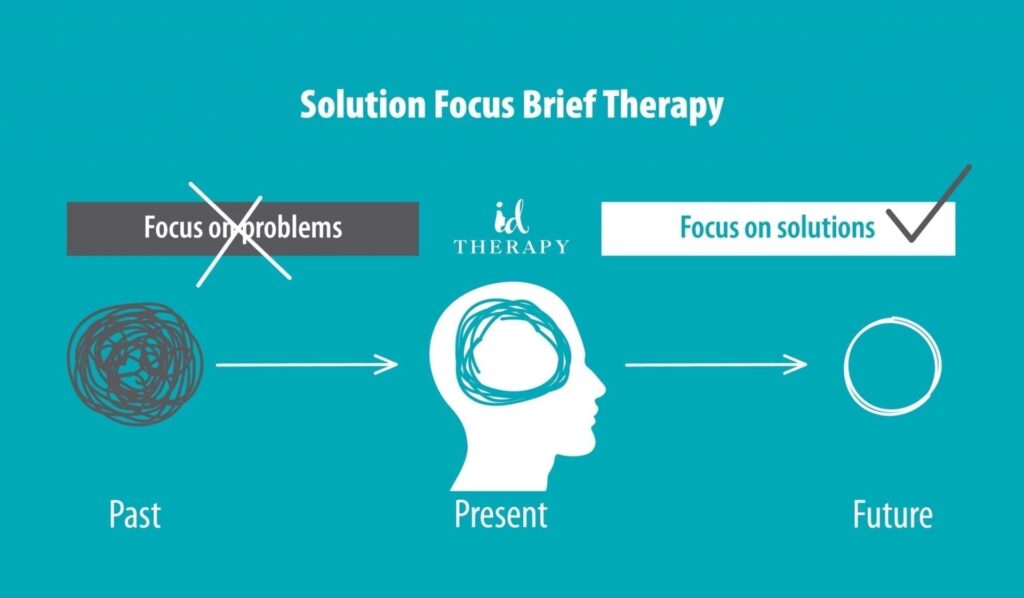
To understand the principles of SFBT, the following short video provides a concise and clear overview.
What is Solution-Focused Therapy? (Solution-Focused Brief Therapy)
This video by Dr. Todd Grande introduces SFBT and its core tenets. It's a useful primer on the model's philosophy.
Watch the segment from the beginning to understand the collaborative, client-as-expert nature of SFBT. Pay special attention to the segment from this point, where he directly contrasts SFBT's approach to problem description with that of CBT. This is a critical point of differentiation.
As Dr. Grande notes, a key difference is that SFBT does not require a detailed exploration of the problem, whereas clinical CBT often begins with a thorough functional analysis of the presenting issue. This makes SFBT particularly well-suited for short-term workplace interventions where time is limited and the focus must remain on practical, forward-looking outcomes.
For a more detailed exploration, Dr. Diane Gehart's lecture provides valuable nuance, especially regarding the practical application and common misconceptions of SFBT.
Solution-Focused Therapy with Dr. Diane Gehart
Dr. Gehart's lecture offers a deeper dive into SFBT, busts common myths, and connects its principles to other modalities, including CBT.
Start by watching the introduction from the beginning, where she discusses the wide application of solution-focused approaches in business, coaching, and school counseling—all non-clinical settings. Next, watch the section on SFBT as a strength-based approach. Note her clarification that the therapist does not give solutions but helps the client identify their own. Continue with the "Myth Busting" section here. This is crucial, as it corrects the misconception that SFBT is cold or ignores client emotions. Finally, listen to the segment from this point, which outlines the practical tenets of solution-oriented work, such as "If it isn't broken, don't fix it" and "Small steps lead to big changes." These are excellent guiding principles for workplace interventions.
Dr. Gehart's points are vital. SFBT is not about ignoring problems or offering simplistic positive thinking. It is a sophisticated method of using language and strategic questioning to help individuals identify their own resources and build momentum toward their goals, making it an efficient and empowering framework for the workplace.
Work-Focused CBT (W-CBT): An Evidence-Based Hybrid
While SFBT offers a distinct alternative, it's also possible to adapt CBT itself for the workplace. This adapted model is often called Work-Focused Cognitive Behavioral Therapy (W-CBT). A recent systematic review provides a clear, evidence-based definition of this approach.
This academic paper synthesizes research to define W-CBT and differentiate it from traditional clinical CBT (T-CBT). It provides the formal, evidence-based grounding for the work you'll be doing.
Begin by reading the Abstract for a concise summary. Note the three recommended criteria for a program to be labeled W-CBT. Next, navigate to the "Discussion" section and read the paragraphs that define W-CBT as a standalone intervention framed by work contexts. Finally, review the "Practical recommendations" subsection, specifically the list of primary components.
As the paper highlights, W-CBT is not simply "CBT at work." It is a distinct intervention where the core components of CBT—cognitive restructuring, behavioral activation, goal setting—are explicitly and consistently framed by work-related matters and the shared goal of improving occupational functioning (e.g., returning to work, managing work stress, improving performance). This reframing is what makes it a suitable and effective model for a workplace psychologist.
Conclusion
In this lesson, we have established the critical distinctions between the clinical application of CBT and the models best suited for the workplace.
Key Takeaways:
- Clinical vs. Workplace: The fundamental shift is from a clinical, treatment-focused model (diagnosing and treating mental illness) to a non-clinical, performance-focused model (enhancing well-being and achieving professional goals).
- Solution-Focused Approach: Models like SFBT are powerful in this context because they are inherently brief, future-oriented, and strengths-based. They empower employees by positioning them as the experts on their own solutions.
- Work-Focused CBT (W-CBT): This is a direct adaptation of CBT where all techniques are specifically framed by work-related goals and contexts. It provides an evidence-based way to use your existing CBT skills in an occupational setting.
- Your Role: Your expertise as a psychologist is invaluable, but its application in the workplace requires a deliberate shift in scope, intent, and methodology to align with coaching and facilitation rather than clinical treatment.
Now that you have a solid understanding of the frameworks for applying CBT in the workplace, our next lesson will focus on a core technique. We will explore how to use Socratic questioning to help employees identify and challenge common maladaptive beliefs related to occupational stress, such as performance anxiety or imposter syndrome.