Hello! Welcome to your fifth and final lesson in our first module, "Christian Foundations and Major Divisions."
In our previous lesson, we explored the Protestant Reformation and its core principles of Sola Scriptura and Sola Fide. We saw how Sola Fide (Faith Alone) presented a new model for how a person is saved, contrasting sharply with the views of the Catholic and Orthodox Churches.
Today, we will dive deeper into this crucial topic. Our goal is to compare the concepts of salvation across the three major traditions: Theosis (Orthodox), Justification/Sanctification (Catholic), and Justification by Faith Alone (Evangelical).
Understanding these different "soteriologies" (theologies of salvation) is perhaps the most important key to unlocking the distinct identities of these Christian traditions. It addresses the ultimate question: What is the purpose of the Christian life, and how is it achieved? This lesson will serve as the capstone for our foundational module, preparing us to focus exclusively on the Ethiopian Orthodox Tewahedo Church (EOTC) from here on.
1. The Evangelical Protestant View: Justification by Faith Alone
We'll begin with the view that grew out of the Reformation. As we touched on last time, the principle of Sola Fide means that a person is saved through faith in Christ alone.
The key theological term for this is forensic justification. "Forensic" relates to law, and this model uses legal concepts. In this view:
- God acts as a judge.
- The believer, though sinful, is declared righteous. This is a legal verdict.
- This righteousness is not the believer's own; it is Christ's perfect righteousness that is imputed, or credited, to their account.
- This act of justification is a one-time, completed event that secures the believer's eternal salvation.
After justification, the believer begins the lifelong process of sanctification, which is being made practically more holy and Christ-like. However, in this framework, sanctification is the result or evidence of salvation, not a part of the justification itself. Your good works prove you are saved; they don't contribute to your being saved.
2. The Roman Catholic View: A Process of Justification and Sanctification
The Roman Catholic Church understands salvation differently. While it agrees that salvation begins with God's grace through faith, it does not make the sharp Protestant distinction between justification and sanctification.
- Infused Righteousness: Instead of Christ's righteousness being imputed (credited externally), grace is infused (poured into) the believer's soul, typically at baptism. This grace begins to heal and transform the person from within, making them truly, inherently more righteous.
- A Lifelong Process: Justification is not a one-time legal declaration but the beginning of a process that includes sanctification. The believer is expected to cooperate with God's grace through faith, hope, and love.
- Merit: Good works performed while in a state of grace can "merit" an increase in grace and contribute to one's final salvation. This isn't "earning" salvation from scratch, but rather a response to and cooperation with God's initial gift.
- This state of "sanctifying grace" can be lost through mortal sin and restored through the sacrament of Penance (Confession).
3. The Orthodox (and EOTC) View: Theosis or Deification
The Orthodox tradition, including the EOTC, approaches salvation from a completely different angle. The model is not primarily legal or meritorious, but therapeutic or ontological. Sin is viewed less as a crime to be pardoned and more as a disease or spiritual death that has corrupted human nature. Salvation is the process of healing and transformation.
The ultimate goal is Theosis (a Greek word meaning "deification" or "divinization"). This is the heart of Orthodox soteriology.
- Definition: Theosis is the process by which a person, through cooperation with divine grace, becomes more and more like God. It is a mystical union with God, becoming by grace what God is by nature. This is famously summarized by St. Athanasius of Alexandria (a key figure for both Coptic and Ethiopian Churches): "God became man so that man might become god." This does not mean we become divine in essence, but that we participate in the divine life.
- Synergy: This transformation is a synergy, or a cooperation between God's grace and human free will. God offers the grace to be healed, and humans must respond with faith, effort, and participation in the life of the Church. Faith and works are inseparable.
- A Lifelong Journey: Salvation is a continuous process that begins at baptism and continues throughout life and into eternity. An Orthodox Christian would say, "I have been saved (at baptism), I am being saved (through my life in the Church), and I will be saved (at the final judgment)."
The following reading from an EOTC perspective explains this concept in detail.
Theosis in Ethiopian Orthodox Tewahedo Theology
This blog post, 'Theosis in Ethiopian Orthodox Tewahedo Theology,' provides an excellent overview of the central goal of Christian life in the EOTC. It will help you see how different this concept is from the Western legal and merit-based models.
Please read from the beginning of the article down to the end of the section titled 'Theosis and the Spiritual Life: Fasting, Prayer, and Asceticism.' Focus on: How Theosis is defined as a 'spiritual transformation' and 'divine participation.' The scriptural basis for the concept (e.g., 2 Peter 1:4). The role of the sacraments (Mysteries) like Baptism and the Eucharist in experiencing Theosis. The practical 'spiritual effort' required, such as fasting and prayer, to participate in this process.
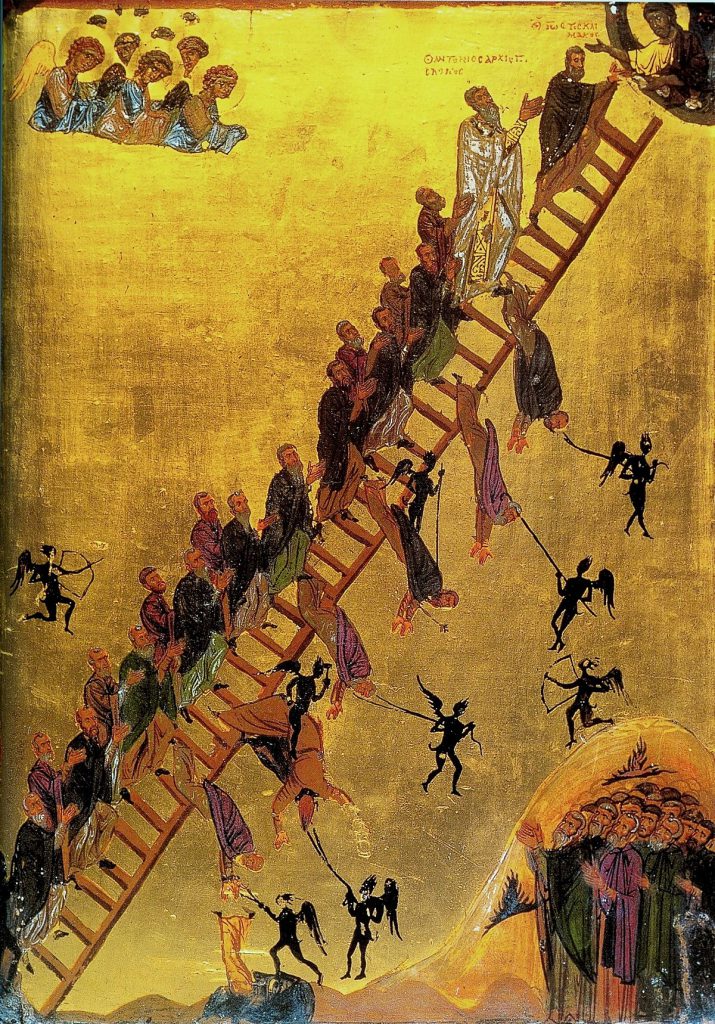
The concept of Theosis is often visualized in Orthodoxy as a long, difficult ascent toward God, requiring immense struggle and reliance on God's help.
4. A Comparative Summary
Now that we've outlined the three views, let's use a resource that puts them side-by-side. The following article provides a detailed comparison that reinforces and expands on what we've discussed.
Orthodox, Catholic, and Protestant Soteriology Compared ...
The article 'Orthodox, Catholic, and Protestant Soteriology Compared...' by Craig Truglia offers a powerful comparative tool. We will focus on the summary table and some key observations to crystallize the differences.
Please study the following parts of this article: The Table: At the very beginning, carefully review the table comparing Orthodoxy, Roman Catholicism, and Protestantism across various points like Atonement, Righteousness, Justification, and Works. Author's Observations: Read the bulleted points under the heading 'Let me offer the following observations:'. Pay close attention to the explanation of why Protestants find the Orthodox view confusing (the non-separation of justification and sanctification). A Note on Definitions: Scroll down to the comments section and find the exchange between a user named 'Christina' and the author (starting with Christina's comment on 'September 26, 2020 at 3:03 am'). This discussion directly addresses how the different groups use the very word 'salvation' differently, which is a major source of misunderstanding.
Based on these readings, we can summarize the core differences like this:
| Feature | Evangelical Protestant | Roman Catholic | Orthodox (EOTC) |
|---|---|---|---|
| Primary Model | Legal / Forensic: Declared righteous. | Legal & Participatory: Made righteous and cooperates. | Therapeutic / Ontological: Healed and transformed. |
| Righteousness | Imputed: Christ's righteousness is credited to you. | Infused: God's grace/righteousness is put inside you. | Imparted / Participatory: You participate in God's life (His "energies"). |
| Key Process | Justification by Faith: A one-time event. | Justification & Sanctification: An intertwined lifelong process. | Theosis (Deification): A lifelong process of union with God. |
| Role of Works | Evidence of salvation. | Cooperation with grace; meritorious for salvation. | Synergy: Inseparable part of the salvation process. |
Test your understanding!
A friend from an Evangelical background says, "I'm saved. It happened the moment I accepted Jesus as my savior." An EOTC Christian, however, says, "With God's help, I am being saved."
Based on what you've learned, explain why both statements make perfect sense within their own theological frameworks.
Show answer
The Evangelical friend sees salvation as forensic justification, a one-time legal event that occurred in the past. When they accepted Christ, their legal status before God was permanently changed, and their salvation was secured. Therefore, they can say with confidence, "I am saved."
The EOTC Christian sees salvation as Theosis, a lifelong therapeutic process of being healed, transformed, and united with God. It is a journey, not a single destination. They have been saved in baptism, are currently being saved through their life of prayer, fasting, and participation in the sacraments, and hope to be fully saved at the final judgment. Therefore, they express salvation as an ongoing reality: "I am being saved."
Conclusion
Today we have contrasted the three major Christian views on salvation. We've seen how they diverge from a legal declaration (Evangelicalism), to a cooperative process of being made righteous (Catholicism), to a mystical and transformative journey of union with God (Orthodoxy/EOTC). This difference in soteriology is arguably the most significant theological distinction between these traditions, influencing everything from worship to spiritual practice.
Key Takeaways:
- Evangelical salvation is centered on Justification by Faith Alone, a one-time forensic act where Christ's righteousness is imputed to the believer.
- Catholic salvation involves infused grace and a lifelong process where justification and sanctification are intertwined, with human cooperation through meritorious works.
- Orthodox (EOTC) salvation is understood as Theosis, a therapeutic and lifelong process of deification, or union with God, achieved through a synergy of divine grace and human effort.
This lesson concludes our first module. You now have a solid framework for understanding the major branches of Christianity and the key theological issues that divide them. You are well-equipped to dive deep into the specific context of Ethiopia.
Preview of the Next Lesson:
We will now begin Module 2, "History and Identity of the Ethiopian Orthodox Church." Our next lesson will transport us back to the 4th-century Aksumite Kingdom to explore the fascinating story of how Christianity first took root in Ethiopia and to examine the EOTC's foundational, centuries-long relationship with its "mother church," the Coptic Patriarchate of Alexandria in Egypt.