Welcome to your third lesson. In our previous sessions, we defined tense as the tool for locating an event in time and aspect as the way we describe the state of that event. You now have the conceptual framework for all the English verb tenses. Today, we will put that framework into practice by reviewing the fundamental architecture of English sentences.
This lesson focuses on how to correctly form the three basic sentence types: affirmative (statements), negative (denials), and interrogative (questions). Mastering these structures is essential for clear and professional communication, as it allows you to express your ideas, negate information, and ask for clarification with grammatical precision. By the end of our session, you'll be able to confidently manipulate these sentence patterns, a skill that will be foundational for every tense we study going forward.
The Bedrock of a Sentence: Affirmative Structure
At its core, every complete sentence is built around a simple relationship: a subject performs an action or is in a state described by a verb. This Subject + Verb (S+V) structure is the foundation of all affirmative sentences, which are statements of fact or opinion.
To start, let's watch a brief segment from an Oxford Online English lesson that explains this fundamental rule.
Grammar Lesson #1 - Tips to Improve Your Sentence Structure
This video provides tips for improving sentence structure. Please watch the first part, which explains the essential components of a sentence.
Watch from the beginning until the explanation of the subject and main verb. The speaker will outline why this basic structure is so critical for clear communication.
As the video explained, the simplest structure is Subject + Verb. This can be expanded with an object or a complement, giving us the common Subject + Verb + Object/Complement pattern.
- Subject: Who or what the sentence is about. (e.g., The company, I, Our project manager)
- Verb: The action or state of being. (e.g., launched, am writing, approved)
- Object/Complement: Who or what receives the action or provides more information. (e.g., a new product, the report, the budget)
Here are some examples in a professional context:
- We (Subject) submit (Verb) a progress report every Friday (Complement).
- The marketing team (Subject) has created (Verb) a new campaign (Object).
- She (Subject) will present (Verb) the findings tomorrow (Object/Complement).
Negating a Statement: Negative Structure
To form a negative sentence, we introduce the word not. The key challenge is knowing where to place it. The rule depends on whether the verb phrase already contains an auxiliary (or "helping") verb.
With an Auxiliary Verb
If the verb phrase already has an auxiliary verb (like am, is, are, was, were, have, has, had, will, can, should, etc.), you simply add not after the first auxiliary verb.
Please read the following resource from the British Council, which explains this rule.
Questions and negatives | LearnEnglish
This page provides a comprehensive reference for forming questions and negatives.
Please read the section titled "Negatives". Focus on the rule about placing not after the first part of the verb. Also, note the common contractions like aren't, won't, and haven't.
Let's see this in action:
-
Affirmative: "They are working on the project."
-
Negative: "They are not (aren't) working on the project."
-
Affirmative: "He has finished the presentation."
-
Negative: "He has not (hasn't) finished the presentation."
Without an Auxiliary Verb (The 'do/does/did' Rule)
When a simple present or simple past sentence does not have an auxiliary verb (e.g., "She works here," "They agreed"), we cannot simply add "not." We must add the appropriate form of the auxiliary verb do (do, does, or did) followed by not and the base form of the main verb.
The following video explains this crucial concept, which is a common point of confusion.
AUXILIARY VERBS in English grammar with examples | BE DO HAVE
This video discusses the function of auxiliary verbs, including the special role of 'do'.
Watch the segment from this section. The presenter clearly contrasts sentences with the main verb 'be' (which doesn't use 'do') with sentences that require 'do' to form negatives and questions.
This rule is also outlined in the British Council resource you looked at earlier. Let's revisit it to see the rules for simple tenses in writing.
Questions and negatives | LearnEnglish
We will now look at the specific section on simple tenses.
Find the heading "Present simple and past simple questions and negatives". Read the explanations and look at the tables showing how to use do/does/did for negatives. Pay close attention to the examples for work.
Here's a summary of the rule:
- Present Simple: Use
do not (don't)ordoes not (doesn't)+ base verb.- Affirmative: "She manages the team."
- Negative: "She does not manage the team."
- Past Simple: Use
did not (didn't)+ base verb.- Affirmative: "They completed the task."
- Negative: "They did not complete the task."
Asking for Information: Interrogative Structure
Interrogative sentences, or questions, generally involve inversion, where the order of the subject and auxiliary verb is switched. There are two main types of questions.
1. Closed Questions (Yes/No Questions)
These questions can be answered with a simple "yes" or "no." They are formed by moving the auxiliary verb to the front of the subject. If there is no auxiliary, you add do, does, or did at the beginning.
- Statement: "He is leading the project." -> Question: "Is he leading the project?"
- Statement: "She will attend the meeting." -> Question: "Will she attend the meeting?"
- Statement: "You finished the report." -> Question: "Did you finish the report?"
2. Open Questions (Wh- Questions)
These questions use a question word (what, where, when, why, who, how) to ask for specific information. The structure is built upon the Yes/No question form:
Question Word + Auxiliary Verb + Subject + Main Verb ...?
This helpful image breaks down the structure for both closed and open questions.
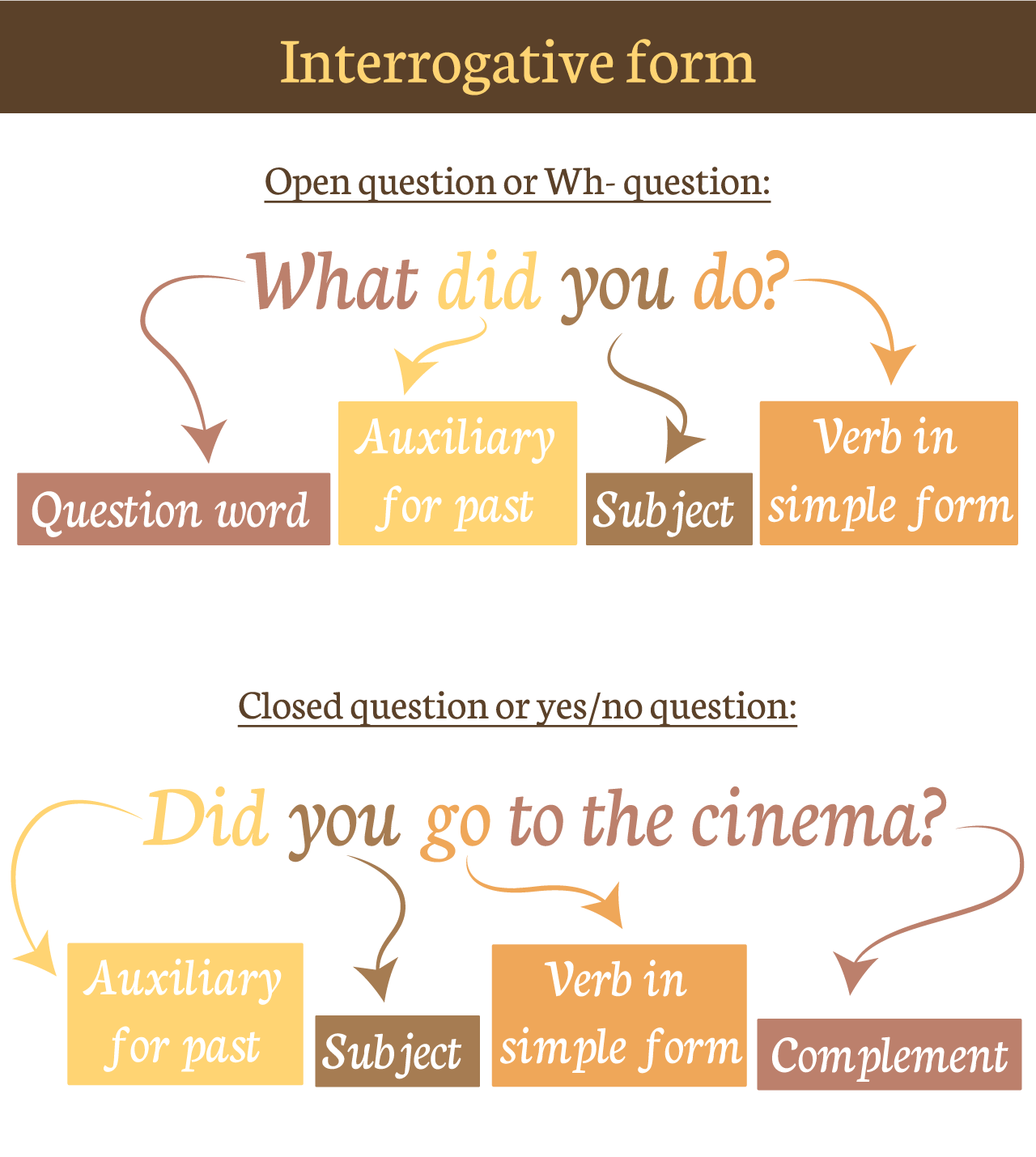
This diagram shows the word order for open (Wh-) and closed (yes/no) questions in the past tense. Notice how the open question simply adds a "Question word" to the beginning of the closed question structure.
Let's refer back to the British Council guide for a detailed breakdown of question formation.
Questions and negatives | LearnEnglish
This guide explains both Yes/No and Wh- questions clearly.
First, review the section Yes/No questions to confirm the inversion rule. Then, scroll down to the heading Wh-questions and read about how these are formed by placing the question word in front of a Yes/No question structure.
Practice
Let's put this all together. Convert the following affirmative professional sentences into both negative and interrogative (Yes/No) forms.
- Affirmative: The team holds a meeting every Monday.
- Affirmative: She is preparing the financial summary.
- Affirmative: The engineers have solved the technical issue.
- Affirmative: He attended the conference in Berlin last year.
- Affirmative: We will launch the new software in the third quarter.
Answers
- Negative: The team does not hold a meeting every Monday.
Interrogative: Does the team hold a meeting every Monday? - Negative: She is not preparing the financial summary.
Interrogative: Is she preparing the financial summary? - Negative: The engineers have not solved the technical issue.
Interrogative: Have the engineers solved the technical issue? - Negative: He did not attend the conference in Berlin last year.
Interrogative: Did he attend the conference in Berlin last year? - Negative: We will not launch the new software in the third quarter.
Interrogative: Will we launch the new software in the third quarter?
Conclusion
In this lesson, we have reviewed the essential structures for building English sentences. You've reinforced your understanding of how to make statements, negate them, and ask questions accurately.
Here are the key takeaways:
- Affirmative: sentences follow the basic
Subject + Verb (+ Object)structure. - Negative: sentences are formed by adding
not. This is placed after an existing auxiliary verb or requires addingdo/does/didfor simple tenses. - Interrogative: sentences are formed by inverting the subject and the auxiliary verb. Again,
do/does/didis added if no other auxiliary is present. Wh- questions add a question word to the beginning of this inverted structure.
These three structures are the fundamental patterns you will use with every tense in English. In our next lesson, we will begin focusing on the specific verb forms needed for these structures, starting with the past tense forms of common irregular verbs.