In our last lesson, we established the fundamental structures for affirmative, negative, and interrogative sentences. You saw that when forming past tense questions and negatives, we use the auxiliary verb did followed by the base form of the main verb (e.g., "He did not attend the meeting," "Did you finish the report?"). Today, we will focus on the verb form used in affirmative past tense statements, which is where things get interesting.
This lesson addresses a core component of English grammar: irregular verbs. While regular verbs form their past tense simply by adding -ed, a large number of the most common verbs in English do not follow this rule. Your goal for this session is to learn how to identify and correctly use the simple past tense forms of these common irregular verbs. Mastering them is non-negotiable for fluent professional communication, as they appear constantly in everyday speech and writing.
Regular vs. Irregular Verbs
To begin, let's clearly define the difference between regular and irregular verbs.
- Regular Verbs: These verbs follow a predictable pattern. To form the simple past tense, you add
-edor-dto the base form.- work -> worked
- decide -> decided
- launch -> launched
- Irregular Verbs: These verbs do not follow the
-edrule. Their past tense forms are unique and must be memorized.- go -> went
- make -> made
- write -> wrote
The following video from English with Emma · engVid provides an excellent overview of why these verbs exist and introduces some of the most common examples.
How to Learn Past Tense IRREGULAR VERBS... the EASY Way!
Watch the first part of the video to understand the fundamental difference between regular and irregular verbs.
Pay attention to the introduction which explains the concept and lists some of the most frequently used irregular verbs in English. Don't worry about memorizing the whole list at once; focus on understanding the distinction.
As the video explains, irregular verbs are often the oldest and most-used words in the language. You can't avoid them, so the best strategy is to learn them systematically.
Three Categories of Irregular Verbs
While "irregular" implies a lack of rules, we can group many of these verbs into helpful categories. This makes them easier to learn than simply memorizing a random list. A useful way to categorize them is by how their spelling and pronunciation change.
Let's watch this short, focused video from Tiny Teaching Tube that breaks irregular verbs down into three main types.
Irregular Past Tense Verbs Grammar Practice
This video clearly illustrates the main patterns of change in irregular verbs.
Please watch the following three segments: Verbs that change their spelling (e.g., eat -> ate). Verbs that do not change their spelling (e.g., put -> put). The special case of verbs where spelling is the same but pronunciation changes (e.g., read -> read).
To summarize, you will encounter:
- Verbs that change spelling: This is the largest group (e.g., begin -> began, know -> knew, speak -> spoke).
- Verbs with no change: The base and past tense forms are identical (e.g., cut -> cut, cost -> cost, put -> put). You rely on context to know if the sentence is present or past tense.
- Verbs with a pronunciation change: The most famous example is read (pronounced /riːd/ in the present) which becomes read (pronounced /rɛd/ in the past).
A List of Common Irregular Verbs
Now it's time to become familiar with the verbs themselves. The image below presents a concise list of common irregular verbs, showing their Base Form, Past Tense, and Past Participle. For this lesson, we are focused only on the first two columns. We will cover the third column, the Past Participle, in our next session.
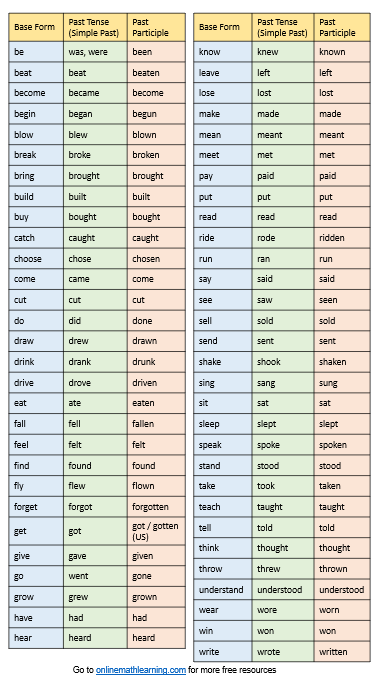
For a more comprehensive set of lists you can use for study, the following resource is very helpful.
Irregular Verb List & Exercises (Beginner / Intermediate English)
This page from English Current offers a clear definition and two excellent lists of irregular verbs, categorized by difficulty.
First, read the brief review at the top. Then, study the two tables provided: the Beginner List and the Intermediate List. As you read, notice which verbs you already know and which are new to you. Try to spot the patterns we just discussed.
Practice Time
Theory is important, but practice is what builds mastery. Let's apply what you've learned.
Activity 1: Fill in the Blanks
Complete the following sentences with the correct simple past tense form of the verb in parentheses. These scenarios are typical of a professional environment.
- She _______ (write) the project proposal last week.
- The management team _______ (choose) a new software vendor yesterday.
- I _______ (speak) with the client this morning about the deadline.
- We _______ (think) the presentation was very effective.
- He _______ (go) to the international trade fair in Frankfurt.
- The new policy _______ (bring) significant changes to our workflow.
- They _______ (meet) their quarterly sales targets.
Answers
- wrote
- chose
- spoke
- thought
- went
- brought
- met
Activity 2: Interactive Exercises
Now, for more in-depth practice, return to the "Irregular Verb List & Exercises" page and complete their online exercises. They provide immediate feedback, which is an excellent way to test your knowledge.
Irregular Verb List & Exercises (Beginner / Intermediate English)
This part of the resource provides interactive exercises to test your knowledge of simple past forms.
Scroll down to the "Exercises for Learning English Irregular Verbs Online" section. Complete the three fill-in-the-blank exercises under the heading Beginner Level: Past Simple. Then, continue to the two exercises under the heading Intermediate Level: Past Simple. Type your answers in the boxes and use the "Check Answers" button to see your score.
Conclusion
In this lesson, you have tackled one of the most essential areas of English verb grammar. You now know how to distinguish regular and irregular verbs and have practiced using the simple past forms of the most common ones.
Key takeaways from today:
- Regular verbs form their past tense with
-ed. Irregular verbs have unique forms that must be learned. - Many irregular verbs can be grouped into patterns: those that change spelling, those that don't, and the special case of
read/read. - The most effective way to learn these verbs is through structured memorization and consistent practice in context.
In our next lesson, we will turn our attention to the past participle—the third form on the verb lists (e.g., written, chosen, spoken). You will learn how this form is used to build more complex tenses, such as the present perfect ("I have written the report"), which are crucial for describing experiences and achievements in a professional context.