Welcome to the start of your journey into statistics! This first lesson establishes the groundwork for everything that follows. We will define what the field of statistics is all about and, more importantly, explore its fundamental role as a tool for analysis and sound decision-making. Understanding this "what" and "why" is the crucial first step before we dive into the specific methods and calculations that form the "how" of statistical analysis, setting you on a firm path toward your goal of mastering statistics for data science and machine learning.
What is Statistics?
At its core, statistics is the science of learning from data. In a world generating vast amounts of information every second, statistics provides the principles and methods to collect, analyze, interpret, and present that data in a meaningful way.

To expand on this, let's read a brief introduction that frames the purpose of the field.
Please read the introductory section of the article "What is Statistics?" from Michigan Tech.
Focus on the first paragraph, which defines the core purpose of statistics. Also, note the distinction it makes between acting on "gut instinct" and using statistics for evidence-based answers.
As you can see, the central theme is turning raw data into useful information. This process isn't just about crunching numbers; it's about uncovering patterns, testing ideas, and ultimately, building a reliable understanding of complex situations. Your background in computer science deals with processing information, often with deterministic logic. Statistics, on the other hand, gives us a framework for reasoning and making decisions in the presence of variability and uncertainty, a constant feature of real-world data.
It's also useful to clarify a common ambiguity in the word "statistics." It can refer to the entire field of study, but it can also refer to the results of a calculation, like a mean or a percentage.
What Is Statistics Crash Course Statistics #1
The video "What Is Statistics: Crash Course Statistics #1" offers a very clear distinction.
Watch the short segment from the two meanings of statistics, which explains this dual usage.
The Role of Statistics in Analysis and Decision-Making
The primary role of statistics is to provide a systematic framework for moving from data to decisions. This journey involves several key stages:
- Data Collection: Designing studies, surveys, and experiments to gather relevant and unbiased data.
- Analysis: Summarizing data (descriptive statistics) and using it to make claims about a larger group (inferential statistics). This is where we identify trends, relationships, and differences.
- Interpretation: Translating the numerical results into practical, real-world conclusions.
- Decision-Making: Using these conclusions to make informed choices, formulate policies, or develop strategies.
The historical example of the streptomycin trial for tuberculosis is a powerful illustration of this process in action, showing how a well-designed statistical experiment can lead to life-saving decisions.
Why Study Statistics? | College Majors | College Degrees | Study Hall
The video "Why Study Statistics?" begins with this compelling story.
Watch the introduction from the streptomycin trial. Notice how the statistician Austin Bradford Hill designed the experiment to isolate the effect of the drug, enabling a clear decision about its effectiveness.
This process of evidence-based decision-making is at the heart of statistics. It's about replacing guesswork and intuition with conclusions supported by data.
Return to the Michigan Tech article and read the section on evidence-based decision-making.
You can find this under the main heading "Why Studying Statistics is Important." Read the part labeled this section. Pay attention to the bullet points that list the specific roles statistics plays in this process.
Statistics: The Backbone of Data Science
Given your goals, it's vital to see the direct connection between statistics and fields like data science and machine learning. In short, statistics provides the theoretical foundation and practical tools upon which data science is built.
As the GeeksforGeeks article "Statistics For Data Science" puts it, statistics acts as the "backbone for understanding data and building reliable models." Without a solid statistical foundation, a data scientist is merely using complex algorithms without truly understanding their output, limitations, or the reliability of their conclusions.
The infographic below illustrates some of the key applications of statistics in a business context, many of which are core tasks in data science.
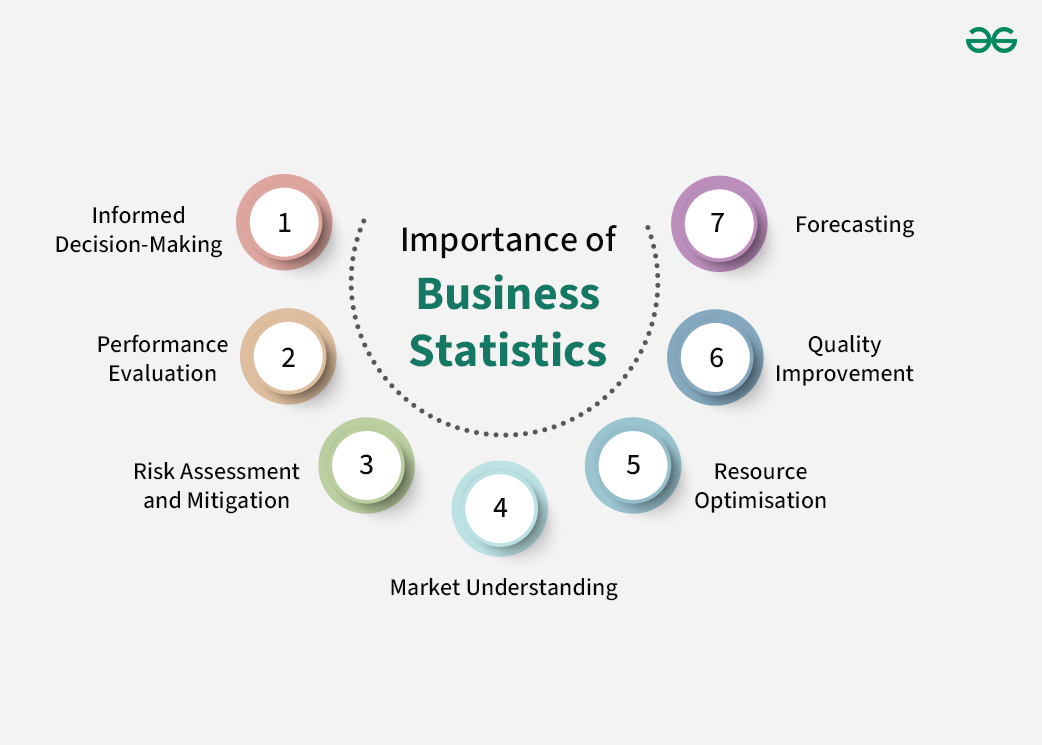
For example, "Forecasting" directly relates to building predictive models in machine learning. "Risk Assessment" relies on probability and distributions to quantify uncertainty. "Market Understanding" is achieved through exploratory data analysis and hypothesis testing.
Let's explore this connection more deeply.
The Michigan Tech article has two excellent sections that bridge this gap.
Please read the subsections Data Science and Business Analytics. Note how they describe data science as a combination of statistics and computer science, where the statistician's role is to ensure the conclusions are accurate and useful.
What Statistics Can and Cannot Do
While statistics is a powerful tool, it's not magic. It's crucial to understand its limitations. Statistics is excellent at answering questions about what is happening in the data—quantifying relationships, comparing groups, and identifying trends. However, it often cannot, by itself, answer the ultimate question of why something is happening.
For instance, statistics can show a strong correlation between ice cream sales and crime rates. A naive interpretation might suggest ice cream causes crime. The statistical analysis, however, has simply identified a pattern. It requires human reasoning to deduce the "lurking variable"—hot weather—that likely drives both.
This distinction is critical. The following video segment uses a practical example to explain the limits of statistical inquiry and introduces the important concept of a "proxy" measure.
What Is Statistics Crash Course Statistics #1
Let's return to the "Crash Course Statistics" video.
Watch the segment from what statistics can do. Focus on the discussion of why answering "Why do people eat fast food?" is difficult, and how statisticians instead answer questions they can measure, like the relationship between fast food consumption and hours worked.
Conclusion
In this introductory lesson, we have established a foundational understanding of statistics. We've seen that it's not just about mathematics, but a comprehensive science for gaining insights and making decisions from data, especially when faced with uncertainty.
Here are the key takeaways:
- Definition: Statistics is the science of collecting, analyzing, interpreting, and presenting data to transform it into meaningful information.
- Core Role: Its primary function is to enable evidence-based decision-making by revealing patterns, quantifying uncertainty, and testing ideas with factual evidence instead of relying on intuition.
- Relevance to Your Goals: Statistics is the fundamental language and "backbone" of data science and machine learning, providing the theory and methods needed to build and validate models.
- Limitations: While powerful, statistics helps us reason with data, but it cannot reason for us. It primarily answers questions of "what," not "why," and its conclusions are only as good as the data and the interpretation behind them.
In our next lesson, we will explore the two major branches of the field: Descriptive Statistics and Inferential Statistics. This will begin to lay out the specific toolsets you will use to perform data analysis.