Hello! Welcome back to our journey into retro doily design.
In the last lesson, we tackled the intricate task of charting a complex geometric filet pattern on a radial grid. That kind of dense, detailed work is what gives many vintage doilies their character. However, a design composed entirely of such complexity can feel overwhelming. Great design is as much about the quiet spaces as it is about the loud patterns.
This lesson focuses on creating those quiet spaces. Our learning outcome is to design 'breather' rounds using simple stitches or mesh to visually separate complex pattern bands. We'll explore why these transitional rounds are critical for both the look and structure of your doily, and you'll learn a toolbox of stitches to create them.
1. The 'Why': The Role of Breather Rounds in Design
Before we get into the 'how', let's establish the 'why'. Breather rounds, sometimes called transition rounds, are not just filler. They are a deliberate and powerful design choice.
- Visual Pacing and Emphasis: In design, areas of low detail (negative space) make areas of high detail stand out. Breather rounds act as the "white space" of your doily. They provide a visual pause, allowing the eye to rest and better appreciate the complexity of the pattern bands you work so hard on, like the filet section we designed previously.
- Structural Simplification: As you discovered, incorporating increases into a complex geometric or pictorial pattern can be tricky. Breather rounds provide a perfect opportunity to "hide" your increases in a simple, orderly way, ensuring the doily continues to lie flat without distorting an intricate motif.
- A Foundation for What's Next: These rounds create a clean, predictable stitch count, which is invaluable when you're preparing to launch into another complex pattern or, as we'll see in the next lesson, calculating the math for a final border.
Take a look at this finished doily. Notice the rounds of open mesh separating the central flower from the radiating pineapple motifs, and separating the pineapples from the outer edge.
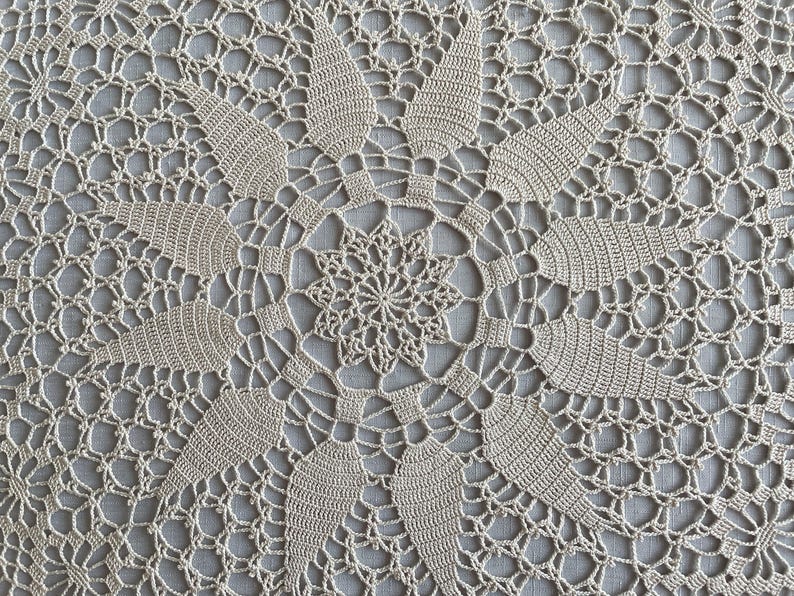
These mesh rounds give the design rhythm and elegance. Without them, the pattern would be a dense, less legible collection of stitches.
2. The 'How': A Toolbox of Breather Stitches
You have several options for creating breather rounds, each with a different visual texture. Let's build your design toolbox.
Type 1: Solid Fabric Rounds
The simplest approach is to work one or more rounds in basic stitches. This creates a solid, opaque band that provides a strong visual break.
- Single Crochet (sc): Creates a very dense, tight fabric. Excellent for a very bold separation.
- Half Double Crochet (hdc): Slightly taller and more fluid than sc. Still quite solid.
- Double Crochet (dc): A classic choice. Creates a taller, more relaxed band. Because the stitches are taller, you can often see a little more light through it compared to sc.
Design Consideration: A solid band of stitches is a very easy place to manage your increases. If you need to add 8 stitches in the round, you can simply space out 8 increases evenly. For example, if your round has 240 stitches, you'd place an increase every 30 stitches.
Type 2: Simple Mesh Rounds
Mesh is the most common choice for breather rounds in vintage doilies, creating a light, airy lace texture.
- Chain-Space Mesh: This is the quintessential lace look. It's typically formed by a repeating pattern of a short stitch and a chain. A very common formula is
(sc, ch 3, skip 2 stitches). You can vary the chain length (ch 4,ch 5) and the number of skipped stitches to create a more open or denser mesh. - V-Stitch Mesh: This creates a more structured, decorative mesh. A V-stitch is typically
(dc, ch 1, dc)worked into the same stitch. A round of V-stitch mesh might look like(V-stitch in next stitch, skip 2 stitches)repeated around. This is a bit more substantial than a simple chain-space mesh.
Look at this crochet chart. You can see several types of rounds. The very dense, complex sections with shell stitches are separated by simpler rounds, like the one marked with o (chains) and + (single crochet), which serve as breather rounds.

Type 3: Filet Mesh Rounds
You can also use the skills from our previous lessons. A few rounds of simple, open filet mesh make an excellent transition. This provides a sense of continuity in the design language while still creating a visual break.
In our lessons on filet crochet, we focused on using both open and solid mesh to create patterns. For a breather round, you would use only the open mesh. For a quick refresher on how open mesh is constructed, you can revisit the 'Filet Crochet – The Basics' article.
Please review the sections 'Method I – worked over 3 Stitches' and 'Method II – worked over 2 Stitches'. Pay attention to how an 'empty (open) box' is created. For example, in Method I, it's '1 dc ... and the next 2 stitches are skipped with 2 chains'. A breather round would consist entirely of these open boxes.
A round of (dc, ch 2, skip 2) creates a beautiful, stable grid that works perfectly as a separator.
3. Designing and Charting a Breather Round
Let's put this into practice. Imagine you have just completed the 8-round diamond filet band from our last lesson. Let's say your final round has 240 stitches. Now, you want to design a 2-round breather section before starting your next big motif.
Step 1: Choose Your Stitch
Let's go with a classic, airy chain-space mesh. We'll use the formula: (sc in next st, ch 3, skip 2 sts).
Step 2: Calculate Stitches and Increases
- Your base round has 240 stitches.
- The chosen mesh repeat
(sc, ch 3, sk 2)uses 3 stitches of the previous round.240 / 3 = 80. This means your first breather round will have 80 repeats of(sc, ch 3). - To keep the doily flat, you need to add increases. A good rule of thumb for
scheight rounds is to add about 6-8 repeats per round. Let's aim to add 8 repeats, bringing the total to 88 for the next round. - How do you add a repeat in a mesh round? You work an extra repeat without skipping stitches, or by working into a chain space.
Step 3: Charting the Breather Rounds
You have your radial grid ready.
- Breather Round 1:
- Chart
(sc, ch 3, sk 2)all the way around. On your chart, this will look like a+symbol, followed by threeosymbols, skipping over the two stitches from the previous round. You will do this 80 times.
- Chart
- Breather Round 2:
- You need to add 8 repeats, for a total of 88. You have 80 chain spaces from the previous round to work into.
- The basic pattern will be
(sc in next ch-3 sp, ch 3). You will do this 80 times. - To add your 8 increases, you will work
(sc, ch 3, sc, ch 3)into 8 evenly spaced chain-3 spaces from the round below. (e.g., in every 10th chain space). - On your chart, you would draw this increase pattern in the designated chain spaces.
Test your understanding!
You've finished a dense pattern band that ends with 256 stitches. You want to add a single breather round of V-stitch mesh before your border. A V-stitch is (dc, ch 1, dc). Your pattern for the round will be (V-stitch in next st, skip 3 sts).
- How many V-stitches will you have in this breather round?
- The V-stitch is
dcheight, so you need to increase to keep it flat. Where is the most logical place within the stitch pattern to add an increase?
Show answer
-
Each V-stitch repeat uses 1 stitch for the V-stitch itself and skips 3, for a total of 4 stitches from the previous round.
256 stitches / 4 stitches per repeat = 64. You will have 64 V-stitches in the round. -
The easiest way to add an increase is to modify the V-stitch itself. Instead of a standard V-stitch
(dc, ch 1, dc), you could periodically work a "double V-stitch" like(dc, ch 1, dc, ch 1, dc)in the same stitch. This adds an extradcandch-1 spto the round, creating a subtle increase while maintaining the pattern's look. Another option is to reduce the number of skipped stitches between two V-stitches (e.g., skip 2 instead of 3).
Conclusion
You've now added a crucial set of tools to your design repertoire. Breather rounds are the elegant punctuation in the language of doily design, providing rhythm, structure, and emphasis.
Key Takeaways:
- Breather rounds serve a dual purpose: visual separation (like white space) and structural simplification (a place for easy increases).
- You have a toolbox of options, from solid rounds (sc, dc) for a bold effect to various mesh rounds (chain-space, V-stitch, filet) for a lighter, lacier feel.
- Designing a breather round involves choosing a stitch, calculating the repeats based on the previous round's stitch count, and planning for the necessary increases to maintain flatness.
Next Lesson:
These breather rounds have given us a clean, stable foundation. In our next lesson, we will leverage this stability as we learn how to calculate the final stitch count required to perfectly accommodate a chosen border pattern repeat without puckering. This will be the final step before designing the grand, decorative edge of your doily.