Hello! Welcome to the fourth lesson in our study of Communication Systems.
In the last lesson, we explored Amplitude Modulation (AM), where we learned to encode information by varying the amplitude of a high-frequency carrier wave. We saw that the message was contained in the "envelope" of the final wave.
Today, we will investigate an alternative and powerful modulation technique. Instead of changing the carrier's amplitude, what if we kept the amplitude constant and varied its frequency instead? This brings us to our topic: Frequency Modulation (FM). By the end of this lesson, you will be able to describe the basic principle of FM and understand how it encodes information.
The Core Principle of Frequency Modulation
The principle of Frequency Modulation is as elegant as its name suggests:
The instantaneous frequency of the high-frequency carrier wave is varied in proportion to the instantaneous amplitude of the low-frequency message signal, while the carrier's own amplitude remains constant.
Let's look at a simple visualization of this process.
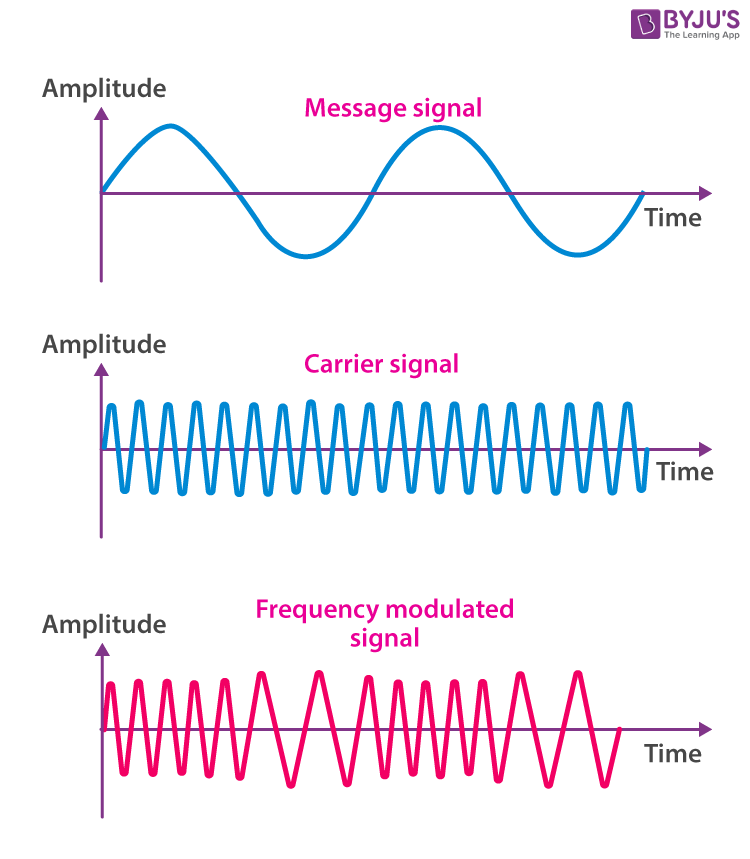
This constant amplitude is the key feature that distinguishes FM from AM. In FM, the information isn't in an "envelope"; it's encoded in the continuous shifting of the carrier's frequency.
To solidify this concept, let's read a short, clear description of FM and how it compares to the AM we've already learned.
Radio Frequency Modulation Made Easy
The article 'Radio Frequency Modulation Made Easy' provides a clear definition of FM and includes a helpful diagram comparing AM, FM, and a related technique, Phase Modulation (PM).
Read the subsection titled 'Frequency Modulation (FM)'. Pay close attention to the definition and look at Figure 2, which visually contrasts the three modulation types. This will help you place FM in context with what you already know about AM.
Visualizing Frequency Deviation
The core of FM is this "change in frequency." Let's define some key terms to describe this process more precisely.
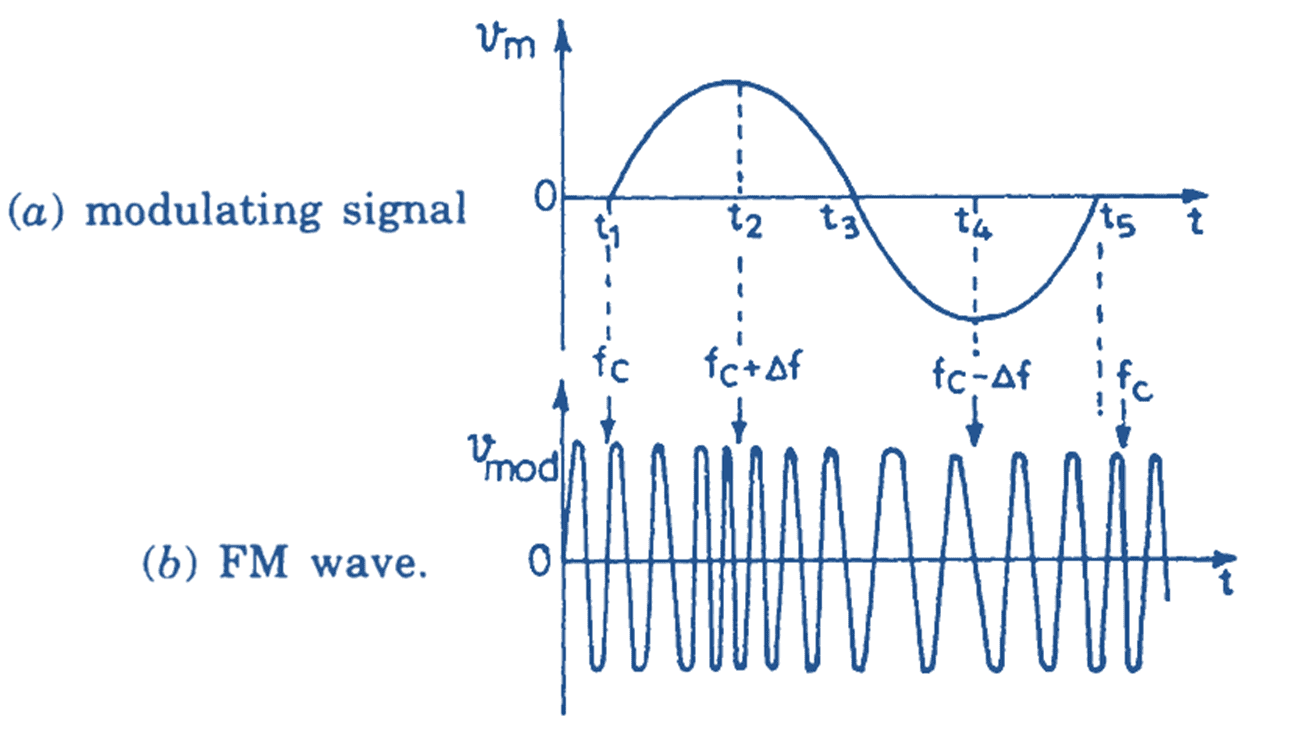
- Center Frequency (): This is the frequency of the carrier wave when no message signal is applied. It's also called the "resting frequency." This is the frequency your radio dial is tuned to, for example, 98.3 MHz.
- Frequency Deviation (): This is the maximum shift in frequency from the center frequency, which occurs at the peak amplitude of the message signal. A louder message signal (higher amplitude) causes a greater frequency deviation.
The image below gives a more detailed view, connecting the message signal's amplitude directly to the resulting frequency change.
To see this in motion, let's watch a short video that animates this principle.
Amplitude Modulation and Frequency Modulation
The video 'Amplitude Modulation and Frequency Modulation' from the channel LTE offers a concise visual explanation of the FM process.
Watch the segment from 01:05 to 02:28. The video first defines FM and then shows exactly how the frequency changes in response to the positive and negative parts of the signal.
Essential FM Terminology
Now that you have a visual grasp of the concept, let's formalize the key terms we'll use to describe FM signals. The video you just watched also introduces a few more important ideas.
Amplitude Modulation and Frequency Modulation
Let's continue with the same video to learn the standard terminology used in FM.
Watch from 02:28 to 03:21. This section defines 'resting frequency' (which we called center frequency), 'frequency deviation', and a new term, 'carrier swing'.
To summarize the terms from the video:
- Resting/Center Frequency (): The carrier frequency with no modulation.
- Frequency Deviation (): The maximum frequency shift from , determined by the message signal's amplitude.
- Carrier Swing: The total frequency variation from the lowest to the highest point. It is simply twice the frequency deviation: Carrier Swing = 2 x .
Amplitude vs. Frequency of the Message Signal
This is a crucial concept to master. We've established that the amplitude of the message signal (e.g., the loudness of a sound) determines how much the carrier frequency deviates.
But what does the frequency of the message signal (e.g., the pitch of a sound) control? It controls how often or how fast the carrier frequency sweeps between its minimum and maximum values.
- Message Amplitude Extent of frequency deviation ().
- Message Frequency Rate of frequency deviation.
The following vintage training film explains this distinction exceptionally well with clear animations.
FREQUENCY MODULATION - PART I - BASIC PRINCIPLES
The video 'FREQUENCY MODULATION - PART I - BASIC PRINCIPLES' does an excellent job of separating the effects of the message signal's amplitude and frequency.
Watch the segment from 08:49 to 10:05. Observe how changing the audio frequency makes the carrier shift back and forth more rapidly, while changing the audio amplitude changes the range of the frequency shift itself.
Test your understanding!
Imagine you are listening to an FM radio station. The broadcast signal is an FM wave.
-
A soprano sings a soft, high-pitched note. A moment later, a bass singer sings a loud, low-pitched note.
- Which singer's voice causes a larger frequency deviation () in the FM wave?
- Which singer's voice causes a faster rate of frequency change?
-
What happens to the amplitude of the FM wave in both cases?
Show answer
-
- The bass singer's loud note causes the larger frequency deviation. Loudness corresponds to the message signal's amplitude, which determines .
- The soprano's high-pitched note causes a faster rate of frequency change. Pitch corresponds to the message signal's frequency, which determines how quickly the carrier frequency is swept back and forth.
-
Nothing. The amplitude of the FM wave remains constant regardless of the sound being transmitted. This is the defining characteristic of FM.
A Quick Note on the Math and a Key Advantage of FM
Since your goal is a deep conceptual understanding, we won't dive into the complex mathematics of FM. However, it can be helpful to see the mathematical form to reinforce the core idea. The expression for an FM signal can be written as:
Don't worry about the integral or the constant . The key things to notice are:
- The amplitude is a constant value outside the cosine function. This confirms that the overall amplitude doesn't change.
- The message signal is inside the cosine function, where it modifies the angle and thus the instantaneous frequency. This is fundamentally different from the AM equation, where was part of the amplitude term.
Finally, why go to the trouble of FM? Its primary advantage, as mentioned in the article you read, is its superior noise immunity. Most sources of radio interference, like lightning or electric motors, create noise by adding unwanted spikes in amplitude. Since an FM receiver is designed to only pay attention to changes in frequency, it can effectively ignore most of these amplitude-based disturbances, resulting in a cleaner, higher-fidelity signal.
Conclusion
Today, we've explored the fundamental principle behind Frequency Modulation, providing a clear contrast to the Amplitude Modulation we studied previously.
Key Takeaways:
- FM encodes information by varying the instantaneous frequency of a carrier wave while keeping its amplitude constant.
- The amplitude of the message signal determines the frequency deviation ()—how far the frequency shifts from its center value.
- The frequency of the message signal determines the rate at which this frequency shift occurs.
- Key terms like Center Frequency, Frequency Deviation, and Carrier Swing are used to describe an FM signal.
- A major advantage of FM is its high immunity to amplitude-based noise.
Preview of the Next Lesson:
Now that we have explored both AM and FM individually, it's time to put them head-to-head. In our next lesson, we will perform a conceptual comparison of the advantages and disadvantages of AM versus FM, helping you understand why each is used in different communication applications.