Hello! Welcome to the third lesson in our exploration of Communication Systems.
In our last session, we answered the crucial "why" question: we need modulation because transmitting low-frequency message signals directly is impractical due to massive antenna requirements, signal interference, and inefficient power radiation. We concluded that the solution is to make the message signal "ride" on a high-frequency carrier wave.
Today, we'll dive into the "how." We'll explore the first and most foundational method for doing this: Amplitude Modulation (AM). By the end of this lesson, you will be able to describe the basic principle of AM, understanding how information is encoded onto a carrier wave by changing its amplitude.
The Core Principle of Amplitude Modulation
The name "Amplitude Modulation" gives a strong clue about how it works. The principle is simple:
The amplitude of the high-frequency carrier wave is varied in direct proportion to the instantaneous amplitude of the low-frequency message signal.
Let's break this down with a visual. Imagine you have your message signal (e.g., a simple audio tone) and your carrier wave.

As you can see, the final AM wave is a high-frequency signal, but its "outline" or envelope has the exact shape of the original message signal. This envelope is how the information is encoded. The receiver will later look at this envelope to reconstruct the original message.
Visualizing AM: What It Is (and Isn't)
A common point of confusion is thinking that modulation is simply adding two waves together (superposition). This is not the case. Let's watch a video that uses an oscilloscope to make the distinction crystal clear.
modulation explained, with demonstrations of FM and AM.
The video 'modulation explained' from the channel PhysicsHigh provides an excellent visual demonstration. First, it will show you what AM is not by superimposing two waves. Then, it will show you what true AM looks like.
Watch the segment from 04:25 to 07:18. Pay close attention to the difference between the 'added' waves and the 'amplitude-modulated' wave. Notice how in AM, the amplitude of the carrier fluctuates to match the shape of the message signal.
As the video demonstrated, AM is a process of multiplication, not simple addition. The message signal controls the strength (amplitude) of the carrier wave from moment to moment.
To reinforce these fundamental definitions, let's turn to a quick reading.
Amplitude Modulation - Definition, Types, Expression
This article from GeeksForGeeks provides clear, concise definitions of the key terms we're using.
Read the introductory section and the sections titled 'What is Amplitude Modulation?' and 'Terms Related to Amplitude Modulation'. This will solidify your understanding of the carrier wave, modulating signal, and the AM process itself.
The Mathematical Description of AM
While your goal is conceptual understanding, the underlying mathematical expression perfectly captures the principle of AM. Let's represent our two waves:
-
Carrier Wave:
- is the constant amplitude of the carrier.
- is the high angular frequency of the carrier.
-
Message Signal (Modulating Signal):
- is the amplitude of the message.
- is the low angular frequency of the message.
In AM, the final amplitude of the carrier is no longer just . Instead, the message signal is added to the carrier's amplitude. The new, time-varying amplitude is .
The complete AM wave, , is this new amplitude multiplied by the carrier's sinusoidal part:
This equation tells us exactly what we see in the diagrams: a high-frequency wave whose amplitude, the term in the brackets , varies according to the message signal. A circuit that can perform this mathematical multiplication is called a modulator.
Modulation Index: Controlling the "Depth" of Modulation
A crucial parameter in AM is the modulation index, denoted by or . It's a simple ratio that tells us the "depth" of the modulation:
The value of determines the quality of the transmitted signal.
- (e.g., 50% modulation): This is the standard case for clean transmission. The carrier's amplitude varies but never drops to zero. The envelope is a faithful copy of the message.
- (100% modulation): This is the maximum possible modulation without distortion. The carrier's amplitude just barely touches zero at the lowest point of the message signal's cycle.
- (Overmodulation): This is a problem. The message amplitude is too large for the carrier. The equation tries to make the carrier amplitude negative, which isn't possible, so the signal gets "clipped" at zero. This distorts the envelope, and the original information is corrupted.
The following reading explains the modulation index and the critical issue of overmodulation in more detail.
Amplitude Modulation Fundamentals
The textbook chapter 'Amplitude Modulation Fundamentals' explains the concepts of modulation index and overmodulation very clearly.
Read the section 3-2 Modulation Index and Percentage of Modulation. Focus on the definition of 'm', the description of overmodulation, and the visual representation in Figure 3-4, which shows the 'clipping' effect.
Test your understanding!
An engineer is setting up an AM transmitter. The carrier wave has a peak voltage of 10V. The audio message signal has a peak voltage of 7V.
- What is the modulation index?
- Is this a good setup for transmission? Why or why not?
- What would happen if the audio signal's peak voltage was increased to 12V?
Show answer
- The modulation index .
- Yes, this is a good setup. Since , the signal is under-modulated, and there will be no distortion. The information can be recovered cleanly.
- If the audio voltage increased to 12V, the modulation index would become . Since , this is overmodulation. The AM wave would be distorted (clipped), and the received audio would sound garbled and corrupted.
Sidebands: The Hidden Frequencies of AM
A fascinating consequence of the multiplication process in modulation is that it creates new frequencies that weren't there to begin with. An AM signal is not just the carrier frequency; it's a composite of three distinct frequencies:
- The original Carrier Frequency ()
- The Upper Sideband (USB) at
- The Lower Sideband (LSB) at
Think of it this way: the information from the message signal is now stored in these two sidebands, which "sit" on either side of the carrier in the frequency spectrum. The carrier itself doesn't contain the message information, but it's essential for the transmission and demodulation process.
This is best understood by looking at a frequency-domain plot, which shows signal amplitude versus frequency.
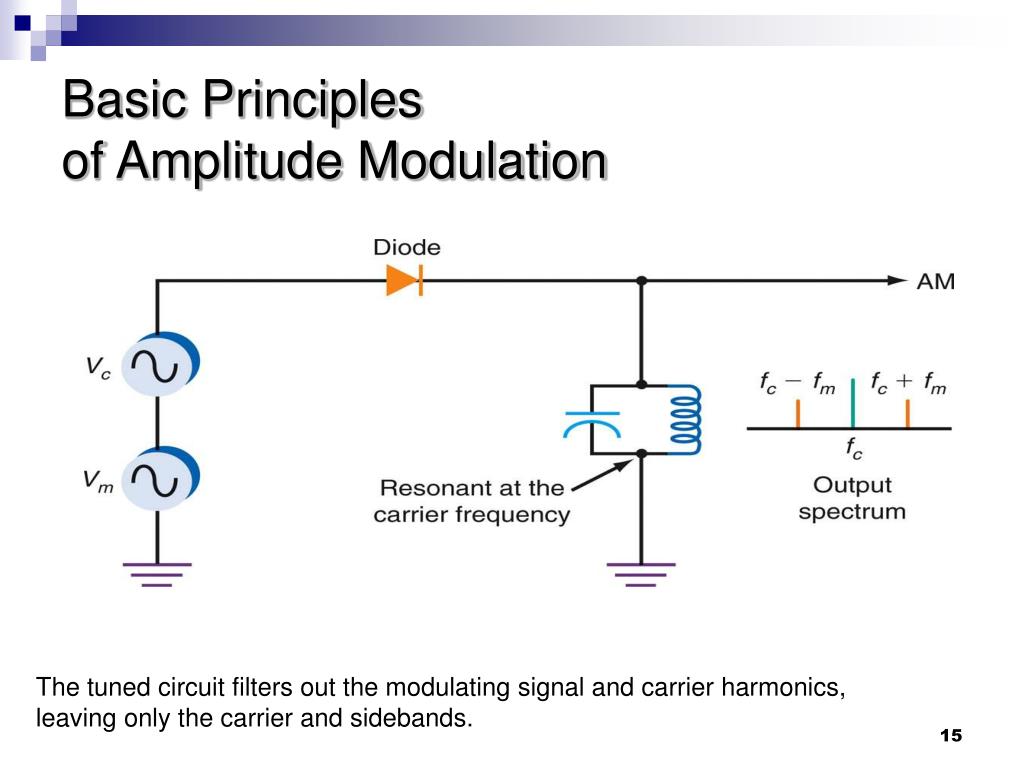
The existence of these sidebands is a fundamental aspect of AM.
Amplitude Modulation Fundamentals
To wrap up, let's read about how these sidebands are created and how we can represent an AM signal in the frequency domain.
Read the section 3-3 Sidebands and the Frequency Domain. Don't worry about the trigonometric proof. Focus on the concept that modulation creates sum and difference frequencies (f_c \pm f_m) and understand the difference between a time-domain display (like on an oscilloscope) and a frequency-domain display (like on a spectrum analyzer, shown in Fig. 3-7).
Conclusion
Today we have demystified the basic principle of Amplitude Modulation. We've moved from the why of modulation to the how, focusing on the first major technique developed for radio communication.
Key Takeaways:
- AM works by varying the amplitude of a high-frequency carrier wave in accordance with the message signal.
- The information is carried in the envelope of the modulated wave.
- The modulation index () quantifies the depth of modulation. To avoid distortion, must be less than or equal to 1.
- The process of AM creates two sidebands ( and ), which contain the message information, alongside the original carrier frequency .
Preview of the Next Lesson:
We've seen how to encode information by varying the carrier's amplitude. But amplitude isn't the only property of a sine wave. What if we kept the amplitude constant but varied its frequency instead? In our next lesson, we will explore this exact idea as we delve into the principle of Frequency Modulation (FM).